



Outline
- Introduction
- What Is Trifacta?
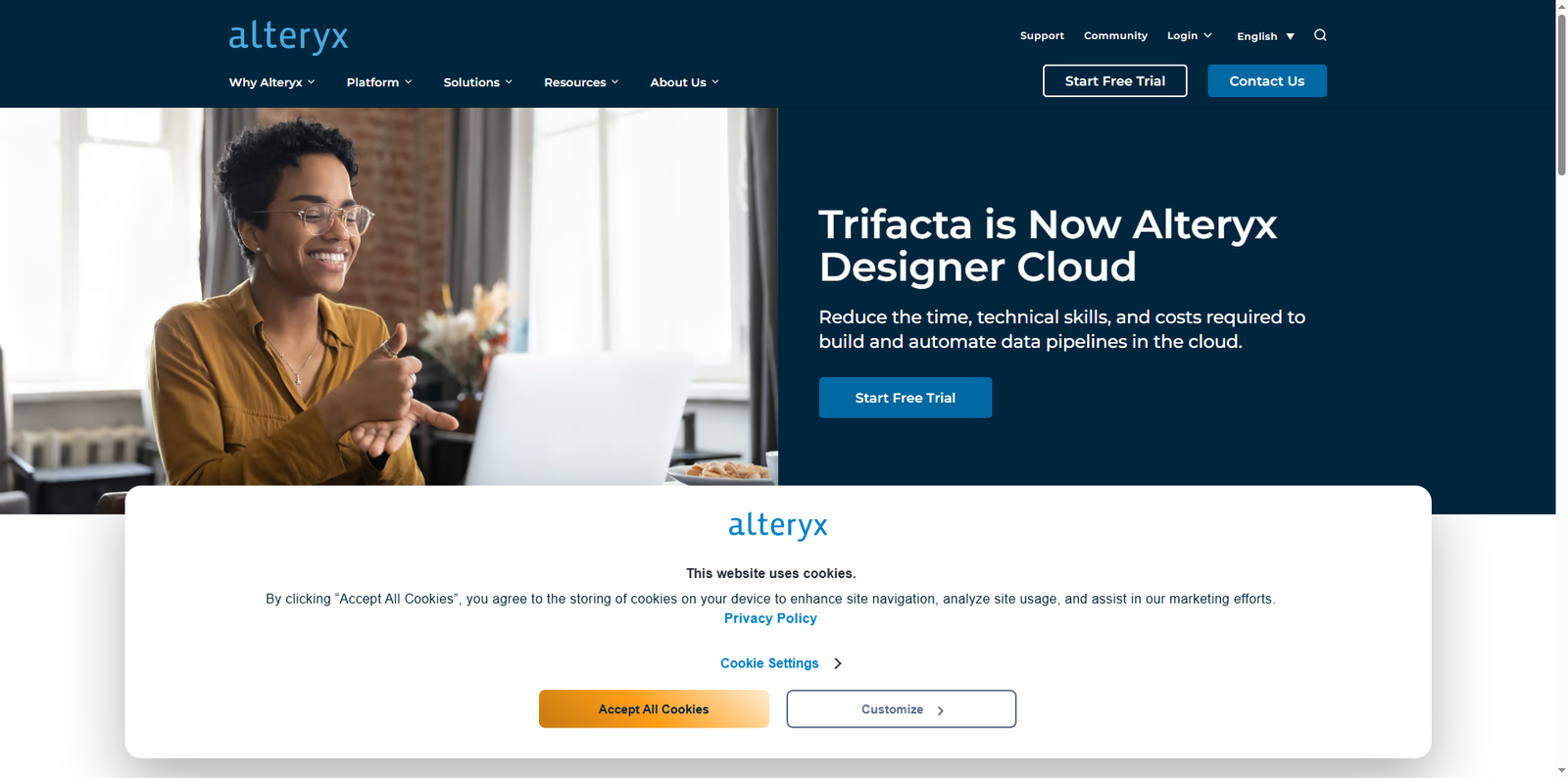
- The Evolution: Trifacta Becomes Alteryx Designer Cloud
- Core Capabilities of Alteryx Designer Cloud
- How Trifacta Simplifies Data Preparation
- Real-World Use Case: Aleatica’s Automation Success
- Benefits of Using Trifacta (Alteryx Designer Cloud)
- Top Alternatives to Trifacta
- Conclusion
Introduction
In the modern data-driven world, organizations are constantly seeking ways to transform raw data into actionable insights. Trifacta, now integrated into Alteryx Designer Cloud, has emerged as a leading solution for simplifying complex data preparation and transformation tasks. This cloud-native platform empowers data professionals and business users alike to clean, structure, and automate data pipelines efficiently. According to Gartner’s 2023 Data Integration Tools Magic Quadrant, Alteryx continues to be recognized as a visionary in enabling self-service analytics and data preparation, making Trifacta’s evolution a significant milestone in the analytics ecosystem.
What Is Trifacta?
Originally launched in 2012, Trifacta was designed to help users visually explore, clean, and prepare data without requiring deep technical expertise. It quickly became a favorite among analysts for its intuitive interface and machine learning-driven recommendations. The platform allowed users to connect to multiple data sources, detect anomalies, and standardize data formats seamlessly.
Trifacta’s mission was to reduce the time spent on data wrangling — a process that typically consumes up to 80% of a data professional’s workload. By automating repetitive tasks and providing visual feedback, Trifacta made data preparation accessible to everyone, from analysts to IT teams.
The Evolution: Trifacta Becomes Alteryx Designer Cloud
In early 2022, Trifacta joined forces with Alteryx, a global leader in analytics automation. This strategic move led to the creation of Alteryx Designer Cloud — a unified, cloud-native platform that combines Trifacta’s intuitive data preparation capabilities with Alteryx’s advanced analytics and automation tools.
The integration offers users a centralized and secure environment for data profiling, transformation, and pipeline automation. With Alteryx Designer Cloud, organizations can now manage their entire data lifecycle — from ingestion to insight — within a single, collaborative workspace.
Core Capabilities of Alteryx Designer Cloud
Alteryx Designer Cloud, powered by Trifacta’s technology, provides a comprehensive suite of tools for modern data operations. Its core capabilities include:
- Data Profiling: Instantly explore and assess the quality of datasets using a browser-based interface.
- Data Preparation: Visualize transformations, create predictive models, and preview results in real time.
- Data Pipeline Automation: Build, deploy, and manage automated workflows that streamline data movement and transformation.
- Collaboration: Enable teams to work together on shared data projects with version control and governance.
These capabilities are built on the Alteryx Analytics Cloud platform, which ensures enterprise-grade security, scalability, and accessibility from anywhere.
How Trifacta Simplifies Data Preparation
Data preparation is often one of the most time-consuming aspects of analytics. Trifacta addresses this challenge by providing a user-friendly interface that combines automation with human intuition. Users can easily connect to cloud data warehouses such as Google BigQuery, Amazon Redshift, and Snowflake, and begin transforming data through an interactive, visual workflow.
Machine learning algorithms within the platform suggest transformations based on data patterns, helping users quickly identify inconsistencies or outliers. The system also provides real-time previews, ensuring that every change is validated before execution. This reduces errors and accelerates the overall data preparation process.
Key Advantages of Simplified Data Preparation
- Reduced Complexity: No need for manual scripting or SQL coding.
- Faster Insights: Automated workflows minimize repetitive tasks.
- Improved Accuracy: Real-time validation ensures data integrity.
- Enhanced Collaboration: Teams can share and reuse workflows across departments.
Real-World Use Case: Aleatica’s Automation Success
Aleatica, a global infrastructure management company, leveraged Alteryx Designer Cloud to automate its internal audit controls. Within weeks, the company achieved full transaction coverage and faster risk detection without hiring additional technical staff. With implementation support from KPMG, Aleatica’s internal audit team was able to streamline purchasing controls and improve compliance monitoring.
This case study highlights how Trifacta’s underlying technology empowers organizations to achieve tangible business outcomes quickly. By automating manual processes, companies can focus more on strategic decision-making rather than data wrangling.
Benefits of Using Trifacta (Alteryx Designer Cloud)
Organizations adopting Trifacta’s cloud-native platform experience a wide range of benefits that extend beyond simple data preparation. These include:
- Scalability: Seamless integration with cloud environments allows handling of large and complex datasets.
- Accessibility: Browser-based access ensures that users can work from anywhere.
- Governance: Built-in data lineage and version control enhance transparency and compliance.
- Integration: Connects effortlessly with popular BI tools like Tableau, Power BI, and Looker.
- Automation: Enables end-to-end workflow automation, reducing manual intervention.
Top Alternatives to Trifacta
While Trifacta (Alteryx Designer Cloud) is a powerful solution, several other tools offer similar capabilities for data preparation and transformation. Below is a comparison of some notable alternatives:
| Tool Name | Description |
|---|---|
| Talend | An open-source data integration platform that supports ETL, data quality, and governance across hybrid environments. |
| Google Cloud Dataprep | A cloud-based data preparation service built on Trifacta technology, optimized for Google Cloud users. |
| Qlik Data Integration | Provides real-time data integration and transformation capabilities for analytics and machine learning pipelines. |
| Informatica Data Preparation | Offers AI-driven data discovery and preparation tools designed for enterprise-scale data management. |
| Databricks | Combines data engineering, machine learning, and analytics in a unified platform built on Apache Spark. |
Why Choose Trifacta Over Other Tools?
Trifacta’s integration into Alteryx Designer Cloud offers a unique blend of usability, automation, and scalability. Unlike traditional ETL tools that require extensive coding, Trifacta’s visual interface democratizes data preparation. Its AI-driven recommendations and real-time feedback loop make it ideal for both technical and non-technical users.
Moreover, the platform’s ability to integrate seamlessly with cloud ecosystems ensures that businesses can future-proof their data operations. Whether you’re preparing data for analytics, machine learning, or AI applications, Trifacta provides the flexibility and performance needed to accelerate outcomes.
Conclusion
Trifacta’s transformation into Alteryx Designer Cloud marks a new era in data preparation and analytics automation. By combining intuitive design with powerful cloud capabilities, it empowers organizations to turn raw data into trusted insights faster than ever before. From profiling and cleansing to automating complex pipelines, the platform simplifies every step of the data journey.
As enterprises continue to embrace digital transformation, tools like Trifacta play a crucial role in bridging the gap between data complexity and business intelligence. Whether you’re a data analyst, IT professional, or business leader, adopting a modern, cloud-native solution like Alteryx Designer Cloud can significantly enhance your organization’s analytical agility and decision-making power.
In a world where data is the new currency, Trifacta stands as a testament to how innovation and integration can redefine the way we work with information — making analytics more accessible, collaborative, and impactful for everyone.