




Outline
- Introduction
- What is Gretel.ai?
- How Gretel.ai Works
- Key Benefits of Using Gretel.ai
- Applications of Synthetic Data
- Comparison with Alternative Tools
- Integration and Deployment Options
- Privacy and Compliance Considerations
- Challenges and Future Outlook
- Conclusion
Introduction
In the rapidly evolving world of artificial intelligence (AI) and machine learning (ML), data remains the cornerstone of innovation. However, organizations often face challenges in accessing high-quality, privacy-compliant datasets. Gretel.ai offers a groundbreaking solution by enabling the creation of synthetic data—artificially generated datasets that mirror the statistical properties of real data without exposing sensitive information. This approach empowers developers, data scientists, and enterprises to train and validate AI models safely and efficiently.
What is Gretel.ai?
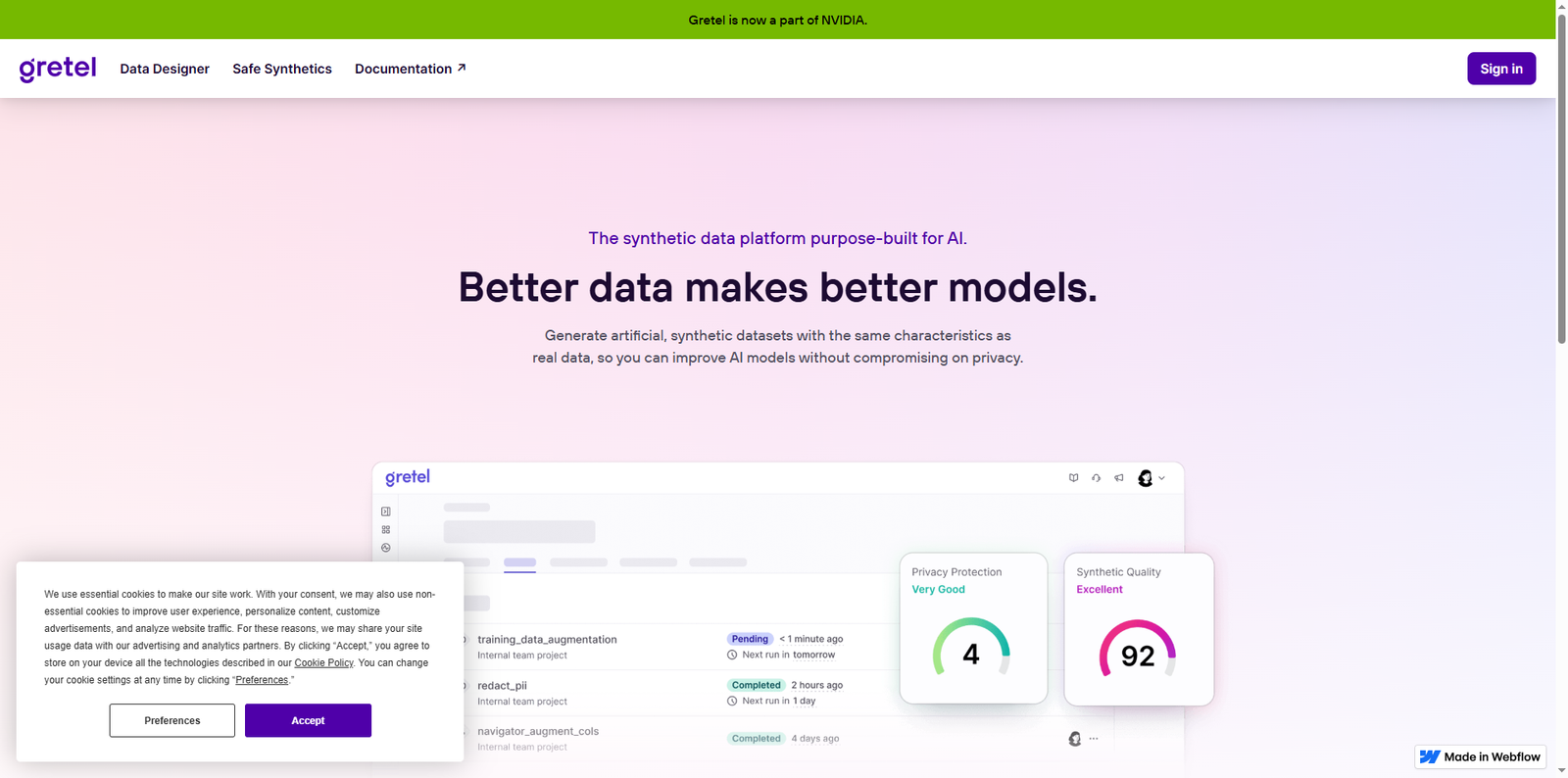
Gretel.ai is a synthetic data platform designed to help organizations generate, validate, and manage artificial datasets that retain the utility of real-world data. Founded in 2020, Gretel.ai has quickly become a leader in privacy-preserving data generation, offering APIs and tools that integrate seamlessly into existing data pipelines. The platform supports multimodal data types, including text, tabular data, and time-series, making it versatile for various AI applications.
According to Gretel’s official documentation, the platform enables users to train generative models that learn the statistical patterns of their datasets, validate the quality and privacy of synthetic data, and generate new data on demand. This approach ensures that sensitive information remains protected while maintaining analytical accuracy.
How Gretel.ai Works
At its core, Gretel.ai leverages generative AI models to learn from existing datasets and produce synthetic versions that replicate the original data’s characteristics. The workflow typically involves three main steps:
- Train: Users train generative models on their original datasets. These models learn the statistical distributions and relationships within the data.
- Validate: Gretel’s validation tools assess the quality and privacy of the generated data using advanced metrics such as privacy scores and similarity indices.
- Generate: Once validated, users can generate synthetic datasets of any size, ensuring scalability and flexibility for AI training and testing.
Gretel’s architecture supports both cloud and on-premises deployments. Organizations can run Gretel containers within their own environments or leverage cloud GPUs for faster processing. This hybrid approach ensures data sovereignty while providing scalability for enterprise workloads.
Key Benefits of Using Gretel.ai
Gretel.ai offers numerous advantages for organizations seeking to enhance their data-driven initiatives:
- Data Privacy: Synthetic data eliminates the risk of exposing personally identifiable information (PII), ensuring compliance with regulations such as GDPR and HIPAA.
- Scalability: Users can generate unlimited synthetic data to augment training datasets, improving model performance without additional data collection costs.
- Collaboration: Teams can share synthetic datasets freely without legal or ethical constraints, accelerating innovation and cross-departmental research.
- Integration: Gretel’s APIs and SDKs integrate seamlessly with popular data science platforms, enabling easy adoption within existing workflows.
Applications of Synthetic Data
The use of synthetic data extends across multiple industries and use cases. Below are some key applications where Gretel.ai plays a transformative role:
- Healthcare: Hospitals and research institutions use synthetic patient data to train diagnostic models while maintaining patient confidentiality.
- Finance: Banks and fintech companies generate synthetic transaction data to detect fraud and improve risk modeling without exposing customer details.
- Retail: Retailers simulate customer behavior data to enhance recommendation systems and optimize inventory management.
- Cybersecurity: Security teams create synthetic network traffic data to test intrusion detection systems under realistic conditions.
According to a 2023 Gartner report, by 2030, synthetic data is expected to outpace real data in AI model training, highlighting its growing importance in the digital economy.
Comparison with Alternative Tools
While Gretel.ai stands out for its enterprise-ready architecture and privacy-first design, several other platforms also offer synthetic data generation capabilities. The table below compares Gretel.ai with some notable alternatives:
| Tool Name | Primary Focus | Deployment Options |
|---|---|---|
| MOSTLY AI | AI-driven synthetic data for structured datasets | Cloud and on-premises |
| Hazy | Privacy-preserving synthetic data for financial services | Cloud-based |
| Synthesized | Data generation and transformation for ML pipelines | Cloud and hybrid |
| Datagen | Visual synthetic data for computer vision | Cloud |
Integration and Deployment Options
Gretel.ai provides flexible deployment models to accommodate diverse organizational needs. Users can deploy the platform in three main ways:
- Cloud Deployment: Run Gretel workloads on cloud GPUs for rapid data generation and model training. This option is ideal for teams seeking scalability without managing infrastructure.
- On-Premises Deployment: For organizations with strict data governance policies, Gretel containers can operate entirely within local environments, ensuring data never leaves the organization’s perimeter.
- Hybrid Deployment: Combine local and cloud resources to balance performance, cost, and compliance. Gretel’s orchestration tools manage workloads across environments seamlessly.
Additionally, the Gretel Console allows users to monitor progress, manage workers, and collaborate on projects from a unified interface. Integration with major cloud providers such as AWS, Google Cloud, Microsoft Azure, and Databricks further enhances its versatility.
Privacy and Compliance Considerations
Data privacy is a central pillar of Gretel.ai’s design philosophy. The platform employs advanced anonymization and differential privacy techniques to ensure that synthetic data cannot be reverse-engineered to reveal sensitive information. Each dataset undergoes rigorous validation using privacy and quality scores, providing transparency and confidence to users.
Compliance with global data protection frameworks is another key advantage. Gretel.ai supports adherence to regulations such as:
- General Data Protection Regulation (GDPR)
- Health Insurance Portability and Accountability Act (HIPAA)
- California Consumer Privacy Act (CCPA)
By integrating privacy-by-design principles, Gretel.ai enables organizations to innovate responsibly while maintaining trust and regulatory compliance.
Challenges and Future Outlook
Despite its advantages, synthetic data generation is not without challenges. Ensuring that synthetic datasets maintain the same predictive power as real data requires careful model tuning and validation. Additionally, as AI models become more complex, maintaining the balance between data utility and privacy remains a critical research area.
Looking ahead, the future of synthetic data appears promising. As AI adoption accelerates, tools like Gretel.ai will play a pivotal role in democratizing access to high-quality data. Emerging trends such as multimodal synthetic data generation and federated learning are expected to further enhance the platform’s capabilities.
Industry analysts predict that by 2027, over 60% of AI training data will be synthetic, underscoring the transformative potential of platforms like Gretel.ai in shaping the next generation of data-driven innovation.
Conclusion
Gretel.ai represents a paradigm shift in how organizations approach data privacy, accessibility, and scalability. By enabling the creation of realistic, privacy-preserving synthetic datasets, it empowers teams to build, test, and deploy AI models with confidence. Whether used in healthcare, finance, or research, Gretel.ai bridges the gap between innovation and compliance, ensuring that better data truly leads to better models. As synthetic data continues to gain traction, Gretel.ai stands at the forefront of this revolution, redefining what’s possible in the age of ethical AI.