


Outline
- Introduction
- Understanding AI Observability
- What Makes Fiddler.ai Stand Out
- How Fiddler.ai Enhances Trust and Transparency
- Applications Across Industries
- Integrating Fiddler.ai into Enterprise Workflows
- Alternative Tools for AI Observability
- Future of AI Observability and Governance
- Conclusion
Introduction
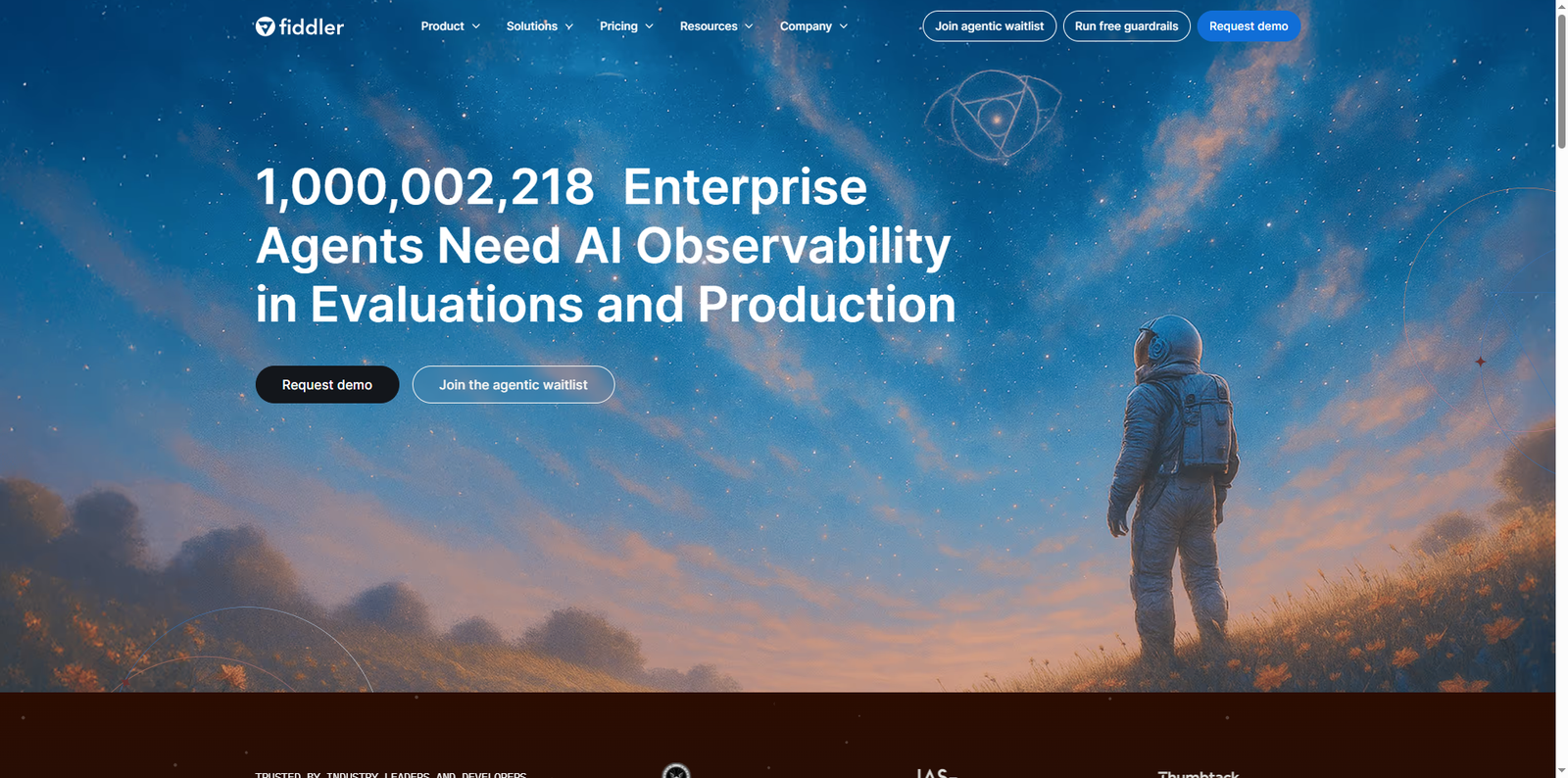
Artificial Intelligence (AI) has become the backbone of modern enterprises, driving automation, insights, and decision-making across industries. However, as AI systems grow more complex, ensuring transparency, fairness, and accountability becomes increasingly challenging. This is where Fiddler.ai steps in — a pioneering platform dedicated to AI observability and trust. Recognized by CB Insights and IDC as a leader in AI agent security and governance, Fiddler.ai empowers organizations to understand every decision made by their AI models, ensuring reliability and compliance in production environments.
Understanding AI Observability
AI observability refers to the ability to monitor, interpret, and explain the behavior of machine learning models and AI agents throughout their lifecycle. Unlike traditional monitoring tools that focus on performance metrics, AI observability delves into the why behind model predictions and actions. It combines explainability, fairness, and continuous evaluation to ensure that AI systems behave as intended.
According to a 2024 Gartner report, over 60% of enterprises deploying AI solutions struggle with model transparency and bias detection. Observability platforms like Fiddler.ai address this gap by offering a unified view of model performance, data drift, and decision logic. This approach helps organizations build AI systems that are not only accurate but also ethical and compliant with emerging regulations such as the EU AI Act.
What Makes Fiddler.ai Stand Out
Fiddler.ai introduces the concept of Agentic Observability, enabling enterprises to see every action, understand every decision, and control every outcome across the AI lifecycle. The platform provides visibility across the agentic hierarchy — from sessions to agents, traces, and spans — ensuring that every layer of AI behavior is monitored and explainable.
Some of the key differentiators of Fiddler.ai include:
- Comprehensive Monitoring: Continuous evaluation of AI models, from development to production, ensuring consistent performance and reliability.
- Guardrails and Trust Models: Over 80 ready-to-run metrics that help organizations enforce safety, fairness, and privacy standards.
- LLM-as-a-Judge: A unique capability that uses large language models to assess the quality and faithfulness of AI outputs.
- Enterprise-Grade Control: Unified observability that integrates seamlessly with enterprise workflows and governance frameworks.
How Fiddler.ai Enhances Trust and Transparency
Trust is the cornerstone of responsible AI adoption. Fiddler.ai’s platform is designed to provide contextual insights into how AI models make decisions, enabling teams to identify potential biases, inaccuracies, or ethical risks before they impact users. By offering explainability at scale, Fiddler.ai ensures that AI systems remain transparent and accountable.
For example, in financial services, explainable AI is critical for credit scoring and fraud detection. Fiddler.ai allows data scientists and compliance teams to trace model outputs back to their inputs, ensuring that decisions are fair and interpretable. Similarly, in healthcare, the platform helps validate diagnostic AI models by providing detailed reasoning behind predictions, supporting clinical transparency and patient trust.
Key Benefits of AI Observability
- Improved Accountability: Enables organizations to justify AI-driven decisions with clear explanations.
- Bias Detection: Identifies and mitigates unfair patterns in model predictions.
- Regulatory Compliance: Supports adherence to AI governance frameworks and ethical standards.
- Operational Efficiency: Reduces downtime and performance degradation through proactive monitoring.
Applications Across Industries
Fiddler.ai’s observability framework is applicable across multiple sectors, each benefiting from enhanced visibility and control over AI operations.
1. Financial Services
Financial institutions use Fiddler.ai to monitor credit risk models, detect anomalies, and ensure compliance with regulatory requirements. The platform’s explainability features help auditors and regulators understand the rationale behind automated decisions.
2. Healthcare
In healthcare, AI models assist in diagnostics, patient triage, and drug discovery. Fiddler.ai provides interpretability tools that help clinicians trust AI recommendations, ensuring that patient outcomes are based on transparent and reliable insights.
3. Retail and E-commerce
Retailers leverage Fiddler.ai to optimize recommendation engines, pricing algorithms, and demand forecasting models. Observability ensures that these systems remain unbiased and aligned with customer expectations.
4. Manufacturing and Supply Chain
Manufacturers use Fiddler.ai to monitor predictive maintenance models and optimize production workflows. By understanding model behavior, they can minimize downtime and improve operational efficiency.
Integrating Fiddler.ai into Enterprise Workflows
Fiddler.ai integrates seamlessly with existing machine learning pipelines, supporting popular frameworks such as TensorFlow, PyTorch, and Scikit-learn. Its API-first architecture allows teams to embed observability directly into their model development and deployment processes.
Enterprises can use Fiddler.ai to:
- Monitor model performance in real time.
- Detect data drift and retrain models proactively.
- Generate explainability reports for stakeholders.
- Implement guardrails to enforce ethical AI practices.
By embedding observability into the AI lifecycle, organizations can move from reactive troubleshooting to proactive governance, ensuring that their AI systems remain robust and trustworthy.
Alternative Tools for AI Observability
While Fiddler.ai is a leader in AI observability, several other platforms also contribute to this evolving field. Below is a comparison of alternative tools that organizations can explore:
| Tool Name | Description |
|---|---|
| WhyLabs | An open-source observability platform for monitoring data quality and model performance in production environments. |
| Arize AI | Focuses on ML observability and performance analytics, helping teams detect drift and improve model reliability. |
| Truera | Provides explainability and model intelligence tools to ensure fairness and transparency across AI systems. |
| Datadog | Offers observability solutions that can be extended to monitor machine learning pipelines and infrastructure metrics. |
Future of AI Observability and Governance
The future of AI observability lies in deeper integration with governance and compliance frameworks. As AI regulations evolve globally, organizations will need tools that not only monitor performance but also ensure ethical alignment and accountability. Fiddler.ai’s approach to agentic observability positions it as a key enabler of responsible AI adoption.
Emerging trends such as LLM observability and AI agent monitoring will further expand the scope of platforms like Fiddler.ai. With the rise of generative AI and autonomous agents, continuous monitoring and interpretability will be essential to maintain control and trust. By combining observability with trust models and guardrails, Fiddler.ai is setting the standard for the next generation of AI governance solutions.
Conclusion
Fiddler.ai represents a significant leap forward in how enterprises build, monitor, and trust their AI systems. By offering comprehensive observability across the entire AI lifecycle, it empowers organizations to understand the “why” behind every decision, ensuring fairness, transparency, and compliance. As AI continues to shape the future of business, platforms like Fiddler.ai will play a crucial role in bridging the gap between innovation and responsibility. For enterprises seeking to build reliable and explainable AI systems, investing in observability is no longer optional — it is essential.