




Outline
- Introduction
- What is Tinybird?
- How Tinybird Works
- Core Advantages of Using Tinybird
- Key Use Cases
- Integrations and Developer Experience
- Alternatives to Tinybird
- Conclusion
Introduction
In today’s data-driven world, organizations are constantly seeking ways to extract insights from massive datasets in real time. Traditional data warehouses often struggle with latency, scalability, and complex infrastructure management. This is where Tinybird emerges as a transformative solution. Built on top of ClickHouse, one of the fastest analytical databases, Tinybird enables developers to turn raw data into real-time APIs without managing complex infrastructure. This article explores how Tinybird works, its benefits, and how it compares to other modern analytics platforms.
What is Tinybird?
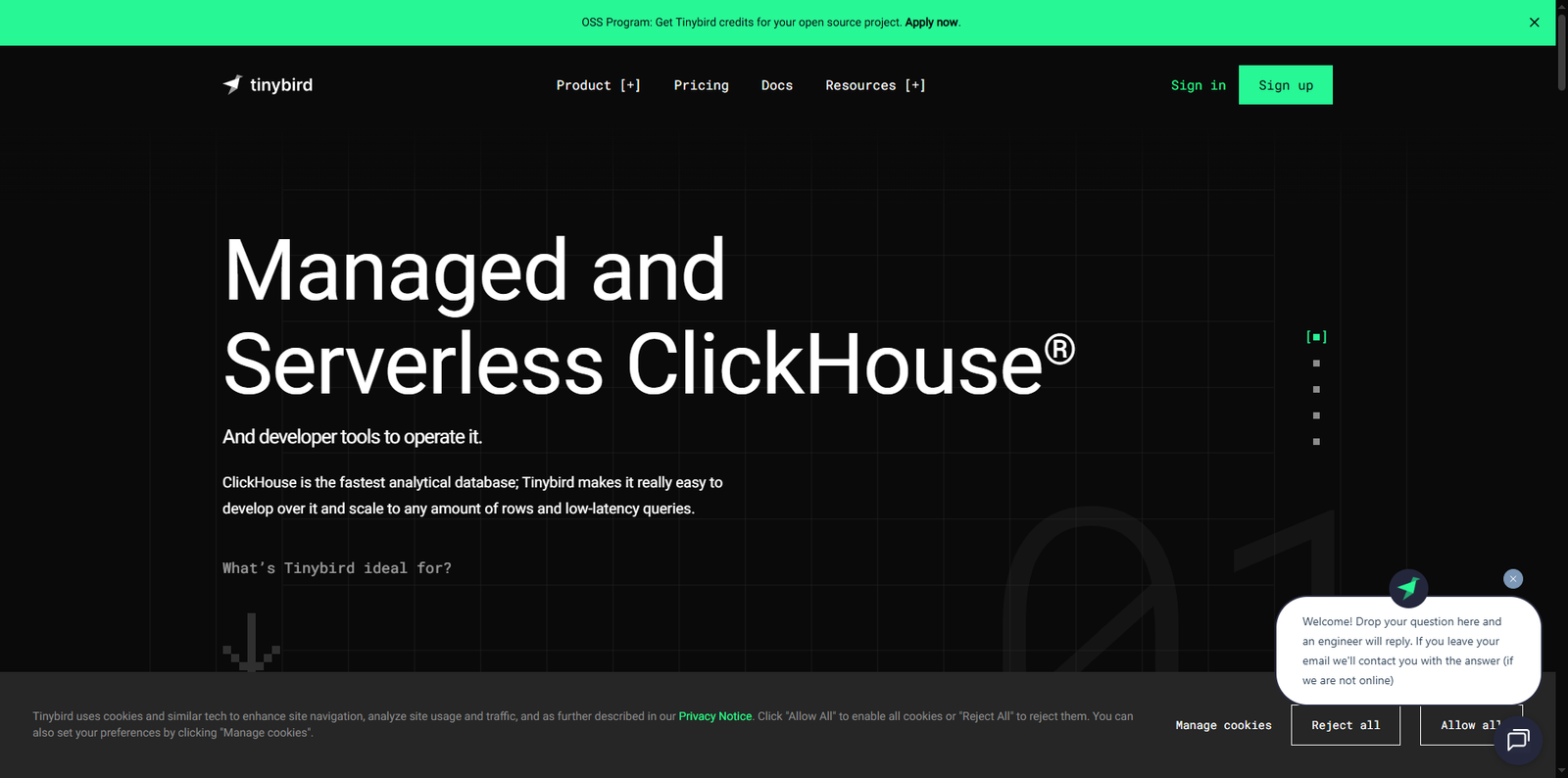
Tinybird is a managed and serverless platform designed to simplify real-time data analytics. It allows developers to ingest, process, and query large volumes of data using SQL, then publish those queries as scalable REST APIs. Founded in 2020, Tinybird has quickly gained traction among data teams at companies like Canva, Framer, and Vercel for its ability to handle billions of rows with sub-second query latency.
At its core, Tinybird leverages ClickHouse — an open-source columnar database known for its high performance in analytical workloads. Tinybird abstracts the operational complexity of ClickHouse, offering a developer-friendly interface and tools that make it easy to build real-time analytics backends.
How Tinybird Works
Tinybird’s architecture revolves around three main components: data ingestion, transformation, and publication.
1. Data Ingestion
Developers can stream data into Tinybird from multiple sources, including event streams, logs, and transactional systems. The platform supports ingestion via HTTP, Kafka, and other connectors. For example, Tinybird’s Events API can handle over 1,000 requests per second, making it suitable for high-throughput scenarios such as telemetry or user activity tracking.
2. Data Transformation
Once data is ingested, it can be transformed using SQL-based pipes. These pipes allow developers to clean, aggregate, and join datasets in real time. Unlike traditional ETL pipelines that run on schedules, Tinybird’s transformations are continuous, ensuring that the published APIs always reflect the latest data.
3. Data Publication
After transformation, developers can publish SQL queries as REST APIs with a single command. Each API endpoint is automatically optimized for performance and scalability, allowing applications to consume real-time analytics without additional backend logic.
Core Advantages of Using Tinybird
Tinybird provides several advantages that make it a preferred choice for modern data teams:
- Speed: Built on ClickHouse, Tinybird delivers sub-second query responses even for datasets with billions of rows.
- Scalability: Its serverless architecture automatically scales with data volume and query load.
- Developer Experience: With a CLI, SDKs, and SQL-based transformations, developers can build and deploy analytics APIs quickly.
- Observability: Tinybird includes built-in observability features that help monitor query performance and data ingestion metrics.
- Integration: It connects seamlessly with popular developer tools, cloud storage, and event streaming platforms.
Key Use Cases
Tinybird is versatile and can be applied across various industries and scenarios. Here are some of the most common use cases:
1. Real-Time Dashboards
Companies use Tinybird to power dashboards that display live metrics such as user engagement, sales performance, or system health. For instance, Framer leverages Tinybird to provide instant analytics to its users, ensuring smooth and responsive data visualization.
2. Product Analytics
By transforming event data into APIs, Tinybird helps teams analyze user behavior and product performance in real time. This enables faster decision-making and iterative product improvements.
3. Observability and Monitoring
Tinybird’s low-latency querying makes it ideal for observability stacks. Developers can stream logs and metrics into Tinybird, then query them instantly to detect anomalies or performance issues.
4. Customer Insights
Companies like Canva use Tinybird to process customer data and generate insights that inform marketing strategies and user experience optimizations.
Integrations and Developer Experience
Tinybird offers a rich ecosystem of integrations and developer tools that enhance productivity and collaboration.
1. CLI and SDKs
The Tinybird CLI allows developers to manage projects directly from the terminal — from creating data sources to deploying APIs. This command-line interface integrates seamlessly with CI/CD pipelines, enabling automated deployments and version control.
2. Tinybird Local
With Tinybird Local, developers can run Tinybird on their own infrastructure or local machines. This flexibility is particularly useful for teams with strict data governance or compliance requirements.
3. Observability Stack
Tinybird’s observability tools provide real-time insights into query performance, ingestion rates, and API usage. This transparency helps teams optimize their data workflows and ensure consistent performance.
4. Integrations
Tinybird connects with numerous data sources and developer tools, including cloud storage services, event streaming platforms, and BI tools. This interoperability allows teams to integrate Tinybird into existing data ecosystems effortlessly.
Alternatives to Tinybird
While Tinybird is a powerful platform, several alternatives offer similar capabilities for real-time analytics and data API creation. Below is a comparison of some popular alternatives:
| Tool Name | Description |
|---|---|
| Databricks | A unified analytics platform that combines data engineering, machine learning, and collaborative notebooks for large-scale data processing. |
| Snowflake | A cloud-based data warehouse known for its scalability and ability to handle structured and semi-structured data efficiently. |
| Redpanda | A modern streaming platform compatible with Kafka APIs, designed for real-time event processing and analytics. |
| Supabase | An open-source alternative to Firebase that provides real-time databases, authentication, and APIs for modern applications. |
| ClickHouse | An open-source columnar database optimized for analytical queries, forming the foundation of Tinybird’s backend performance. |
Conclusion
Tinybird represents a new era of real-time analytics, empowering developers to build scalable, high-performance data APIs without the burden of managing infrastructure. By combining the speed of ClickHouse with a developer-friendly interface, Tinybird bridges the gap between data engineering and application development. Its ability to transform raw data into actionable insights in seconds makes it an invaluable tool for modern data-driven organizations.
Whether you’re building live dashboards, monitoring systems, or customer analytics platforms, Tinybird provides the agility and performance needed to deliver real-time insights at scale. While alternatives like Databricks, Snowflake, and Redpanda offer their own strengths, Tinybird’s simplicity and focus on developer experience make it a standout choice for teams seeking to operationalize data faster and more efficiently.
As real-time analytics continues to shape the future of digital products, Tinybird stands out as a platform that not only accelerates data workflows but also empowers developers to innovate without limits.