


Outline
- Introduction to Timescale
- Understanding the Core of TimescaleDB
- Why Timescale Stands Out in the PostgreSQL Ecosystem
- Real-World Applications and Use Cases
- Architecture and Performance Insights
- Integration with Cloud and Ecosystem Tools
- Alternatives to Timescale
- Conclusion
Introduction to Timescale
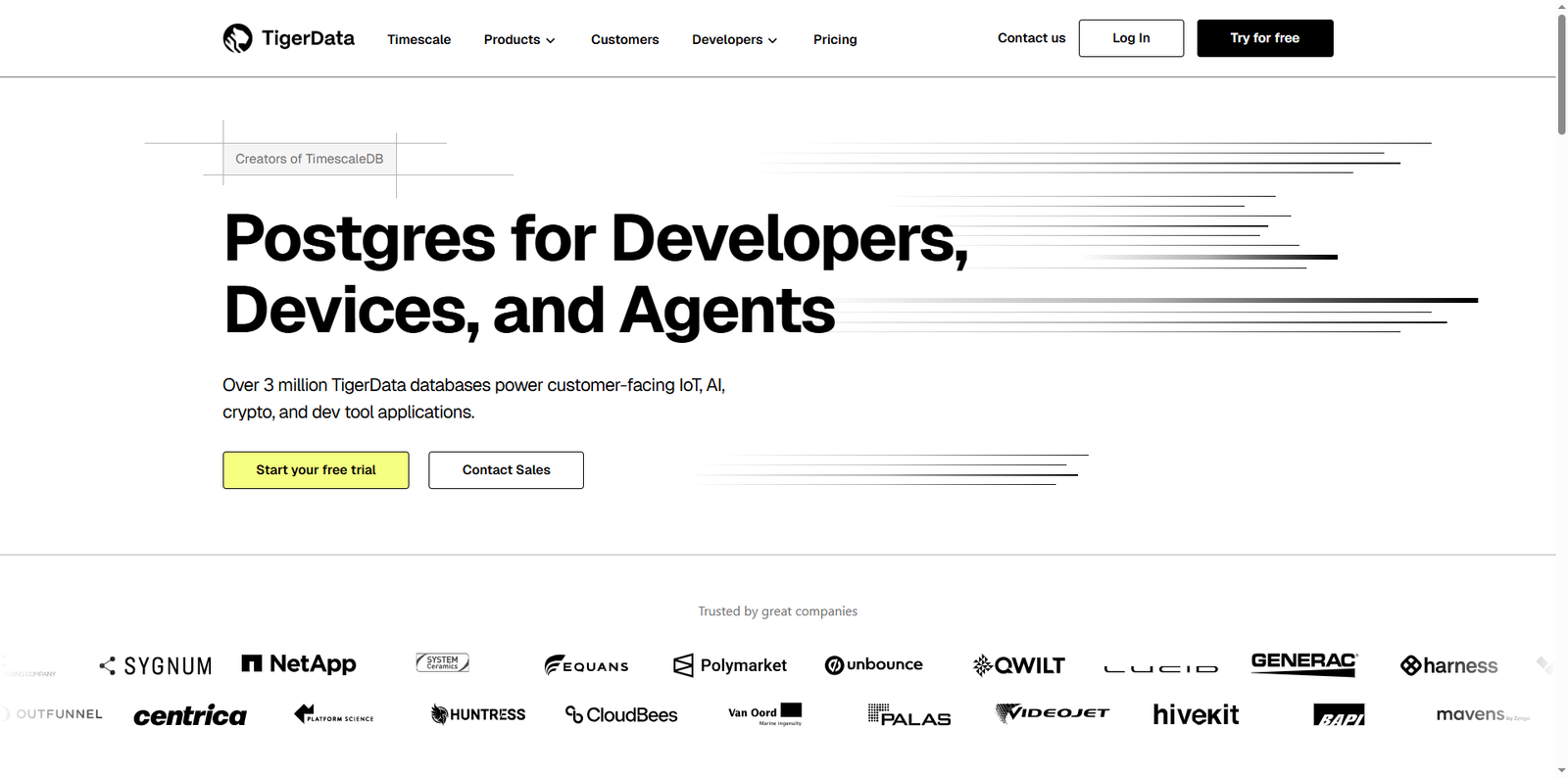
Timescale, developed by the creators of TimescaleDB, is a high-performance PostgreSQL database designed specifically for real-time analytics and time-series workloads. It powers over 3 million databases globally, serving industries such as IoT, AI, fintech, and SaaS. Built entirely on PostgreSQL, it provides the reliability and familiarity of the world’s most trusted open-source database while enhancing it with time-series superpowers.
According to company data, Timescale’s TigerData platform manages over 400 trillion data points, ingests 1.5 trillion metrics daily, and stores more than 2 petabytes of data. These numbers highlight its ability to handle massive workloads efficiently, making it a preferred choice for developers and enterprises seeking scalable, real-time data processing.
Understanding the Core of TimescaleDB
At its heart, TimescaleDB extends PostgreSQL with native time-series capabilities. It introduces hypertables, a core abstraction that automatically partitions data by time and space, enabling efficient storage and querying of large datasets. This design allows developers to use standard SQL while benefiting from optimized time-series performance.
TimescaleDB’s architecture supports continuous aggregates, compression, and advanced indexing strategies. Continuous aggregates precompute query results, dramatically improving performance for analytical workloads. Compression reduces storage costs and improves query speed, while native PostgreSQL compatibility ensures seamless integration with existing tools and workflows.
Why Timescale Stands Out in the PostgreSQL Ecosystem
Unlike forked databases, Timescale is built directly on PostgreSQL, ensuring full compatibility with its ecosystem. This means developers can use familiar SQL syntax, extensions, and tools without modification. Timescale’s enhancements focus on scalability, low-latency analytics, and efficient updates, making it ideal for production-grade applications.
Several key factors differentiate Timescale:
- Performance: Optimized for ingesting and querying billions of rows per second.
- Scalability: Handles petabyte-scale datasets with minimal overhead.
- Reliability: Enterprise-ready with continuous backups, automatic failovers, and SOC2/GDPR compliance.
- Flexibility: Works seamlessly across major cloud providers and integrates with the broader PostgreSQL ecosystem.
Real-World Applications and Use Cases
Timescale’s versatility makes it suitable for diverse industries. Below are examples of how leading organizations leverage its capabilities:
Manufacturing: Titan America
Titan America uses Timescale to enhance visibility into manufacturing operations. According to Matt Markham, Senior Manager of Industrial Digitization, the platform’s compression and continuous aggregates have significantly reduced costs while improving operational insights.
Fintech: Polymarket
Polymarket, a decentralized prediction market, processes vast amounts of time-series data. Software Engineer Jonathan Amenechi noted that Timescale’s Tiger Cloud solution simplified setup and improved data processing efficiency, enabling faster analytics and decision-making.
Internet Software & Services: Cloudflare
Cloudflare engineers use TimescaleDB to balance analytical and configuration data within a unified environment. Robert Cepa, Senior Software Engineer, highlighted that Timescale delivers OLAP-like performance while maintaining PostgreSQL’s simplicity.
SaaS: Linktree
Linktree’s engineering team reported substantial storage savings—approximately 12.6 TB tiered—and faster time-to-market for analytics features, reducing release cycles from two weeks to two days. This demonstrates Timescale’s impact on accelerating innovation and reducing infrastructure costs.
Architecture and Performance Insights
Timescale’s architecture is designed for speed, scalability, and reliability. It leverages PostgreSQL’s proven foundation while introducing specialized optimizations for time-series workloads.
Key Architectural Components
- Hypertables: Automatically partition data across time intervals and dimensions for efficient querying.
- Continuous Aggregates: Maintain precomputed summaries of data to speed up analytical queries.
- Compression: Reduces storage footprint by up to 90% without sacrificing query performance.
- Parallelization: Distributes workloads across multiple cores for faster query execution.
Performance Metrics
Timescale’s TigerData service demonstrates real-world scalability:
- 400 trillion data points stored
- 1.5 trillion metrics ingested daily
- Over 2 petabytes of data volume managed
These metrics underscore its ability to handle demanding workloads with low latency and high throughput, making it a top choice for data-intensive applications.
Integration with Cloud and Ecosystem Tools
Timescale integrates seamlessly with popular cloud providers and developer tools, ensuring flexibility and ease of deployment. It supports managed services through Tiger Cloud, offering enterprise-grade reliability with continuous backups, encryption, and SSO integration.
Compatible Ecosystem Tools
- Grafana – For real-time visualization of time-series data.
- Prometheus – For monitoring and alerting on metrics data.
- Tableau – For advanced business intelligence and analytics.
- Apache Airflow – For orchestrating data pipelines and workflows.
- Apache Kafka – For streaming data ingestion and event-driven architectures.
Deployment Flexibility
Timescale works across multiple environments, including AWS, Google Cloud, and Azure. Its compatibility with the PostgreSQL ecosystem ensures that existing tools, drivers, and extensions function without modification. This flexibility allows teams to deploy Timescale in hybrid or multi-cloud setups, maintaining performance consistency across environments.
Alternatives to Timescale
While Timescale offers exceptional performance for time-series workloads, several alternative tools cater to similar use cases. The following table highlights notable alternatives:
| Tool Name | Description |
|---|---|
| InfluxDB | A purpose-built time-series database optimized for high-write throughput and real-time analytics. |
| QuestDB | An open-source SQL database designed for fast ingestion and analytics on time-series data. |
| Apache Druid | A high-performance analytics database for event-driven and real-time data exploration. |
| ClickHouse | A columnar database management system known for ultra-fast query performance on large datasets. |
| CrateDB | A distributed SQL database optimized for machine data and time-series analytics. |
Conclusion
Timescale stands as a transformative force in the world of time-series and real-time analytics. Built on PostgreSQL, it combines the reliability of a proven relational database with the performance enhancements required for modern data workloads. From IoT and AI to fintech and SaaS, organizations across industries rely on Timescale to power mission-critical applications with speed, scalability, and precision.
Its seamless integration with cloud platforms, strong ecosystem compatibility, and enterprise-ready features make it an ideal choice for developers and businesses seeking to harness the full potential of their data. As data volumes continue to grow exponentially, Timescale’s commitment to performance and innovation ensures it remains at the forefront of time-series database technology.
In essence, Timescale is not just a database—it’s a platform that empowers developers to build, scale, and analyze data-driven applications with confidence and efficiency.