







Outline
- Introduction
- What Is Rill Data?
- How Rill Data Transforms Business Intelligence
- Key Advantages of Using Rill Data
- Rill’s Metrics-First Philosophy
- BI-as-Code: A New Paradigm for Data Teams
- Performance and Real-World Use Cases
- Alternative Tools to Explore
- Conclusion
Introduction
In today’s data-driven world, organizations are constantly seeking faster, more efficient ways to analyze and visualize data. Rill Data stands out as a modern business intelligence (BI) platform that redefines how teams interact with data. By combining an embedded in-memory database with a metrics-first design, Rill empowers analysts to create dashboards that respond in milliseconds, enabling real-time decision-making. This article explores how Rill Data is reshaping the BI landscape and why it’s becoming a preferred choice for data professionals worldwide.
What Is Rill Data?
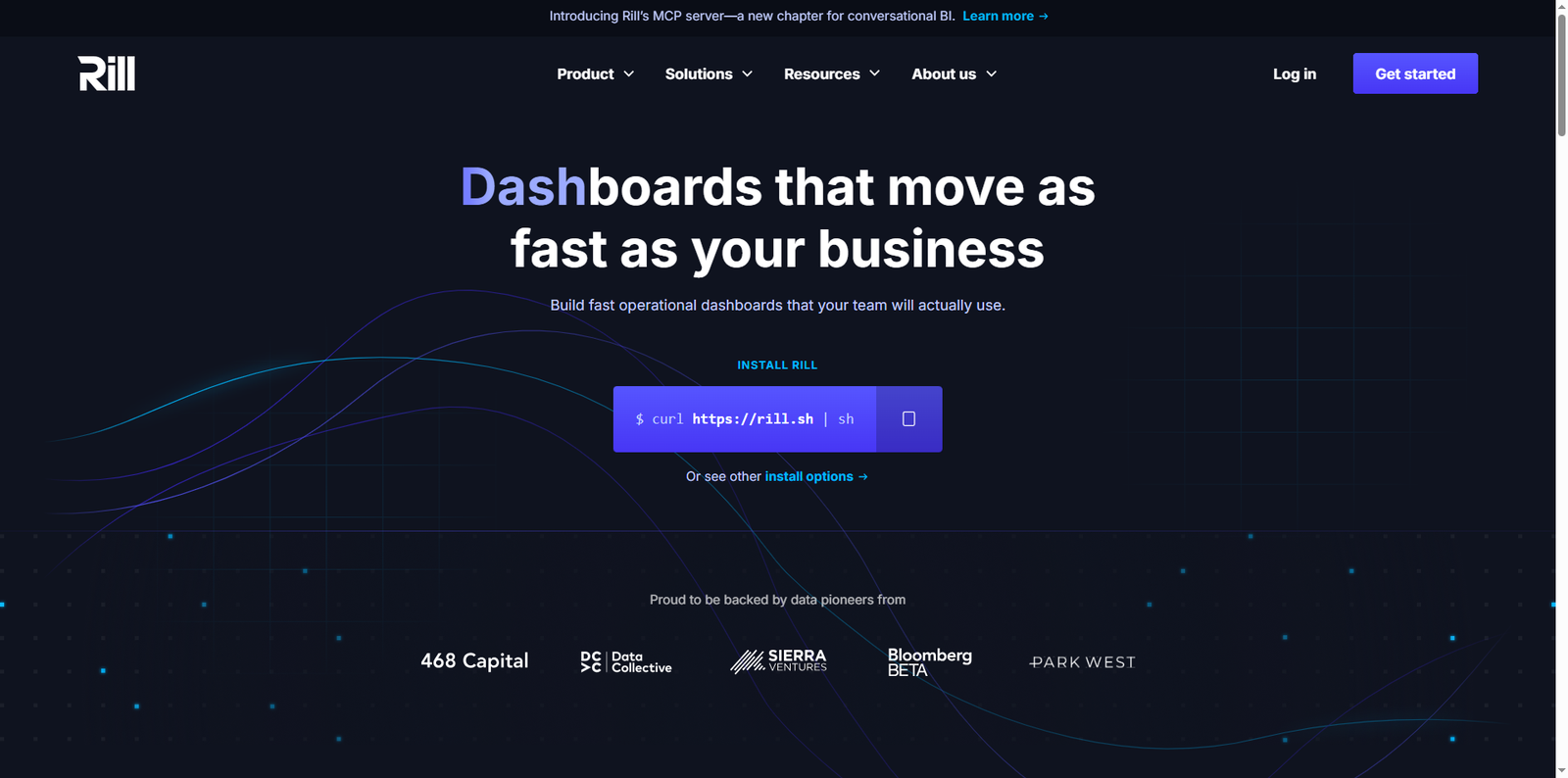
Rill Data is a next-generation BI platform designed to deliver lightning-fast analytics without the complexity of traditional BI stacks. Unlike conventional tools that rely heavily on cloud warehouses, Rill integrates compute and data storage within its own in-memory engine. This architecture allows users to explore, pivot, and drill down into datasets instantly. Founded by a team of data engineers and open-source advocates, Rill emphasizes simplicity, speed, and transparency in analytics workflows.
Core Philosophy
At its core, Rill promotes a metrics-first approach, meaning that instead of focusing on raw data tables, users define and explore business metrics directly. This ensures consistency across dashboards and reports, reducing discrepancies that often arise when different teams calculate metrics differently.
How Rill Data Transforms Business Intelligence
Traditional BI tools often struggle with latency, complex data pipelines, and high infrastructure costs. Rill addresses these challenges through its unique architecture and design principles. By embedding an in-memory database, Rill eliminates the need for constant queries to external warehouses, significantly reducing query time and cloud costs. This allows analysts to interact with data in real time, making it ideal for time-sensitive analyses such as campaign performance tracking or operational monitoring.
Real-Time Dashboards
Rill’s dashboards are designed for speed. Queries return in milliseconds, enabling users to explore data dynamically without waiting for refreshes. This responsiveness encourages deeper exploration and faster insights, which is crucial in industries like marketing, finance, and logistics where timing is everything.
Data Transformation with SQL
Rill supports last-mile ETL (Extract, Transform, Load) using SQL, allowing analysts to join, transform, and aggregate data from multiple sources. This flexibility ensures that teams can prepare data directly within the platform, streamlining the analytics process and minimizing dependency on external ETL tools.
Key Advantages of Using Rill Data
Rill Data offers several advantages that make it a compelling choice for modern data teams:
- Speed and Performance: In-memory processing ensures sub-second query responses.
- Cost Efficiency: Reduced reliance on cloud warehouses helps lower operational costs.
- Developer-Friendly: Supports BI-as-code workflows, enabling version control and collaboration.
- Consistency: Metrics-first modeling ensures uniform definitions across dashboards.
- Ease of Deployment: Rill can be developed locally and deployed globally with minimal setup.
Rill’s Metrics-First Philosophy
Rill’s metrics-first design is one of its most innovative aspects. Instead of building dashboards from raw datasets, users define metrics such as revenue, conversion rate, or churn directly within the platform. Rill then automatically generates visualizations and dashboards based on these metrics. This approach not only speeds up dashboard creation but also ensures that all stakeholders are aligned on the same definitions.
Why Metrics-First Matters
In many organizations, different teams calculate metrics using slightly different formulas, leading to inconsistencies and confusion. Rill eliminates this issue by centralizing metric definitions. Once a metric is defined, it becomes a single source of truth across all dashboards, ensuring accuracy and trust in the data.
BI-as-Code: A New Paradigm for Data Teams
Rill embraces the concept of BI-as-code, allowing analysts and engineers to manage BI projects using Git workflows. This means that dashboards, metrics, and transformations can be version-controlled, reviewed, and deployed just like software code. This approach brings software engineering best practices—such as collaboration, testing, and continuous integration—into the world of business intelligence.
Benefits of BI-as-Code
- Collaboration: Multiple team members can work on the same BI project simultaneously.
- Version Control: Changes to dashboards and metrics are tracked, ensuring transparency.
- Reproducibility: Teams can easily roll back to previous versions if needed.
- Automation: Integrates seamlessly with CI/CD pipelines for automated deployment.
Performance and Real-World Use Cases
Rill’s performance has been praised by users across industries. According to testimonials, companies like Liftoff and Emodo have reported significant improvements in analytics speed and efficiency. Analysts at Liftoff, for instance, prefer Rill over traditional BI tools because of its responsiveness and ability to handle time-series data efficiently. Similarly, Emodo’s analytics team reduced custom data requests to engineering by nearly 30% after adopting Rill, freeing up valuable development resources.
Example Use Cases
- Marketing Analytics: Track campaign performance in real time and adjust strategies instantly.
- Product Analytics: Monitor user behavior and feature adoption with near-instant feedback.
- Operational Dashboards: Visualize logistics and supply chain metrics for faster decision-making.
- Financial Reporting: Generate accurate, up-to-date financial dashboards without manual refreshes.
Alternative Tools to Explore
While Rill Data offers a unique approach to BI, several other tools provide complementary or alternative solutions. Below is a comparison table of popular alternatives worth exploring:
| Tool Name | Description |
|---|---|
| Looker | A Google Cloud-based BI platform known for its semantic modeling layer and data governance capabilities. |
| Metabase | An open-source BI tool that allows teams to create dashboards and visualizations with minimal setup. |
| Redash | A lightweight analytics tool designed for querying and visualizing data from multiple sources. |
| Apache Superset | An open-source data exploration and visualization platform built for scalability and extensibility. |
| Power BI | Microsoft’s enterprise-grade BI solution offering deep integration with the Microsoft ecosystem. |
Conclusion
Rill Data is redefining business intelligence by combining speed, simplicity, and developer-friendly workflows into one cohesive platform. Its in-memory architecture delivers real-time analytics performance, while its metrics-first philosophy ensures data consistency across teams. By embracing BI-as-code, Rill bridges the gap between data engineering and analytics, enabling organizations to manage BI projects with the same rigor as software development. Whether you’re a data analyst seeking faster insights or a data engineer aiming for scalable workflows, Rill Data offers a forward-thinking solution that aligns with the future of analytics.
As the demand for real-time decision-making continues to grow, tools like Rill Data will play a pivotal role in shaping the next generation of business intelligence. For teams looking to modernize their analytics stack, exploring Rill Data could be the key to unlocking faster, more reliable insights that drive smarter business outcomes.