





Outline
- Introduction
- What Is Redpanda?
- Why Real-Time Data Streaming Matters
- Core Architecture of Redpanda
- Kafka API Compatibility
- Performance and Efficiency
- Tiered Storage and Scalability
- Deployment Flexibility
- Use Cases Across Industries
- Alternatives to Redpanda
- Conclusion
Introduction
In today’s digital economy, enterprises depend on real-time data to make intelligent decisions, power AI-driven applications, and enhance user experiences. Redpanda has emerged as a next-generation streaming data platform that redefines how organizations handle event-driven architectures. Built from the ground up in C++, Redpanda offers exceptional performance, simplicity, and scalability without the operational overhead of traditional streaming systems.
What Is Redpanda?
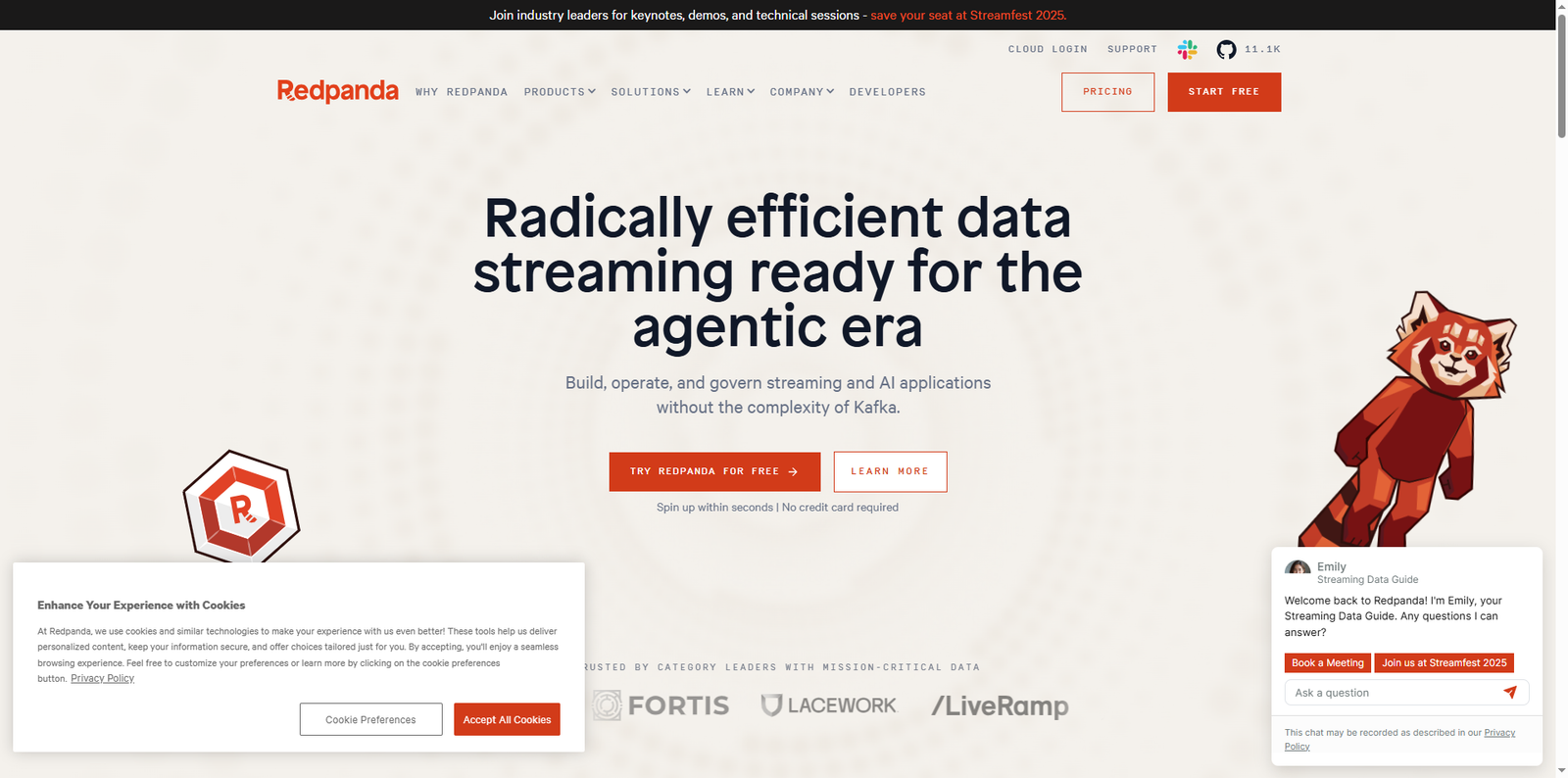
Redpanda is a modern streaming data platform designed for real-time workloads. It provides a Kafka API-compatible solution that eliminates the need for Java Virtual Machine (JVM) dependencies. Its single binary architecture simplifies deployment, while its self-tuning capabilities make it ideal for enterprises seeking predictable performance and low latency. According to Redpanda’s official documentation, the platform delivers up to 10x lower tail latencies compared to open-source Kafka implementations.
Why Real-Time Data Streaming Matters
Real-time data streaming enables organizations to process and analyze data as it arrives, rather than relying on batch processing. This capability is critical for applications such as fraud detection, IoT analytics, and AI-driven automation. Gartner predicts that by 2025, over 75% of enterprise-generated data will be processed outside traditional data centers, emphasizing the need for efficient streaming solutions like Redpanda.
Core Architecture of Redpanda
Redpanda’s architecture is built on a single binary C++ engine that leverages the Seastar framework. This design allows it to fully utilize modern multi-core CPUs, ensuring optimal throughput and minimal latency. The system’s thread-per-core model ensures that each CPU core handles its own workload independently, reducing contention and improving performance consistency.
Key Architectural Highlights
- Single Binary Deployment: Simplifies installation and reduces dependency management.
- Seastar Framework: Provides asynchronous I/O for high concurrency.
- Auto-Tuning: Automatically optimizes performance based on hardware and workload.
- Self-Healing Clusters: Reduces manual intervention and operational complexity.
Kafka API Compatibility
One of Redpanda’s most attractive features is its native compatibility with the Kafka API. This means that existing Kafka clients, connectors, and tools can integrate seamlessly with Redpanda without code modifications. Organizations can migrate to Redpanda to gain performance improvements while maintaining their existing data pipelines and ecosystem investments.
Benefits of Kafka Compatibility
- Zero code changes for existing Kafka applications.
- Access to the full Kafka ecosystem of tools and connectors.
- Reduced migration risk and faster adoption.
- Improved performance with simplified operations.
Performance and Efficiency
Performance is at the heart of Redpanda’s design philosophy. Its native C++ architecture and thread-per-core design enable it to achieve low latency and high throughput even under heavy workloads. The system’s follower-fetching mechanism optimizes data transfer efficiency, reducing ingress and egress costs by up to 60% compared to traditional streaming systems.
Performance Metrics
- 10x lower tail latencies than open-source Kafka.
- Optimized for modern NVMe SSDs and high-speed networks.
- Predictable performance under varying workloads.
- Reduced operational overhead through self-tuning.
Tiered Storage and Scalability
Redpanda’s tiered storage feature intelligently manages data across local and cloud storage. Hot data remains on local SSDs for rapid access, while older segments are automatically offloaded to object storage services such as Amazon S3, Google Cloud Storage, or Azure Blob Storage. This approach provides virtually unlimited data retention and cost-efficient scalability.
Advantages of Tiered Storage
- Balances speed and cost by separating hot and cold data.
- Supports long-term data retention without performance degradation.
- Enables cluster recovery and topic hibernation.
- Integrates seamlessly with major cloud object storage services.
Deployment Flexibility
Redpanda offers multiple deployment models to suit diverse enterprise needs. Whether deployed on-premises, in a serverless environment, or through a Bring Your Own Cloud (BYOC) model, Redpanda ensures consistent performance and governance. The BYOC model allows Redpanda experts to manage clusters within an organization’s virtual private cloud (VPC), ensuring data sovereignty and compliance.
Deployment Options
- Self-Managed: Full control over infrastructure and configuration.
- Serverless: Simplified operations with automatic scaling.
- BYOC: Managed service within the customer’s own cloud environment.
Use Cases Across Industries
Redpanda’s versatility makes it suitable for a wide range of industries and applications. From financial services to e-commerce and IoT, enterprises leverage Redpanda to power mission-critical, real-time data pipelines.
Common Use Cases
- Financial Services: Real-time fraud detection and transaction monitoring.
- E-commerce: Personalized recommendations and dynamic pricing.
- IoT and Manufacturing: Sensor data processing and predictive maintenance.
- AI and Analytics: Continuous data ingestion for machine learning models.
Alternatives to Redpanda
While Redpanda offers impressive performance and simplicity, several other tools provide robust streaming capabilities. Below is a comparison of popular alternatives that enterprises may consider.
| Tool Name | Description |
|---|---|
| Apache Kafka | An open-source distributed event streaming platform widely used for building real-time data pipelines and streaming applications. |
| Apache Flink | A powerful stream processing framework that supports event-time processing and complex analytics. |
| Confluent | A commercial platform built around Kafka, offering enterprise-grade features and managed services. |
| Apache Pulsar | A cloud-native messaging and streaming platform designed for scalability and multi-tenancy. |
| Amazon Kinesis | A fully managed AWS service for real-time data streaming and analytics integration. |
Conclusion
Redpanda represents a significant evolution in the world of real-time data streaming. Its C++-based architecture, Kafka API compatibility, and self-tuning capabilities make it a compelling choice for enterprises seeking performance, simplicity, and scalability. By eliminating the complexities of JVM-based systems and offering flexible deployment options, Redpanda empowers organizations to build reliable, high-speed data pipelines that support modern AI, analytics, and operational workloads.
As data continues to grow in volume and velocity, platforms like Redpanda are shaping the future of event-driven architectures. Whether you are modernizing your data infrastructure or building new real-time applications, Redpanda provides the foundation for a faster, more efficient, and future-ready enterprise data ecosystem.