


Outline
- Introduction
- Understanding Qwak and Its Evolution
- Core Capabilities of Qwak
- How Qwak Simplifies the MLOps Lifecycle
- LLMOps and the Rise of Generative AI
- Integration and Collaboration Features
- Alternatives to Qwak
- Real-World Use Cases
- Conclusion
Introduction
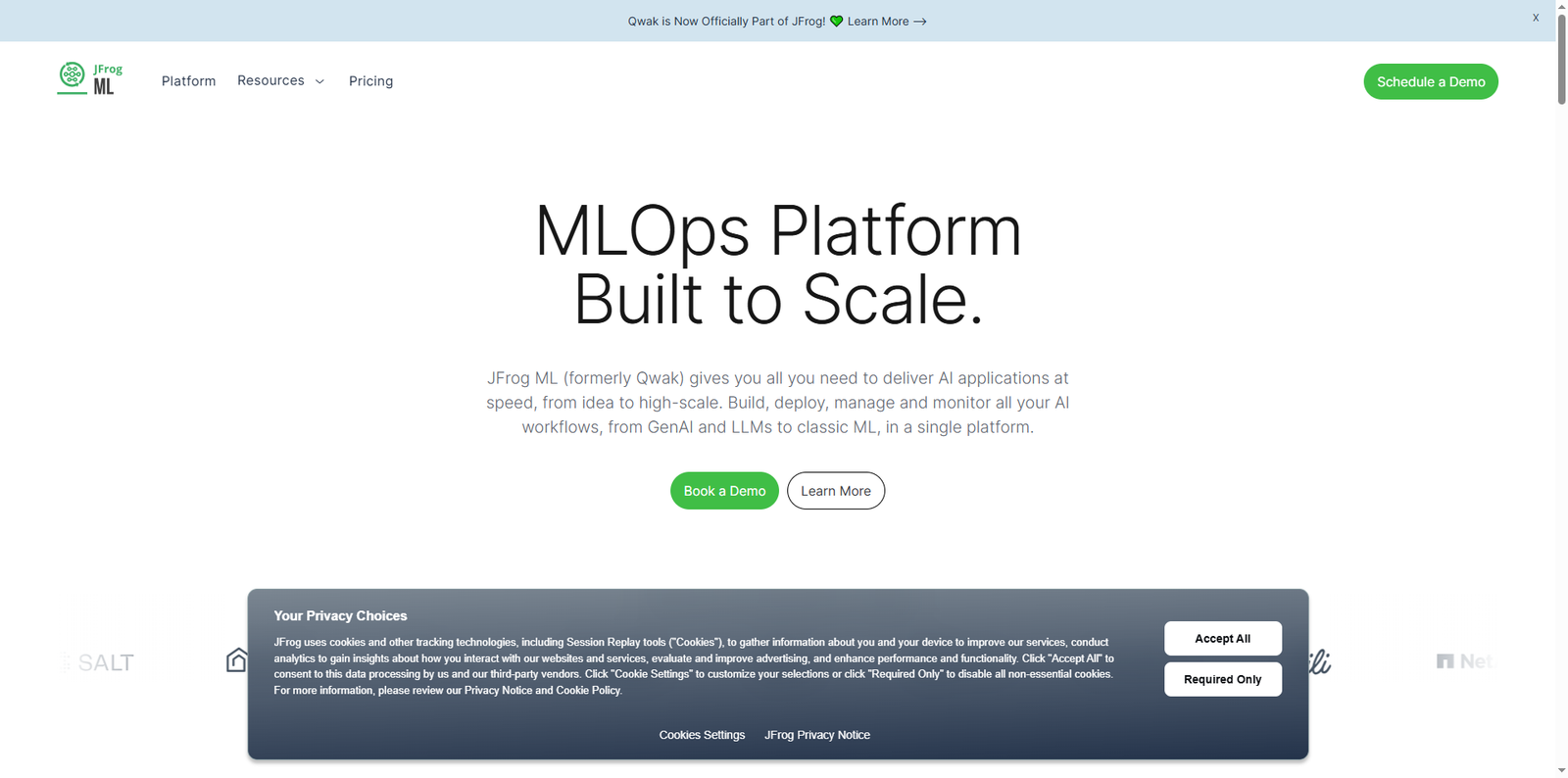
In the rapidly evolving world of artificial intelligence and machine learning, organizations face a common challenge: how to efficiently build, deploy, and manage models at scale. Qwak, now known as JFrog ML, has emerged as a unified MLOps platform designed to streamline the entire machine learning lifecycle. From model training to deployment and monitoring, it offers a centralized environment that accelerates AI innovation while maintaining operational efficiency. This article explores Qwak’s capabilities, its approach to MLOps and LLMOps, and how it fits into the broader AI ecosystem.
Understanding Qwak and Its Evolution
Qwak was founded with the mission to simplify machine learning operations for data science teams. In 2024, it became part of JFrog under the name JFrog ML, integrating seamlessly with JFrog’s DevOps ecosystem. This evolution reflects the growing convergence between software development and AI model management. The platform provides tools for continuous integration and continuous delivery (CI/CD) of machine learning models, enabling organizations to move from experimentation to production faster and more reliably.
Core Capabilities of Qwak
Qwak’s architecture is built around four key pillars: building, training, deploying, and monitoring models. Each component is designed to help teams collaborate efficiently and maintain visibility across the entire ML lifecycle.
Model Building and Training
Data scientists can build and train models using Qwak’s integrated environment that supports both CPU and GPU resources. The platform automates retraining processes, ensuring that models remain up-to-date with evolving data. It also provides metadata tracking, allowing teams to compare experiments and optimize performance.
Deployment at Scale
Qwak enables one-click deployment of models as live API endpoints or batch inference jobs. It supports multi-version deployments, allowing organizations to test new models alongside existing ones. This flexibility ensures minimal downtime and faster iteration cycles, which are critical for production-grade AI systems.
Real-Time Monitoring
Monitoring is a crucial aspect of maintaining model performance. Qwak provides real-time dashboards that track metrics such as latency, accuracy, and data drift. It integrates with communication tools like Slack and PagerDuty for instant alerts, helping teams respond quickly to anomalies or performance degradation.
How Qwak Simplifies the MLOps Lifecycle
The traditional machine learning workflow often involves multiple disconnected tools for data preparation, model training, deployment, and monitoring. Qwak consolidates these stages into a single platform, reducing complexity and improving collaboration. This unified approach allows teams to:
- Automate repetitive tasks such as retraining and deployment.
- Maintain version control for models, datasets, and configurations.
- Collaborate across teams with shared visibility into experiments.
- Integrate seamlessly with CI/CD pipelines for continuous delivery.
By bridging the gap between data science and engineering, Qwak ensures that models move smoothly from research to production without the friction often associated with handoffs between teams.
LLMOps and the Rise of Generative AI
As large language models (LLMs) like GPT and Llama continue to dominate the AI landscape, organizations require specialized tools to manage their complexity. Qwak’s LLMOps capabilities address this need by providing a structured environment for developing, deploying, and monitoring LLM-based applications.
Prompt Management and Versioning
Qwak introduces a centralized prompt registry where teams can create, test, and version prompts. This feature is particularly valuable for enterprises building generative AI applications that rely on consistent and reproducible prompt engineering.
LLM Model Library
The platform offers a library of optimized open-source models, including popular architectures like Llama 3 and Mistral 7B. These models can be deployed with a single click, either on the organization’s infrastructure or on Qwak’s managed cloud environment. Automatic scaling ensures that applications remain responsive even under heavy workloads.
Workflow Visualization and Tracing
Developers can design complex LLM workflows using Qwak’s visual interface. The tracing feature provides complete visibility into each request, enabling quick debugging and optimization. This transparency is essential for maintaining reliability in production-grade AI systems.
Integration and Collaboration Features
Qwak’s strength lies in its ability to integrate with existing data and DevOps ecosystems. It supports connections with popular tools for data storage, orchestration, and monitoring. For example, teams can integrate Qwak with Apache Airflow for workflow automation or Kubernetes for container orchestration. Additionally, Qwak’s API-first design allows developers to embed its functionality into custom pipelines and dashboards.
Collaboration Across Teams
Machine learning projects often involve multiple stakeholders, including data scientists, ML engineers, and product managers. Qwak fosters collaboration by providing shared workspaces, experiment tracking, and role-based access control. This ensures that every team member has the right level of visibility and control over the project lifecycle.
Alternatives to Qwak
While Qwak offers a comprehensive MLOps solution, several other platforms provide similar capabilities. Below is a table highlighting some notable alternatives:
| Tool Name | Description |
|---|---|
| MLflow | An open-source platform for managing the ML lifecycle, including experimentation, reproducibility, and deployment. |
| DataRobot | A commercial AI platform that automates model building, deployment, and monitoring for enterprise-scale projects. |
| Amazon SageMaker | A fully managed service by AWS that provides tools for building, training, and deploying ML models at scale. |
| Vertex AI | Google Cloud’s unified platform for ML development, offering integrated tools for data preparation, training, and deployment. |
| Kubeflow | An open-source project that simplifies deploying ML workflows on Kubernetes, ideal for organizations seeking flexibility and control. |
Real-World Use Cases
Qwak’s unified approach has attracted adoption from leading AI teams across industries. For instance, fintech companies use it to deploy fraud detection models that process millions of transactions in real time. E-commerce platforms leverage Qwak to personalize product recommendations, while healthcare organizations employ it for predictive analytics in patient care. These use cases demonstrate the platform’s versatility and scalability across diverse domains.
Accelerating AI Innovation
By reducing the operational overhead associated with managing ML pipelines, Qwak allows data scientists to focus on innovation rather than infrastructure. Its automation features shorten development cycles, enabling faster experimentation and deployment of new models.
Ensuring Reliability and Compliance
Enterprises operating in regulated industries benefit from Qwak’s built-in governance and audit capabilities. The platform’s version control and monitoring tools help maintain compliance with data protection and model transparency standards, which are increasingly important in today’s AI-driven world.
Conclusion
Qwak, now part of JFrog ML, stands out as a comprehensive MLOps and LLMOps platform that bridges the gap between data science and production. Its unified environment for building, deploying, and monitoring models empowers organizations to scale their AI initiatives efficiently. With features that support both traditional ML and cutting-edge generative AI workflows, Qwak represents the next generation of operational excellence in machine learning. As enterprises continue to embrace AI-driven transformation, platforms like Qwak will play a pivotal role in ensuring that innovation remains both agile and reliable.