



Outline
- Introduction
- Understanding Time-Series Databases
- What Makes QuestDB Unique
- Architecture and Core Concepts
- Performance and Use Cases
- Integration and Compatibility
- Alternative Tools Comparison
- Conclusion
Introduction
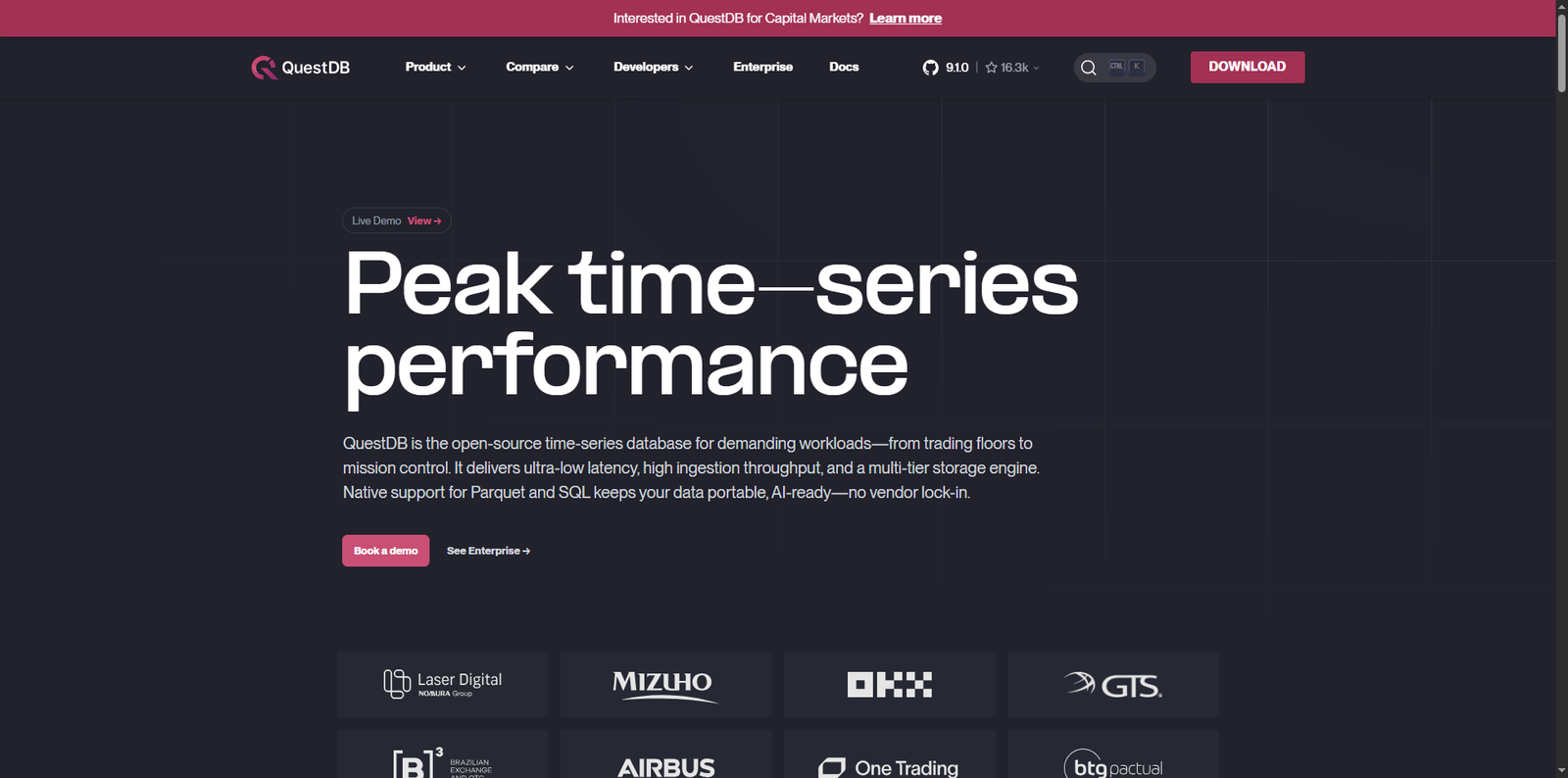
In today’s data-driven world, organizations are increasingly relying on real-time analytics to make critical decisions. Whether it’s monitoring financial markets, IoT devices, or infrastructure performance, the ability to process and analyze time-series data efficiently is essential. QuestDB has emerged as one of the most powerful open-source time-series databases, designed to handle high-throughput workloads with ultra-low latency. This article explores QuestDB’s architecture, performance, and how it compares with other solutions in the time-series ecosystem.
Understanding Time-Series Databases
Time-series databases (TSDBs) are specialized systems optimized for handling data indexed by time. They are particularly useful for applications that require continuous data collection and analysis, such as telemetry, monitoring, and financial analytics. Unlike traditional relational databases, TSDBs are optimized for:
- High ingestion rates of sequential data
- Efficient storage and compression of time-based records
- Fast querying and aggregation over time intervals
According to research by DB-Engines, time-series databases have seen a significant rise in popularity, with QuestDB ranking among the top open-source options due to its performance and SQL compatibility.
What Makes QuestDB Unique
QuestDB is an open-source, column-oriented time-series database built for speed and scalability. It supports standard SQL syntax, making it accessible to developers familiar with relational databases. Unlike other TSDBs that require custom query languages, QuestDB’s SQL engine allows users to perform complex time-based operations using familiar constructs.
Key Differentiators
- Ultra-Low Latency: QuestDB’s SIMD-accelerated SQL queries and multi-threaded engine deliver sub-millisecond query responses, even under heavy workloads.
- High Ingestion Throughput: Capable of ingesting up to 5 million rows per second, QuestDB is ideal for real-time analytics pipelines.
- Open Architecture: It supports open formats like Parquet and integrates seamlessly with PostgreSQL wire protocol, ensuring flexibility and interoperability.
- AI-Ready Design: With standard SQL and REST API support, QuestDB can easily integrate with AI and machine learning workflows.
Architecture and Core Concepts
QuestDB’s architecture is designed for performance, scalability, and resilience. It employs a columnar storage model, which optimizes analytical queries by reading only the necessary columns. The system also supports partitioning by time, enabling efficient data pruning and faster queries.
Core Components
- Columnar Storage Engine: Stores data in columns rather than rows, improving compression and query performance.
- Multi-Tier Storage: Combines in-memory and disk-based storage for optimal speed and scalability.
- Time Bucketing (SAMPLE BY): Allows resampling of data into fixed intervals for downsampling and aggregation.
- Streaming Materialized Views: Continuously compute rollups and metrics that refresh in real time.
- ASOF JOIN: Enables time-bounded joins to align events across different data streams.
Scalability and Resilience
QuestDB supports petabyte-scale tiered storage and multi-availability zone (Multi-AZ) resilience. This makes it suitable for enterprise-grade deployments that require instant scale-out and fault tolerance. Its open-source nature under the Apache 2.0 license ensures transparency and community-driven innovation.
Performance and Use Cases
QuestDB’s performance benchmarks demonstrate its ability to handle demanding workloads. The database can ingest millions of rows per second while maintaining low query latency. This makes it a preferred choice for industries that rely on real-time analytics.
Common Use Cases
- Financial Market Data: QuestDB is used to process high-frequency trading data, compute OHLC (Open, High, Low, Close) metrics, and perform time-bounded joins for market analysis.
- IoT and Sensor Data: Its high ingestion rate supports large-scale IoT deployments, enabling real-time monitoring and predictive maintenance.
- Infrastructure Monitoring: QuestDB can store and query metrics from servers, applications, and networks to detect anomalies and optimize performance.
- AI and Machine Learning Pipelines: With Parquet format support, QuestDB integrates with data science tools for model training and inference.
Example SQL Query
QuestDB’s SQL syntax allows developers to easily perform time-based aggregations. For instance, a query to compute OHLC data per minute might look like:
This query efficiently aggregates trading data into one-minute intervals, showcasing QuestDB’s ability to handle time-series analytics with standard SQL.
Integration and Compatibility
QuestDB’s compatibility with existing data ecosystems is one of its strongest advantages. It supports the PostgreSQL wire protocol, allowing applications and tools that work with PostgreSQL to connect seamlessly. Additionally, QuestDB can integrate with modern data pipelines and visualization platforms.
Integration Options
- PostgreSQL Clients: Connect using standard PostgreSQL drivers and libraries.
- Parquet and Object Storage: Store long-term data in open formats for cost efficiency and portability.
- REST API: Enables real-time data ingestion and querying from external applications.
- Data Visualization: Compatible with tools like Grafana for dashboarding and monitoring.
Developer Experience
QuestDB’s developer-friendly design includes comprehensive documentation, SQL tutorials, and community support. Its REST API and SQL compatibility make it easy to integrate into existing workflows without steep learning curves.
Alternative Tools Comparison
While QuestDB stands out for its performance and open-source model, several other time-series databases are also popular in the market. The table below compares QuestDB with some alternatives based on general characteristics such as scalability, ecosystem, and integration capabilities.
| Tool Name | Overview |
|---|---|
| InfluxDB | An open-source time-series database known for its TICK stack and strong ecosystem for monitoring and IoT applications. |
| TimescaleDB | Built on PostgreSQL, TimescaleDB combines relational and time-series capabilities, offering SQL support and scalability. |
| Prometheus | A monitoring and alerting toolkit widely used in DevOps environments, optimized for metrics collection and visualization. |
| Apache Druid | A high-performance analytics database designed for real-time data ingestion and OLAP-style queries on large datasets. |
Conclusion
QuestDB represents a new generation of time-series databases that combine open-source flexibility with enterprise-grade performance. Its ability to handle millions of rows per second, execute ultra-fast SQL queries, and integrate seamlessly with modern data ecosystems makes it a top choice for developers and organizations seeking real-time insights. Whether you’re building financial analytics systems, IoT platforms, or AI-driven pipelines, QuestDB provides the speed, scalability, and openness required for modern data workloads. As the demand for real-time analytics continues to grow, QuestDB’s innovative approach positions it as a cornerstone technology for the future of time-series data management.