



Outline
- Introduction
- What is Prophecy.io?
- How Prophecy.io Works
- Core Components of Prophecy.io
- Benefits of Using Prophecy.io
- Real-World Use Cases
- Alternatives to Prophecy.io
- Future of AI-Native Data Engineering
- Conclusion
Introduction
In today’s data-driven world, organizations are constantly seeking ways to accelerate analytics, improve governance, and empower business users with self-service capabilities. Prophecy.io has emerged as a leading AI-native data engineering platform that bridges the gap between data analysts, data scientists, and platform teams. By enabling users to visually design, automate, and manage data pipelines directly on cloud data platforms, Prophecy.io is redefining how enterprises handle large-scale data operations.
What is Prophecy.io?
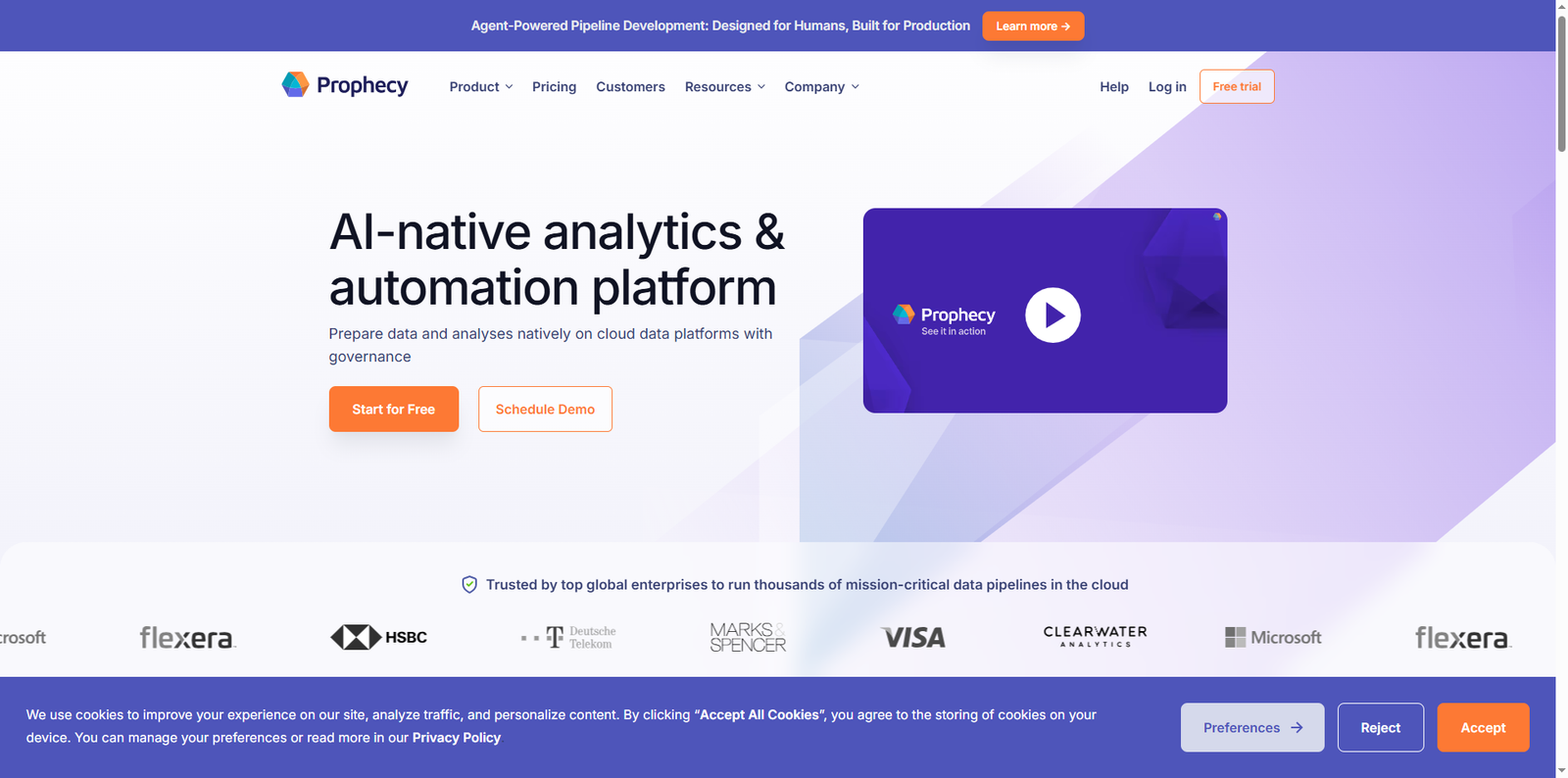
Prophecy.io is an AI-native analytics and automation platform that allows business data users to prepare, transform, and analyze data natively on cloud data platforms such as Databricks, Snowflake, and Google BigQuery. The platform provides a visual interface for building data pipelines, ensuring that both technical and non-technical users can collaborate effectively without compromising governance or scalability.
According to Prophecy’s official information, the platform is trusted by global enterprises to run thousands of mission-critical data pipelines daily. It integrates seamlessly with enterprise-grade systems and follows best software engineering practices such as Git integration, versioning, and automated testing.
How Prophecy.io Works
Prophecy.io operates as a self-service environment for data preparation and automation. It connects directly to cloud data warehouses, allowing users to:
- Read data from multiple sources
- Transform data using a visual drag-and-drop interface
- Write results back into cloud data platforms for analytics and reporting
Under the hood, Prophecy.io leverages Apache Spark and SQL to execute transformations at scale. Its AI-powered automation assists users in generating optimized code, ensuring that pipelines are efficient and maintainable. This approach reduces dependency on specialized data engineering teams and accelerates time-to-insight across departments.
Core Components of Prophecy.io
Prophecy Studio
Prophecy Studio is the visual development environment where users design and manage data pipelines. It supports collaborative workflows, allowing teams to version control their projects through Git integration. The studio also provides automated testing and validation features to ensure data quality and compliance.
Prophecy Automate
Prophecy Automate focuses on orchestration and monitoring. It enables users to schedule, observe, and optimize pipeline executions across different environments. Automated alerts and dashboards provide real-time visibility into performance and cost metrics, helping teams maintain operational efficiency.
Governance and Security
Governance is at the core of Prophecy.io’s architecture. The platform enforces enterprise-grade access controls, ensuring that data usage complies with internal and regulatory policies. Built-in auditing and lineage tracking features allow organizations to maintain transparency and accountability throughout the data lifecycle.
Benefits of Using Prophecy.io
Prophecy.io delivers several advantages that make it a valuable asset for modern data teams:
- Self-Service Data Engineering: Enables analysts and scientists to build pipelines without deep coding expertise.
- AI-Powered Automation: Uses machine learning to optimize transformations and suggest improvements.
- Scalability: Runs natively on cloud data platforms, ensuring performance even with massive datasets.
- Governance and Compliance: Provides built-in controls for data access, lineage, and versioning.
- Collaboration: Integrates with Git for version control and team-based development workflows.
Real-World Use Cases
Prophecy.io has been adopted across industries such as finance, retail, and manufacturing to streamline data operations. Here are some notable examples:
- Financial Services: A global bank modernized its data infrastructure using Prophecy.io, achieving 2x faster KPI access and a 20% improvement in data processing efficiency.
- Retail Analytics: A leading retailer leveraged Prophecy.io to accelerate supply chain analytics, enabling 10x faster insights across billions of transactions daily.
- Healthcare: Healthcare organizations use Prophecy.io to integrate patient and operational data securely, ensuring compliance with HIPAA and other regulations.
These results highlight the platform’s ability to handle large-scale, mission-critical workloads while maintaining governance and performance.
Alternatives to Prophecy.io
While Prophecy.io offers a unique AI-native approach, several other tools provide similar functionalities for data pipeline automation and analytics. Below is a comparison of some popular alternatives:
| Tool Name | Description |
|---|---|
| Alteryx | A data preparation and analytics platform that enables users to blend and analyze data through a drag-and-drop interface. |
| Talend | Offers cloud-native data integration and governance solutions for building and managing data pipelines at scale. |
| Matillion | Provides ETL and ELT solutions optimized for cloud data warehouses, focusing on performance and ease of use. |
| Databricks | A unified analytics platform that integrates data engineering, machine learning, and AI workflows on the cloud. |
| RapidMiner | Delivers an end-to-end data science platform for building predictive models and automating analytics processes. |
Future of AI-Native Data Engineering
The rise of AI-native platforms like Prophecy.io marks a significant shift in how organizations approach data engineering. As enterprises move toward data democratization, the demand for tools that combine automation, governance, and scalability will continue to grow. Gartner predicts that by 2026, over 70% of new data pipelines will be generated using low-code or no-code tools, emphasizing the importance of platforms that empower non-technical users.
Prophecy.io’s AI-driven approach positions it at the forefront of this transformation. Its ability to integrate seamlessly with existing cloud ecosystems ensures that organizations can modernize their data infrastructure without disrupting current workflows. Moreover, as AI models become more sophisticated, Prophecy.io’s automation capabilities are expected to evolve, offering even greater predictive insights and optimization.
Conclusion
Prophecy.io stands out as a transformative platform in the realm of data engineering and analytics. By combining AI-native automation, visual design, and enterprise-grade governance, it empowers organizations to accelerate data-driven decision-making while maintaining control and compliance. Whether you are a data analyst seeking self-service capabilities or a data platform leader aiming to enhance productivity, Prophecy.io provides a unified environment that bridges technical and business teams.
As data continues to grow in volume and complexity, platforms like Prophecy.io will play a pivotal role in shaping the future of analytics. By embracing AI-native automation and cloud-native scalability, enterprises can unlock new levels of efficiency, collaboration, and innovation in their data operations.