



Outline
- Introduction
- What Is MotherDuck?
- How MotherDuck Works
- Core Use Cases
- Architecture and Scalability
- MotherDuck vs. Traditional Data Warehouses
- Alternatives to MotherDuck
- Conclusion
Introduction
In the evolving world of data analytics, businesses are constantly seeking tools that simplify complex data workflows while maintaining performance and scalability. MotherDuck has emerged as a transformative platform that bridges the gap between local analytics and cloud-scale data processing. Built on the foundation of DuckDB, a lightweight analytical database, MotherDuck enables teams to manage, analyze, and collaborate on data efficiently without the overhead of traditional data warehouses.
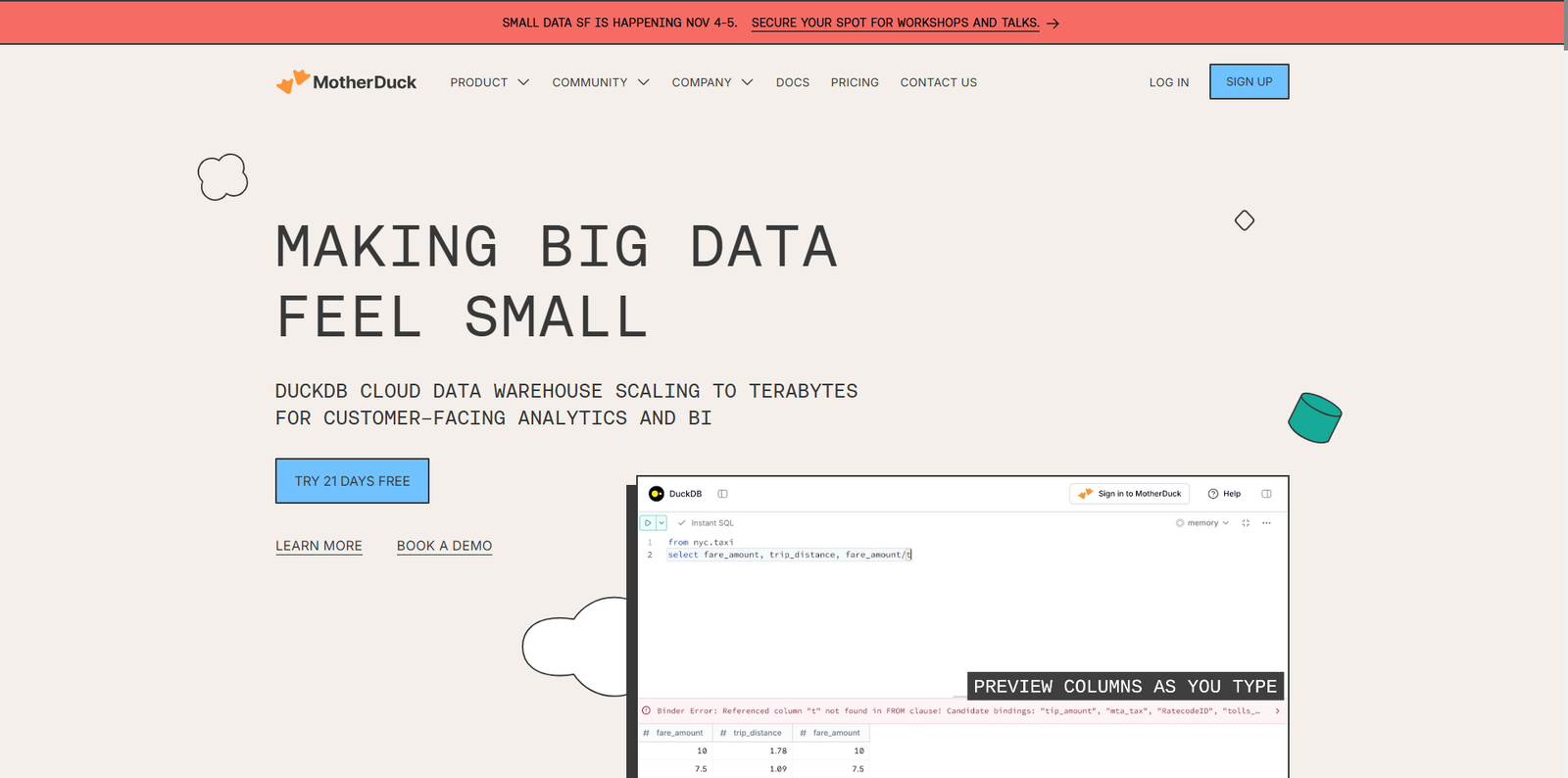
According to the company’s mission, MotherDuck aims to make “big data feel small.” It provides a seamless experience for developers, data scientists, and engineers who need to handle terabytes of data without dealing with cumbersome infrastructure. This article explores how MotherDuck works, its architecture, use cases, and how it compares to other analytics solutions in the market.
What Is MotherDuck?
MotherDuck is a cloud-based data analytics platform that extends the capabilities of DuckDB into a collaborative environment. It allows users to run analytics locally or in the cloud, offering flexibility for both small-scale and enterprise-level workloads. The platform reads multiple data formats such as CSV, JSON, Parquet, Iceberg, and XLS, making it adaptable to diverse data ecosystems.
Unlike traditional data warehouses that require complex setup and maintenance, MotherDuck integrates directly into existing workflows. It’s designed for professionals who want to focus on insights rather than infrastructure management. The platform’s hybrid model allows users to process data locally for speed and push workloads to the cloud for scalability and reliability.
Who Uses MotherDuck?
- Software Engineers: Developers who encounter large datasets while building applications or analytics features.
- Data Scientists: Professionals who need to perform quick, iterative analysis without waiting for long query times.
- Data Engineers: Teams responsible for maintaining data pipelines and ensuring data consistency across systems.
How MotherDuck Works
MotherDuck’s architecture is built around the concept of “ducklings,” which are isolated DuckDB instances assigned to each user. This per-user tenancy model ensures that every user experiences consistent performance and data isolation. Each duckling can be configured in different sizes depending on the workload requirements, allowing flexibility in scaling analytics operations.
The platform leverages a columnar data storage structure optimized for analytical queries. This design enables fast aggregation, filtering, and transformation of large datasets. Users can start analyzing data locally and later deploy their workflows to the cloud for collaboration or larger-scale processing.
Integration and Workflow
MotherDuck integrates smoothly with modern data tools and ecosystems. It supports SQL-based pipelines, making it accessible to teams already familiar with relational databases. The platform also provides APIs and connectors for popular data visualization and business intelligence tools, enabling end-to-end analytics workflows.
Core Use Cases
1. Data Warehousing
For organizations struggling with fragmented data sources, MotherDuck offers a unified environment for data warehousing. Teams can consolidate data from multiple systems, build SQL pipelines, and share insights across departments. The ability to handle structured and semi-structured data formats simplifies integration across business units.
2. Customer-Facing Analytics
Customer-facing analytics is one of MotherDuck’s standout use cases. Unlike traditional BI dashboards that serve internal teams, this approach embeds analytics directly into customer applications. MotherDuck’s low-latency architecture supports thousands of concurrent queries, delivering real-time insights to end users. This capability enhances user engagement and provides immediate feedback loops for product teams.
3. Collaborative Data Analysis
MotherDuck’s cloud deployment model supports team collaboration by allowing multiple users to work on shared datasets simultaneously. This eliminates the need for complex data synchronization processes and ensures that everyone works with the most up-to-date information.
Architecture and Scalability
Scalability is at the heart of MotherDuck’s design. The platform scales both vertically and horizontally to handle fluctuating workloads. Vertical scaling allows users to increase resources for a single duckling, while horizontal scaling distributes workloads across multiple instances. This dual approach ensures consistent performance even during high-demand periods.
Data Storage and Performance
MotherDuck employs a columnar storage format optimized for analytical workloads. This structure minimizes I/O operations and accelerates query execution. The system also supports vectorized query execution, which processes data in batches for improved computational efficiency.
Security and Reliability
Data security is a critical consideration for any analytics platform. MotherDuck ensures data isolation through its per-user tenancy model and employs encryption for data in transit and at rest. The cloud infrastructure provides redundancy and fault tolerance, ensuring high availability and reliability for enterprise users.
MotherDuck vs. Traditional Data Warehouses
Traditional data warehouses like Snowflake or BigQuery have long dominated the analytics landscape. However, they often come with high costs and complex configurations. MotherDuck differentiates itself by offering a lightweight, developer-friendly alternative that combines local performance with cloud scalability.
| Aspect | MotherDuck | Traditional Data Warehouses |
|---|---|---|
| Deployment | Hybrid (Local + Cloud) | Cloud-only |
| Performance | Optimized for analytical queries with DuckDB engine | Dependent on cluster configuration |
| Ease of Use | Simple setup, minimal configuration | Requires setup and maintenance |
| Scalability | Vertical and horizontal scaling with ducklings | Scales through cluster resizing |
| Collaboration | Built-in cloud collaboration | Requires external integrations |
Alternatives to MotherDuck
While MotherDuck provides a unique blend of local and cloud analytics, several other tools offer comparable capabilities. Below are some notable alternatives worth exploring:
| Tool Name | Description |
|---|---|
| DuckDB | An in-process analytical database designed for fast OLAP workloads, forming the foundation of MotherDuck’s engine. |
| Snowflake | A cloud-based data warehouse known for its scalability and support for structured and semi-structured data. |
| BigQuery | Google’s serverless data warehouse that enables real-time analytics and machine learning integration. |
| Databricks | A unified data analytics platform built on Apache Spark, offering collaborative data engineering and machine learning capabilities. |
| Amazon Redshift | A fully managed cloud data warehouse service optimized for large-scale analytics workloads. |
Conclusion
MotherDuck represents a new era in data analytics, where simplicity meets scalability. By extending DuckDB’s local analytical power into the cloud, it empowers teams to handle massive datasets without the complexity of traditional data warehouses. Its per-user tenancy model, hybrid deployment, and support for multiple data formats make it a versatile choice for developers, data scientists, and engineers alike.
As organizations continue to seek efficient ways to manage and analyze data, MotherDuck’s approach of making “big data feel small” stands out as both innovative and practical. Whether used for internal analytics, customer-facing insights, or collaborative data projects, MotherDuck provides a streamlined, high-performance platform that adapts to modern data challenges.
In summary, MotherDuck is not just another analytics tool—it’s a reimagined experience that prioritizes speed, simplicity, and scalability. For teams looking to modernize their data workflows without sacrificing control or performance, MotherDuck offers a compelling solution that bridges the best of both local and cloud analytics worlds.