







Outline
- Introduction
- What is MLflow.org?
- Core Components of MLflow
- Why MLflow Matters in the AI Ecosystem
- Key Integrations and Ecosystem Support
- How MLflow Enhances GenAI Applications
- Alternatives to MLflow
- Getting Started with MLflow
- Conclusion
Introduction
In the rapidly evolving world of artificial intelligence (AI) and machine learning (ML), managing the end-to-end model lifecycle is one of the biggest challenges faced by data scientists and engineers. From tracking experiments to deploying models into production, the process involves multiple steps, tools, and frameworks. MLflow.org has emerged as a leading open-source platform that simplifies this process by offering a unified interface for managing the entire ML lifecycle. Originally developed by Databricks, MLflow is now trusted by thousands of organizations and research teams worldwide.
What is MLflow.org?
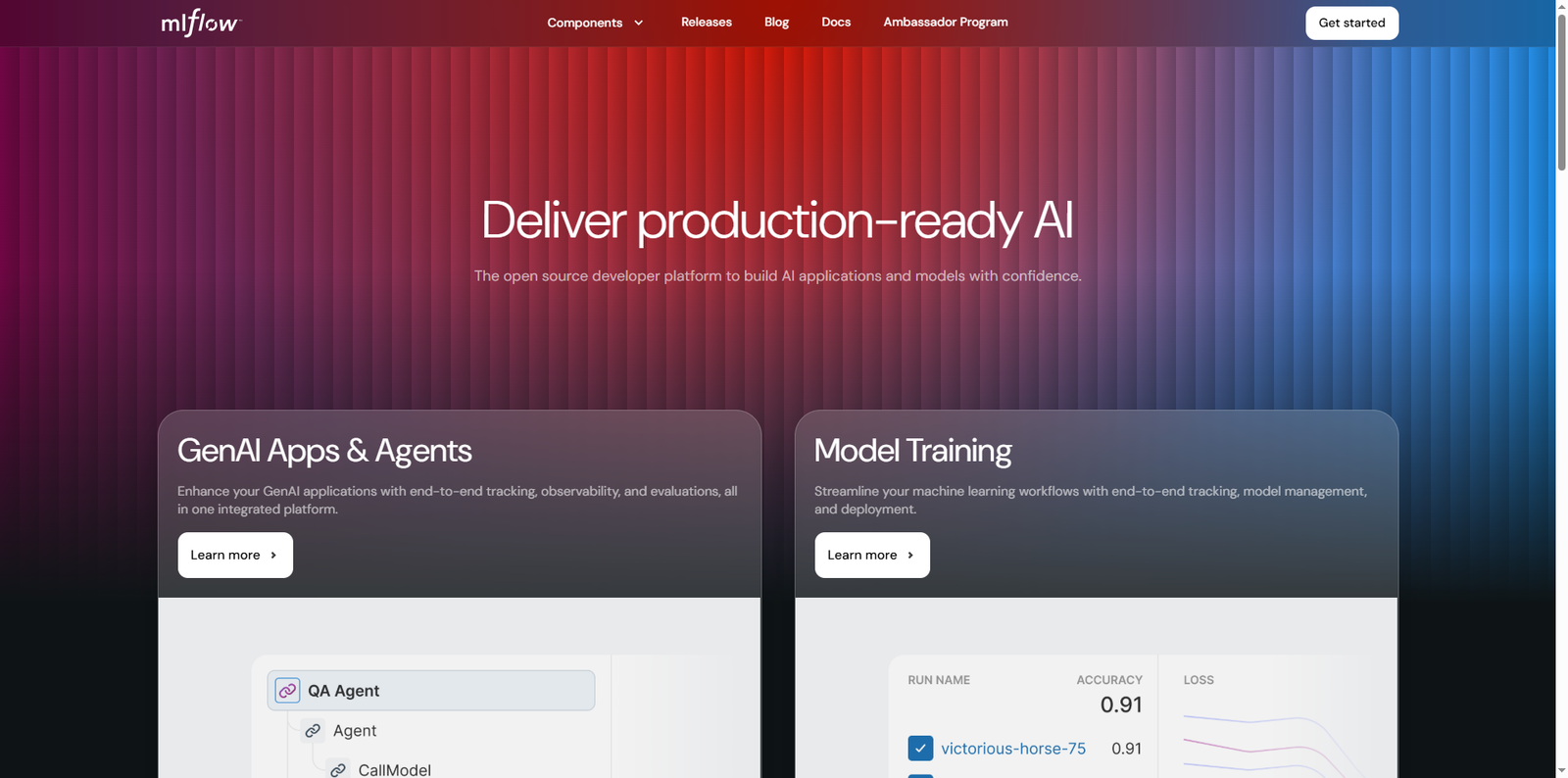
MLflow.org is an open-source platform designed to streamline the machine learning lifecycle, including experimentation, reproducibility, and deployment. It provides a flexible and extensible framework that integrates seamlessly with popular ML libraries and tools. According to the official MLflow community, the platform has over 20,000 stars on GitHub and is supported by an active open-source community of developers and researchers.
MLflow supports both self-hosted and managed options, allowing teams to choose between full control over their infrastructure or a fully managed experience. The platform is built under the Apache 2.0 license, ensuring transparency and flexibility for enterprise and research use cases.
Core Components of MLflow
MLflow is composed of four main components that together form a comprehensive ML lifecycle management system:
- MLflow Tracking: Enables users to log and query experiments, parameters, metrics, and artifacts. This helps teams compare results and improve model performance systematically.
- MLflow Projects: Provides a standardized format for packaging ML code to ensure reproducibility across different environments.
- MLflow Models: Offers a flexible model packaging format that supports multiple ML frameworks, making it easier to deploy models across various platforms.
- MLflow Registry: Acts as a centralized model store, enabling version control, stage transitions, and collaboration across teams.
Why MLflow Matters in the AI Ecosystem
As organizations increasingly adopt AI-driven solutions, managing the complexity of ML workflows has become essential. MLflow addresses this challenge by providing a unified solution that integrates with over 25 popular frameworks and libraries, including TensorFlow, PyTorch, Scikit-learn, and XGBoost. This interoperability allows teams to focus on building better models rather than managing fragmented tools.
Moreover, MLflow’s open architecture makes it adaptable to a wide range of use cases—from academic research to enterprise-scale production systems. Its ability to track experiments, manage models, and ensure reproducibility makes it a cornerstone of modern MLOps practices.
Key Integrations and Ecosystem Support
MLflow’s strength lies in its extensive ecosystem. It integrates seamlessly with major data science and cloud platforms, enabling teams to build, track, and deploy models efficiently. Some of the most notable integrations include:
- Databricks: Provides a managed MLflow experience with additional enterprise features.
- Amazon SageMaker: Allows users to deploy MLflow models directly into AWS environments.
- Azure Machine Learning: Offers native support for MLflow tracking and model registry.
- Google Cloud Vertex AI: Enables integration with MLflow for model management and deployment.
These integrations make MLflow a versatile choice for organizations operating across different cloud infrastructures.
How MLflow Enhances GenAI Applications
With the rise of Generative AI (GenAI), MLflow has expanded its capabilities to support the development and evaluation of large language models (LLMs) and generative systems. The platform provides end-to-end tracking, observability, and evaluation tools that help developers build domain-specific evaluators and automate model assessments.
Recent updates from MLflow’s official blog highlight its role in automating LLM-based systems, such as optical character recognition (OCR) and domain-specific evaluators. These advancements demonstrate MLflow’s adaptability to emerging AI trends and its commitment to supporting next-generation AI applications.
Alternatives to MLflow
While MLflow is a powerful and widely adopted platform, there are several alternative tools that offer similar capabilities for managing ML workflows. Below is a comparison table of popular alternatives:
| Tool Name | Description |
|---|---|
| Weights & Biases | A collaborative platform for experiment tracking, model management, and visualization. |
| Neptune.ai | Focuses on metadata management and experiment tracking for ML and deep learning projects. |
| DVC | An open-source version control system for ML projects that integrates with Git for data and model tracking. |
| Kubeflow | A Kubernetes-native platform for deploying and managing ML workflows at scale. |
| ClearML | Provides experiment tracking, orchestration, and data management for ML pipelines. |
Getting Started with MLflow
Getting started with MLflow is straightforward, whether you prefer a self-hosted setup or a managed environment. The platform’s documentation provides detailed guides and examples to help users quickly set up their ML pipelines.
Step 1: Installation
MLflow can be installed using Python’s package manager:
pip install mlflow
This command installs the core MLflow package, allowing you to start tracking experiments immediately.
Step 2: Tracking Experiments
Once installed, you can log parameters, metrics, and artifacts from your ML experiments. For example, you can track model accuracy, training time, and hyperparameters to compare different runs effectively.
Step 3: Managing Models
MLflow’s model registry allows you to version and manage models throughout their lifecycle. You can transition models between stages such as “Staging,” “Production,” and “Archived,” ensuring smooth collaboration between data scientists and engineers.
Step 4: Deployment
MLflow supports multiple deployment targets, including local servers, cloud environments, and containerized applications. This flexibility enables teams to deploy models wherever their infrastructure resides.
Step 5: Monitoring and Evaluation
With built-in observability tools, MLflow helps monitor model performance post-deployment. This ensures that models remain accurate and reliable over time, even as data distributions change.
Conclusion
MLflow.org has become a cornerstone of modern machine learning operations, offering a unified and open-source solution for managing the entire ML lifecycle. Its modular architecture, broad integration support, and active community make it a reliable choice for organizations seeking to scale their AI initiatives. Whether you are building traditional ML models or advanced GenAI applications, MLflow provides the tools and flexibility needed to move from experimentation to production with confidence. As the AI landscape continues to evolve, MLflow’s commitment to openness and innovation ensures it will remain a key player in the MLOps ecosystem for years to come.