





Outline
- Introduction
- Understanding Time Series Data
- What Is InfluxData?
- Core Components of the InfluxData Platform
- How InfluxDB Powers Real-Time Systems
- Key Use Cases Across Industries
- Integration and Ecosystem
- Alternatives to InfluxData
- Conclusion
Introduction
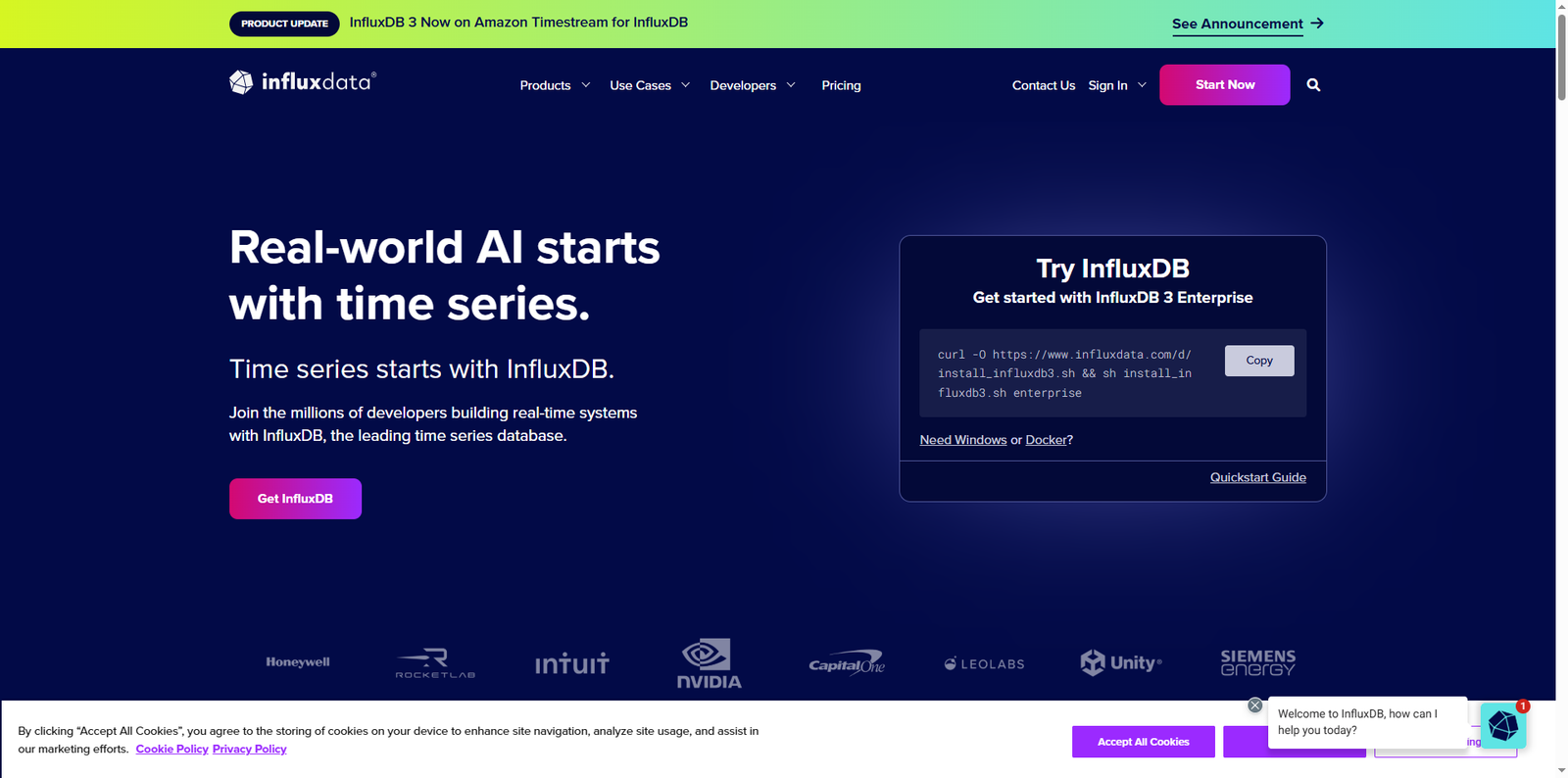
In today’s data-driven world, organizations are increasingly relying on real-time analytics to make informed decisions. Time series data—data points indexed in time order—has become the backbone of modern monitoring, IoT, and AI systems. InfluxData, the company behind InfluxDB, stands out as a leader in this domain, enabling developers to collect, store, and analyze massive streams of time-stamped data efficiently. With over 1 billion downloads via Docker and more than 2,800 contributors worldwide, InfluxData has established itself as the most trusted open-source time series database platform.
Understanding Time Series Data
Time series data represents how a system changes over time. It’s commonly used in applications such as system monitoring, financial analysis, IoT sensor tracking, and predictive maintenance. Unlike traditional relational databases, time series databases are optimized for handling high-ingest rates and querying large volumes of sequential data efficiently.
According to DB-Engines, InfluxDB consistently ranks as the #1 time series database, reflecting its widespread adoption and performance reliability.
What Is InfluxData?
InfluxData is a data platform designed specifically for time series workloads. Its flagship product, InfluxDB, is an open-source time series database that enables developers to manage high-volume, high-velocity data without sacrificing performance. The platform supports deployment in the cloud, on-premises, or at the edge, making it highly flexible for diverse environments.
InfluxData’s mission is to empower developers to build real-time systems that can ingest, analyze, and act on data streams instantly. This capability is crucial for modern AI and machine learning applications that depend on continuous data flows to make intelligent predictions.
Core Components of the InfluxData Platform
The InfluxData ecosystem is composed of several integrated components that together form a complete time series data pipeline:
- InfluxDB: The core time series database optimized for high-speed data ingestion and real-time analytics.
- Telegraf: A plugin-driven server agent for collecting and reporting metrics from various sources, with over 5,000 integrations available.
- Chronograf: A visualization and dashboarding tool that helps users explore and monitor their time series data.
- Kapacitor: A data processing engine for real-time streaming analytics and alerting.
Together, these components enable organizations to build end-to-end monitoring and analytics solutions that scale seamlessly.
How InfluxDB Powers Real-Time Systems
InfluxDB’s architecture is designed to handle millions of writes per second while maintaining low latency for queries. Its latest version, InfluxDB 3.5, introduces several enhancements such as Explorer Dashboards and Cache Querying, improving both usability and performance.
High-Speed Ingest
InfluxDB can ingest millions of time series data points per second without impacting performance. This capability is essential for IoT and telemetry systems where data is generated continuously from sensors and devices.
Real-Time Analytics
With real-time analytics capabilities, InfluxDB allows users to transform and analyze data streams as they arrive. This enables immediate insights for monitoring, anomaly detection, and predictive modeling.
Compression and Downsampling
InfluxDB uses advanced compression techniques to store large volumes of data efficiently. By leveraging Parquet file formats, it minimizes storage costs while maintaining query performance. Downsampling further optimizes storage by summarizing older data at lower resolutions.
Lakehouse and AI/ML Integration
InfluxDB seamlessly integrates with data lakes and warehouses, enabling organizations to stream cold data into long-term storage or AI/ML pipelines. This integration supports advanced analytics and model training on historical data.
Key Use Cases Across Industries
InfluxData’s technology is used across a wide range of industries to enable real-time insights and automation. Below are some common applications:
- IoT and Edge Computing: Collecting and analyzing sensor data from connected devices for predictive maintenance and operational efficiency.
- DevOps and Infrastructure Monitoring: Tracking system metrics, logs, and events to ensure uptime and performance.
- Financial Services: Monitoring market data and transaction streams for fraud detection and algorithmic trading.
- Energy and Utilities: Managing smart grid data and optimizing energy consumption patterns.
- Healthcare: Monitoring patient vitals and medical device telemetry for proactive care.
Integration and Ecosystem
InfluxData’s ecosystem is built for interoperability. It supports multiple programming languages, APIs, and integration standards, allowing developers to connect it easily with their existing tech stack.
Supported Integrations
- Cloud platforms such as AWS, Azure, and Google Cloud.
- Visualization tools like Grafana and Tableau.
- Data processing frameworks including Apache Spark and Apache Kafka.
- Machine learning environments like TensorFlow and PyTorch.
Developer Community and Open Source
InfluxData’s open-source foundation has fostered a vibrant developer community. With over 1 million open-source instances live today and thousands of contributors, the platform continues to evolve rapidly. This community-driven approach ensures continuous innovation and transparency in development.
Alternatives to InfluxData
While InfluxData leads the time series database market, several other tools offer comparable capabilities for specific use cases. The table below highlights some popular alternatives:
| Tool Name | Description |
|---|---|
| Prometheus | An open-source monitoring system and time series database widely used for system and service monitoring. |
| TimescaleDB | A PostgreSQL extension optimized for time series data, offering SQL compatibility and scalability. |
| Datadog | A cloud-based monitoring and analytics platform for large-scale applications and infrastructure. |
| New Relic | A performance monitoring tool that provides observability across distributed systems. |
| Zabbix | An enterprise-grade monitoring solution for networks, servers, and applications. |
Conclusion
InfluxData has revolutionized how organizations handle time series data, offering a robust, scalable, and developer-friendly platform for real-time analytics. Its open-source foundation, combined with powerful ingestion, compression, and integration capabilities, makes it a cornerstone for modern data-driven infrastructures. Whether you’re monitoring IoT devices, optimizing cloud infrastructure, or building predictive AI systems, InfluxDB provides the performance and flexibility needed to transform raw data into actionable intelligence.
As real-time data continues to shape the future of technology, InfluxData remains at the forefront, empowering developers and enterprises to harness the full potential of time series intelligence.