


Outline
- Introduction
- Understanding Holistics.io
- Core Concepts Behind Holistics.io
- How Holistics.io Transforms Data Analytics
- Key Benefits of Using Holistics.io
- Real-World Use Cases
- Top Alternatives to Holistics.io
- Conclusion
Introduction
In today’s data-driven world, organizations are constantly seeking ways to empower business users with reliable insights without overburdening data teams. Holistics.io stands out as a modern self-service analytics platform that merges business intelligence (BI) with DevOps best practices. By enabling analytics-as-code, Holistics.io allows teams to define, manage, and reuse analytics logic efficiently. This approach ensures consistency, scalability, and collaboration across data workflows.
Understanding Holistics.io
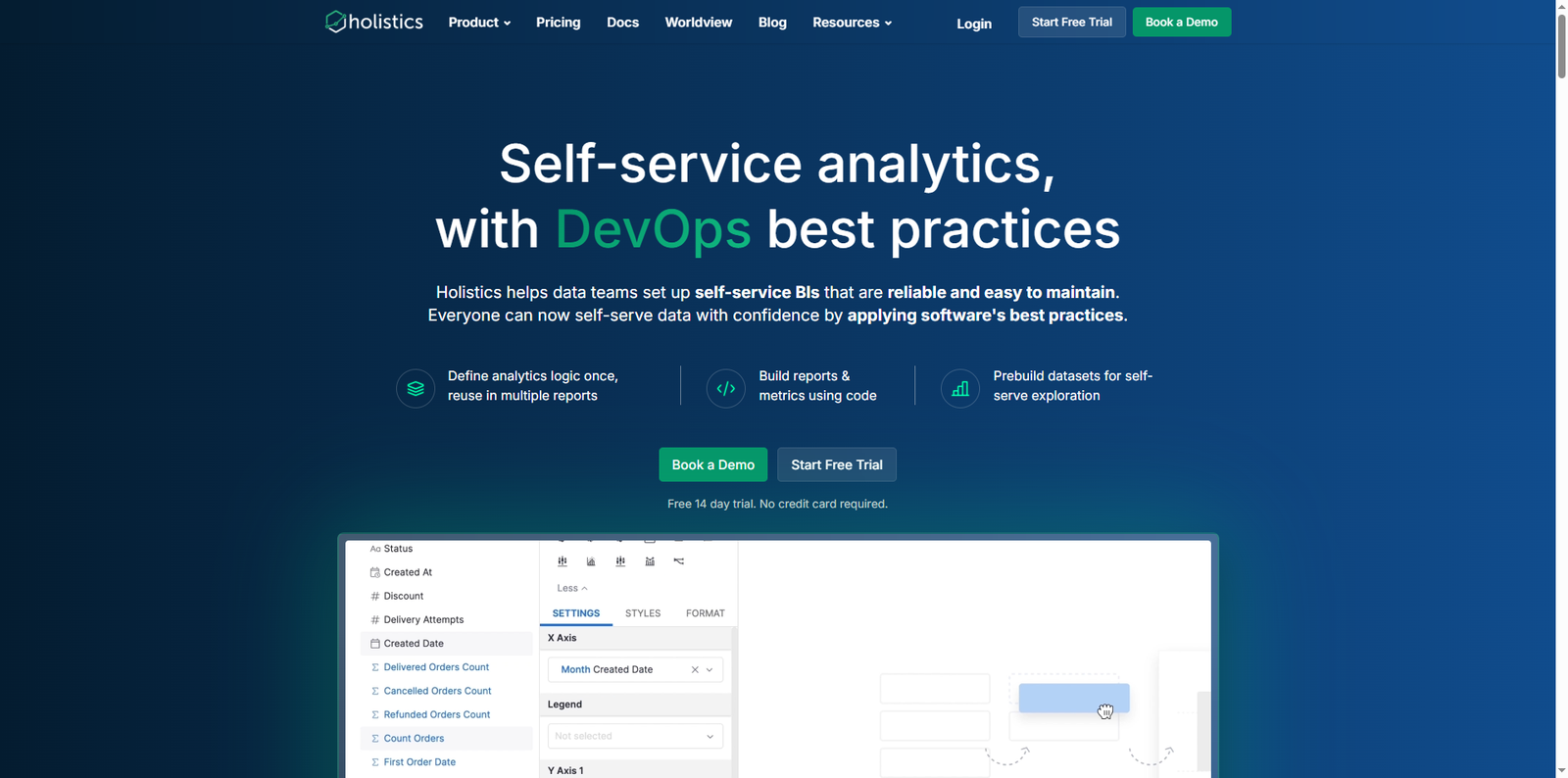
Holistics.io is a self-service business intelligence platform designed to simplify data exploration and reporting. Founded in Singapore, the platform has gained recognition for its unique approach to analytics that combines software engineering principles with BI. According to the company’s official documentation, Holistics.io enables data teams to define analytics logic once and reuse it across multiple reports, ensuring consistency and accuracy throughout the organization.
Unlike traditional BI tools that rely heavily on drag-and-drop interfaces, Holistics.io embraces a code-based approach. This means data analysts can define models, metrics, and dimensions using code, store them in Git repositories, and perform version control just like software developers. This methodology bridges the gap between data engineering and analytics, fostering collaboration and transparency.
Core Concepts Behind Holistics.io
1. Semantic Modeling Layer
The semantic modeling layer is the foundation of Holistics.io. It acts as a centralized repository where analytics logic is defined once and reused across various dashboards and reports. This ensures that all stakeholders are working with consistent metrics and definitions, eliminating confusion over “which number is correct.”
2. Analytics-As-Code
Holistics.io introduces the concept of Analytics-As-Code, allowing teams to manage BI assets using code. This approach integrates seamlessly with Git for version control, enabling code reviews, collaboration, and rollback capabilities. It also supports continuous integration and deployment (CI/CD) pipelines, aligning BI practices with modern DevOps methodologies.
3. AI-Assisted Self-Service
Through AI-assisted self-service, Holistics.io empowers business users to explore data independently. Analysts can curate datasets, while non-technical users can generate insights using natural language queries. This reduces dependency on data teams and accelerates decision-making across departments.
How Holistics.io Transforms Data Analytics
Holistics.io transforms the traditional BI workflow by introducing automation, reusability, and governance. Instead of manually building reports for each department, data teams can define reusable models that automatically propagate updates across all reports. This ensures that every dashboard reflects the latest business logic without redundant effort.
Moreover, Holistics.io integrates with popular data warehouses such as Google BigQuery, Amazon Redshift, and Snowflake. This compatibility allows organizations to leverage their existing data infrastructure while enhancing analytical capabilities. The platform’s ability to manage analytics as code also means that teams can apply software engineering best practices—such as testing, versioning, and peer review—to their BI processes.
Streamlined Collaboration
By storing analytics definitions in Git, Holistics.io encourages collaboration between data engineers, analysts, and business users. Each change to a model or metric can be reviewed and approved before deployment, ensuring data integrity and reducing errors. This collaborative workflow mirrors the development cycle used in software engineering, fostering accountability and transparency.
Enhanced Data Governance
Data governance is a critical aspect of modern analytics. Holistics.io’s centralized semantic layer ensures that all metrics are defined consistently, reducing discrepancies across departments. This unified approach enhances trust in data and supports compliance with organizational standards.
Key Benefits of Using Holistics.io
- Consistency: Define metrics once and reuse them across multiple reports, ensuring accuracy and uniformity.
- Scalability: Manage analytics logic as code, making it easier to scale BI operations as data grows.
- Collaboration: Enable cross-functional teams to work together through version control and code reviews.
- Efficiency: Reduce repetitive tasks by automating report generation and updates.
- Empowerment: Allow business users to self-serve data insights without relying on technical teams.
Real-World Use Cases
Holistics.io has been adopted by organizations across various industries, including technology, retail, and finance. Below are some practical examples of how companies leverage the platform:
1. Retail Analytics
Retail companies use Holistics.io to unify sales, inventory, and customer data. By defining metrics such as revenue, conversion rate, and customer lifetime value in the semantic layer, teams can generate consistent reports across regions and departments. This helps executives make data-driven decisions faster.
2. SaaS Performance Monitoring
Software-as-a-Service (SaaS) businesses rely on Holistics.io to monitor key performance indicators (KPIs) such as churn rate, monthly recurring revenue (MRR), and user engagement. The analytics-as-code approach enables them to iterate quickly and maintain accuracy across dashboards.
3. Financial Reporting
Financial institutions use Holistics.io to automate reporting workflows and ensure compliance. The platform’s version-controlled analytics logic allows auditors and analysts to trace changes, improving transparency and accountability.
Top Alternatives to Holistics.io
While Holistics.io offers a unique combination of self-service analytics and DevOps principles, several other tools provide comparable capabilities. Below is a table of top alternatives worth exploring:
| Tool Name | Description |
|---|---|
| Looker | A modern BI platform by Google Cloud that uses LookML for modeling data and building scalable analytics workflows. |
| Tableau | Popular for its intuitive visual analytics and drag-and-drop interface, ideal for interactive dashboards and storytelling. |
| Power BI | Microsoft’s powerful BI solution that integrates seamlessly with Excel and Azure for enterprise-grade analytics. |
| Metabase | An open-source BI tool that allows teams to visualize data quickly and share insights effortlessly. |
| Mode | A collaborative analytics platform combining SQL, Python, and R for advanced data exploration and reporting. |
Conclusion
Holistics.io represents a paradigm shift in how organizations approach business intelligence. By merging self-service analytics with DevOps best practices, it empowers data teams to build scalable, maintainable, and transparent BI systems. Its semantic modeling layer ensures consistency, while analytics-as-code promotes collaboration and governance. As businesses continue to prioritize data-driven decision-making, tools like Holistics.io will play a crucial role in bridging the gap between data engineering and business analysis.
Whether you are a data engineer seeking better control over analytics logic or a business leader aiming to democratize data access, Holistics.io offers a powerful framework for achieving both. With its focus on reusability, accuracy, and automation, it stands as a forward-thinking solution for modern data teams looking to transform their analytics workflows.