




Outline
- Introduction
- What is Hex.tech?
- How Hex.tech Empowers Data Teams
- Core Functionalities and Capabilities
- Real-World Use Cases and Testimonials
- Integrations and Compatibility
- Alternatives to Hex.tech
- Why Hex.tech Stands Out in the Data Analytics Landscape
- Conclusion
Introduction
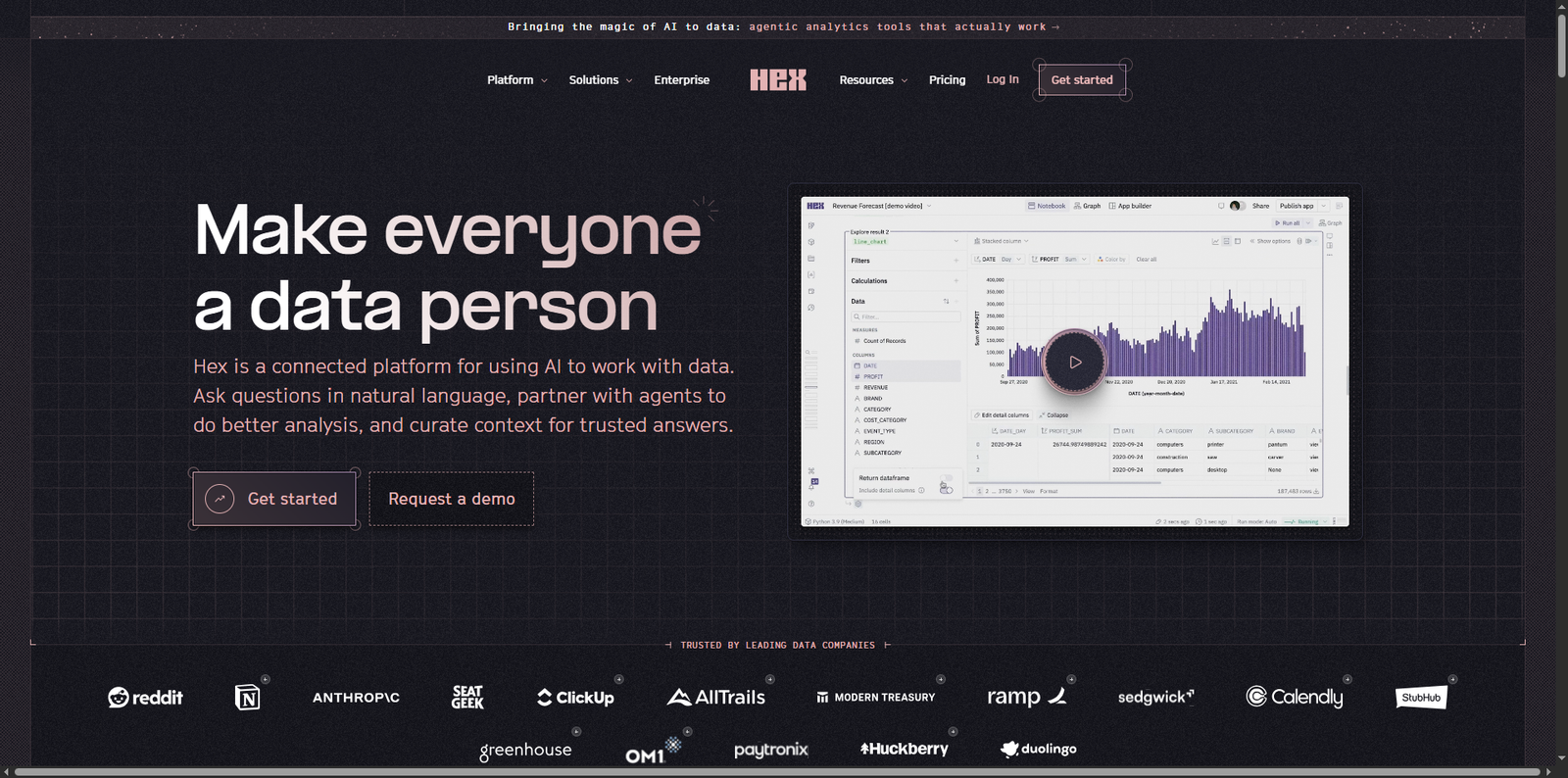
In today’s data-driven world, organizations are constantly seeking ways to make analytics more accessible and actionable. Hex.tech has emerged as a transformative platform that bridges the gap between data science and everyday business decision-making. Designed to make “everyone a data person,” Hex empowers teams to explore, analyze, and visualize data collaboratively using AI. This article explores how Hex.tech is reshaping modern analytics workflows, its real-world impact, and how it compares to other tools in the market.
What is Hex.tech?
Hex.tech is a connected data platform that enables users to work with data using natural language and AI-powered assistance. It allows teams to ask questions, build analyses, and publish interactive data applications—all within a single environment. Founded in 2019, Hex has rapidly gained traction among leading data-driven companies such as Notion, ClickUp, and StubHub. The platform’s mission is to democratize data access, empowering both technical and non-technical users to derive insights without relying heavily on engineering teams.
According to Hex’s official vision, the platform aims to make data exploration intuitive and collaborative, helping organizations move from static dashboards to dynamic, AI-assisted analytics experiences.
How Hex.tech Empowers Data Teams
Traditional data workflows often involve multiple tools and handoffs between analysts, engineers, and business stakeholders. Hex.tech simplifies this by offering a unified workspace where teams can:
- Write and execute SQL or Python code directly within the platform.
- Leverage AI agents to generate queries and interpret results.
- Create interactive data applications that can be shared across departments.
- Collaborate in real time, reducing the friction between analysis and decision-making.
This collaborative approach allows data teams to focus on strategic projects rather than repetitive tasks. For instance, engineers can build reusable data models, while business users can self-serve insights using the same trusted data sources.
Core Functionalities and Capabilities
Hex.tech’s strength lies in its ability to combine code-based analytics with AI-driven assistance. Users can interact with data through natural language queries, making complex analysis accessible to non-technical users. The platform supports multiple data sources, including cloud data warehouses like Snowflake, BigQuery, and Databricks.
Key capabilities include:
- AI-Powered Querying: Users can ask questions in plain English, and Hex’s AI translates them into executable queries.
- Collaborative Workspaces: Teams can co-edit notebooks, comment, and share insights seamlessly.
- Interactive Data Apps: Analysts can turn their work into live, shareable applications with just a few clicks.
- Version Control and Governance: Built-in versioning ensures data integrity and reproducibility across projects.
By integrating these capabilities, Hex.tech eliminates the need for switching between multiple tools, streamlining the analytics lifecycle from exploration to presentation.
Real-World Use Cases and Testimonials
Hex.tech’s impact is evident across various industries. Leading companies have reported significant improvements in their data workflows after adopting the platform:
- Notion: Abhishek Modi, Software Engineer at Notion, stated that Hex enables anyone, regardless of technical proficiency, to use data confidently.
- ClickUp: Sai Srigiriaju, Head of Growth Strategy & Ops, highlighted how Hex allows their team to move from ad-hoc analysis to published data apps effortlessly.
- StubHub: Meghana Reddy, Head of Data, mentioned that Hex empowers analysts to explore and dig into data independently.
- Huckberry: Ben Saxe, Head of Data, shared that their CFO described Hex-powered data apps as “a million-dollar product.”
These testimonials reflect Hex’s ability to drive efficiency, transparency, and trust in data processes. By enabling self-service analytics, Hex reduces dependency on data teams and accelerates decision-making across organizations.
Integrations and Compatibility
Hex.tech integrates seamlessly with modern data ecosystems. It connects directly to popular data warehouses, visualization tools, and version control systems. This interoperability ensures that teams can continue using their preferred infrastructure while enhancing their analytics capabilities.
Common integrations include:
- Cloud data warehouses such as Snowflake, BigQuery, and Redshift.
- Version control systems like GitHub for collaborative development.
- Visualization and BI tools for embedding dashboards within workflows.
Additionally, Hex’s API support allows developers to extend functionality or integrate with internal systems, making it a flexible choice for enterprises of all sizes.
Alternatives to Hex.tech
While Hex.tech offers a unique combination of AI and collaboration, several other tools provide complementary or alternative solutions for data analysis and visualization. Below is a comparison of some popular alternatives:
| Tool Name | Description |
|---|---|
| Mode | A collaborative analytics platform that combines SQL, Python, and visualization in one environment, ideal for data teams. |
| Looker | A Google Cloud-based BI tool that helps organizations explore and share real-time business insights. |
| Tableau | A leading visualization platform known for its intuitive dashboards and data storytelling capabilities. |
| Databricks | An AI and data engineering platform that unifies data science, analytics, and machine learning workflows. |
| Power BI | Microsoft’s business intelligence tool that enables users to visualize and share insights across the organization. |
Each of these tools has its strengths, but Hex.tech stands out for its integration of AI-driven analytics and collaborative app-building capabilities, which make it particularly appealing for modern data teams.
Why Hex.tech Stands Out in the Data Analytics Landscape
Hex.tech’s differentiation lies in its combination of AI, collaboration, and accessibility. Unlike traditional BI tools that focus primarily on visualization, Hex integrates the entire analytics workflow—from data exploration to application deployment—into one cohesive platform. Its AI agents assist users in writing queries, interpreting results, and generating insights faster than ever before.
Moreover, Hex promotes a culture of data literacy across organizations. By enabling non-technical users to engage directly with data, it reduces bottlenecks and fosters a more data-informed decision-making process. This democratization of analytics aligns with the growing trend of “self-service BI,” where every team member can independently explore and act on data insights.
According to industry reports, companies that adopt collaborative analytics platforms like Hex experience up to 30% faster decision cycles and improved cross-functional alignment. This efficiency gain underscores the strategic value of adopting tools that empower both analysts and business users alike.
Conclusion
Hex.tech represents a new era in data analytics—one where AI, collaboration, and accessibility converge to make data-driven decision-making a reality for everyone. By simplifying complex workflows and enabling self-service analytics, Hex empowers organizations to unlock the full potential of their data. Whether you’re a data scientist, analyst, or business leader, Hex provides the tools and environment needed to transform raw data into actionable insights. As the analytics landscape continues to evolve, platforms like Hex will play a pivotal role in shaping how teams interact with and derive value from their data.