


Outline
- Introduction
- Understanding h2o.ai and Its Vision
- Core Technologies Powering h2o.ai
- Real-World Applications and Case Studies
- How h2o.ai Supports Enterprise AI Transformation
- Alternatives to h2o.ai
- Conclusion
Introduction
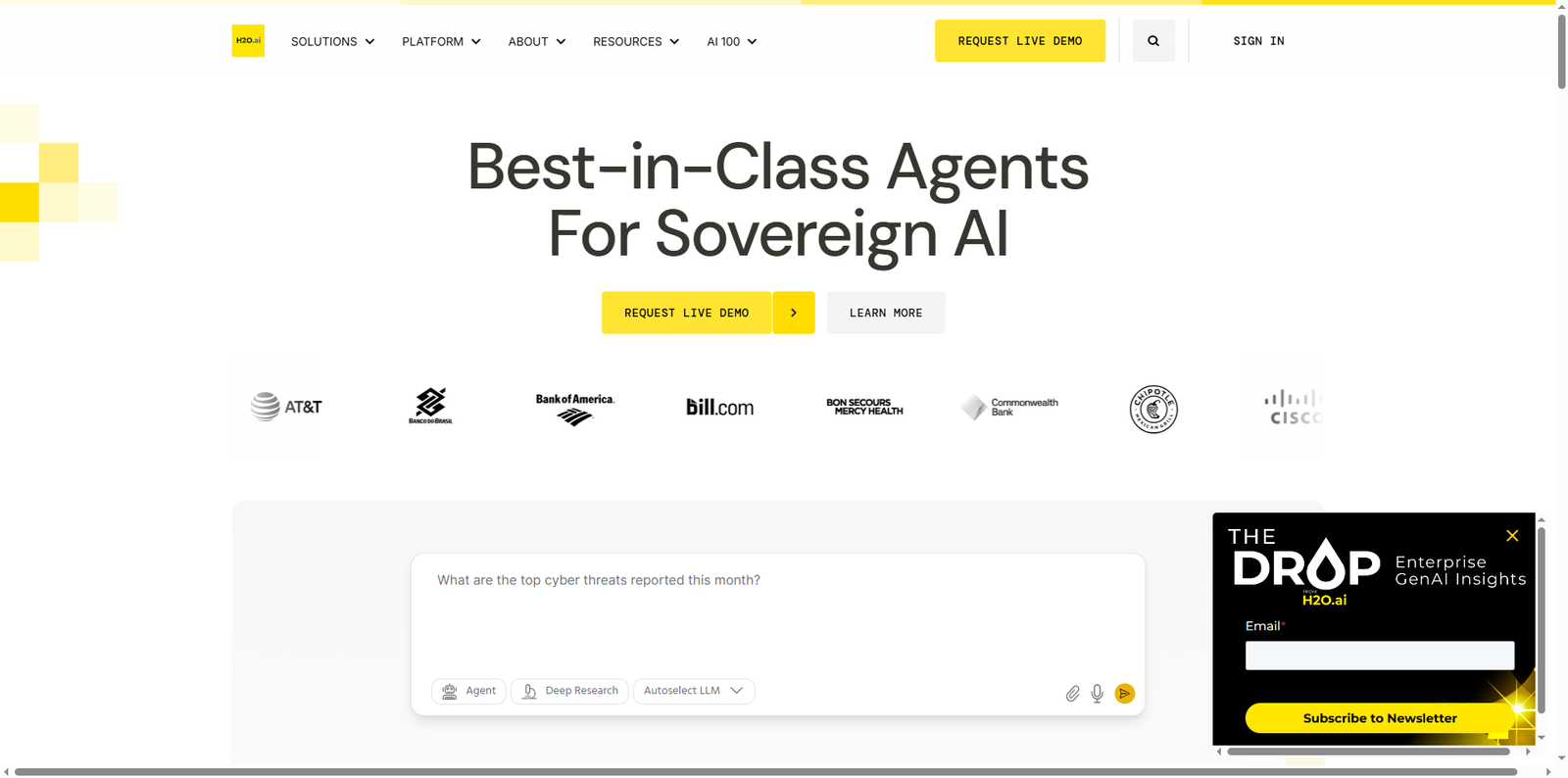
Artificial Intelligence (AI) continues to redefine how organizations operate, innovate, and deliver value. Among the leading players in this transformation is h2o.ai, a company that has built a strong reputation for enabling enterprises to harness the power of both predictive and generative AI. With a global community of over 2 million data science users, h2o.ai is trusted by some of the world’s most regulated industries, including finance, telecommunications, and healthcare. This article explores how h2o.ai is shaping the future of AI, its core technologies, real-world impact, and available alternatives for businesses seeking similar capabilities.
Understanding h2o.ai and Its Vision
Founded in 2012, h2o.ai has evolved from an open-source machine learning platform into a comprehensive AI ecosystem that bridges the gap between data science and enterprise deployment. The company’s mission is to democratize AI by making it accessible, explainable, and secure for all organizations. Its flagship offerings, such as h2oGPTe and H2O Enterprise LLM Studio, empower businesses to build, fine-tune, and deploy AI models on their private infrastructure.
According to the company’s public data, h2o.ai’s solutions are used by institutions like the Commonwealth Bank of Australia, AT&T, and the National Institutes of Health (NIH). These organizations leverage h2o.ai to optimize operations, enhance decision-making, and ensure compliance with strict data governance requirements. The platform’s focus on sovereign AI—AI that operates securely within an organization’s infrastructure—has made it a preferred choice for enterprises prioritizing data privacy and security.
Core Technologies Powering h2o.ai
1. h2oGPTe: Generative AI for Enterprises
h2oGPTe is a secure, enterprise-grade generative AI platform that integrates large language models (LLMs) and small language models (SLMs) for business applications. It enables organizations to create private, domain-specific AI assistants that can perform deep research, automate workflows, and generate insights from internal data. Unlike public AI models, h2oGPTe can be deployed within an organization’s own environment, ensuring data sovereignty and compliance.
2. H2O Enterprise LLM Studio
The H2O Enterprise LLM Studio provides tools for fine-tuning and distilling language models on private datasets. This allows enterprises to customize AI behavior to align with their unique business needs. The studio supports model transparency, version control, and integration with existing data pipelines, making it a powerful solution for organizations scaling their AI initiatives.
3. Open-Source Foundation
h2o.ai’s legacy lies in its open-source roots, with projects like H2O-3 and Driverless AI contributing significantly to the data science community. These tools have been instrumental in advancing automated machine learning (AutoML) and explainable AI (XAI), enabling users to build and interpret models efficiently.
Real-World Applications and Case Studies
1. Commonwealth Bank of Australia
Australia’s largest bank leveraged h2o.ai to reduce fraud by 70%. By training over 900 analysts to use h2o.ai’s platform, the bank enhanced its decision-making capabilities across millions of daily transactions. According to Andrew McMullan, the bank’s former Chief Data & Analytics Officer, every customer decision became “100% better” through AI-driven insights.
2. AT&T
AT&T integrated h2oGPTe into its call center operations, achieving a twofold return on investment in free cash flow within a year. Andy Markus, AT&T’s Chief Data Officer, highlighted that the partnership allowed the company to move faster, deliver more value, and co-create new AI products. This case demonstrates how generative AI can streamline customer service and operational efficiency.
3. National Institutes of Health (NIH)
The NIH deployed h2oGPTe within its air-gapped environment to create a secure generative AI assistant supporting over 8,000 federal employees. The assistant provides instant access to policy and procurement information, freeing staff from repetitive tasks and allowing them to focus on mission-critical work. This implementation underscores h2o.ai’s ability to deliver AI solutions that meet stringent government security standards.
How h2o.ai Supports Enterprise AI Transformation
1. Data Privacy and Security
h2o.ai’s architecture emphasizes data sovereignty, allowing organizations to deploy AI models within their own infrastructure. This approach ensures that sensitive data never leaves the enterprise environment, addressing compliance concerns in sectors like finance, healthcare, and government.
2. Democratizing AI Across Teams
Through intuitive interfaces and automated workflows, h2o.ai enables both technical and non-technical users to engage with AI. Data scientists can build and deploy models efficiently, while business users can interact with AI-driven insights through natural language interfaces. This democratization fosters collaboration and accelerates AI adoption across departments.
3. Integration with Existing Ecosystems
The platform seamlessly integrates with popular data science tools and cloud environments, supporting hybrid and on-premise deployments. This flexibility allows enterprises to leverage their existing infrastructure while scaling AI initiatives securely.
4. Continuous Innovation and Community Support
With an active global community of over two million users, h2o.ai continues to evolve through open collaboration. The company frequently releases updates and research contributions, ensuring that its technology remains at the forefront of AI innovation. This community-driven approach accelerates learning and adoption across industries.
Alternatives to h2o.ai
While h2o.ai offers a robust ecosystem for enterprise AI, several other platforms provide complementary or alternative solutions. Below is a comparison of notable alternatives that organizations may consider:
| Tool Name | Description |
|---|---|
| Databricks | An integrated data and AI platform that unifies data engineering, analytics, and machine learning workflows. |
| Vertex AI | Google Cloud’s managed machine learning platform that simplifies model training, deployment, and monitoring. |
| Azure Machine Learning | A cloud-based environment for building, training, and deploying AI models with enterprise-grade security. |
| Amazon SageMaker | A fully managed service that enables developers and data scientists to build, train, and deploy machine learning models at scale. |
| IBM watsonx | An AI and data platform designed for building trustworthy AI solutions with governance and transparency. |
Conclusion
h2o.ai stands out as a transformative force in the AI landscape, merging the power of generative and predictive intelligence into secure, enterprise-ready solutions. Its commitment to data privacy, explainability, and accessibility has earned it the trust of global leaders across industries. From reducing fraud in banking to enhancing customer experiences in telecommunications and improving efficiency in government operations, h2o.ai demonstrates the tangible impact of AI when implemented responsibly.
As organizations continue to embrace digital transformation, the demand for sovereign, secure, and scalable AI platforms will only grow. h2o.ai’s ecosystem—anchored by h2oGPTe and H2O Enterprise LLM Studio—positions it as a pioneer in this evolving field. However, enterprises should also explore complementary tools like Databricks, Vertex AI, and IBM watsonx to build a holistic AI strategy tailored to their unique goals. Ultimately, the future of enterprise AI lies in collaboration, innovation, and the responsible use of technology—and h2o.ai is leading the way.