




Outline
- Introduction
- What Is DuckDB?
- Why DuckDB Is Gaining Popularity
- Core Capabilities and Architecture
- Supported Programming Languages
- Installation and Setup
- Real-World Use Cases
- DuckDB vs. Alternative Tools
- Community and Ecosystem
- Conclusion
Introduction
In the fast-evolving world of data analytics, DuckDB has emerged as a powerful, lightweight, and high-performance analytical database. Designed for efficient in-process execution, it allows users to query and transform data directly within their applications without the need for a separate database server. Since its inception, DuckDB has gained traction among data scientists, engineers, and analysts for its simplicity, speed, and flexibility.
What Is DuckDB?
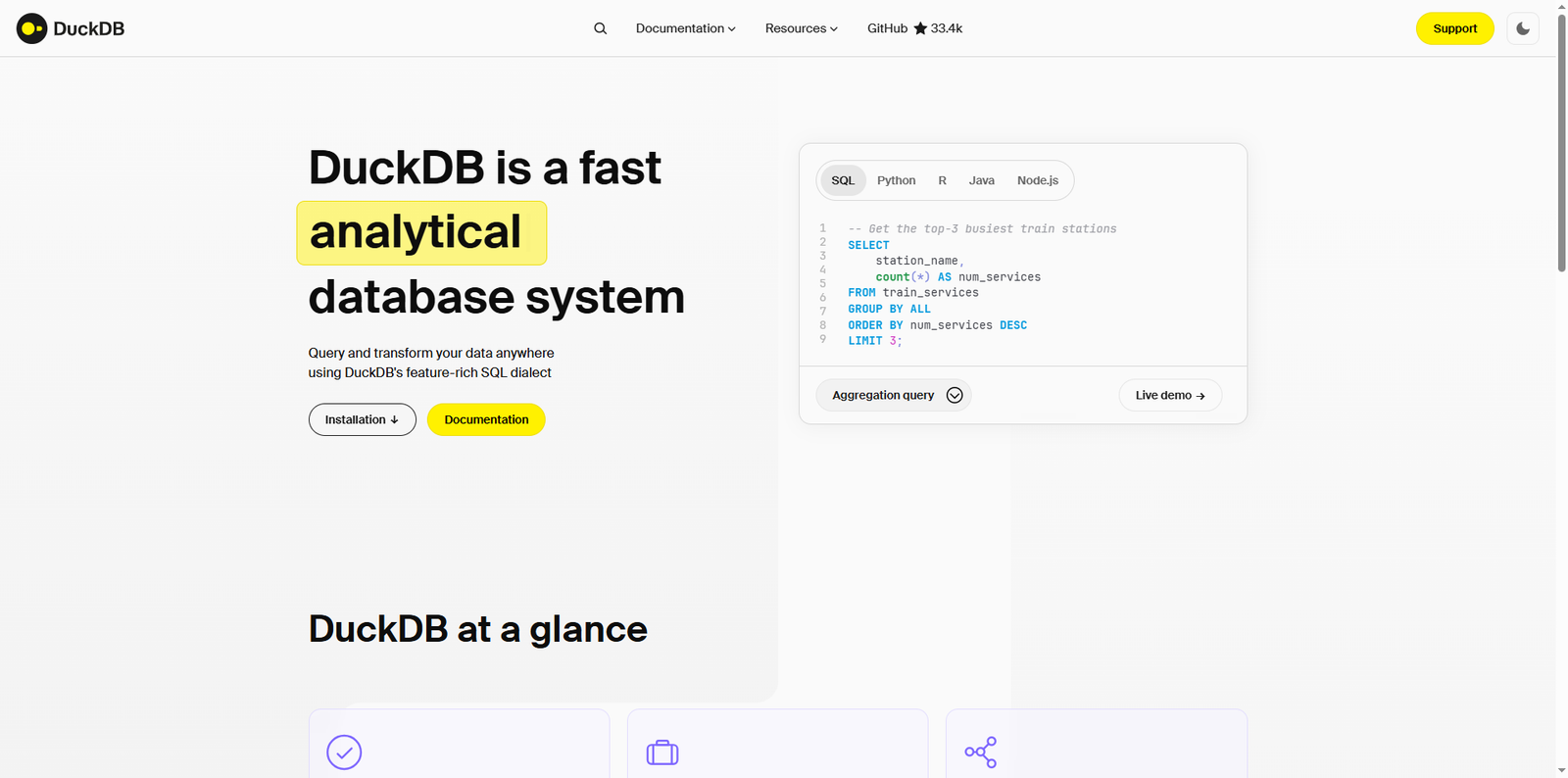
DuckDB is an open-source, in-process analytical database management system (DBMS) optimized for Online Analytical Processing (OLAP) workloads. Unlike traditional client-server databases, DuckDB runs directly inside the host process, making it ideal for embedded analytics, data science workflows, and local data exploration. It supports a rich SQL dialect and integrates seamlessly with popular programming languages such as Python, R, Java, and Node.js.
Developed by researchers at CWI (Centrum Wiskunde & Informatica) in the Netherlands, DuckDB has been designed to bring analytical capabilities to the same environment where data resides. This design eliminates the overhead of data movement between systems, resulting in faster insights and simplified workflows.
Why DuckDB Is Gaining Popularity
DuckDB’s appeal lies in its combination of performance, portability, and ease of use. It has been benchmarked as one of the fastest single-node analytical databases, outperforming several traditional systems on standard tests such as TPC-H. Its ability to handle large datasets efficiently, even on modest hardware, makes it a go-to choice for local analytics and prototyping.
According to the ClickBench benchmark, DuckDB ranked as the number one system for single-node analytical queries, demonstrating its capacity to process complex aggregations and joins at remarkable speed. Its architecture supports parallel execution and vectorized query processing, enabling it to handle larger-than-memory workloads efficiently.
Core Capabilities and Architecture
DuckDB’s architecture is built around the concept of in-process analytics. This means that instead of running as a separate server, DuckDB operates as a library embedded within the host application. This approach provides several advantages:
- Zero Dependencies: DuckDB can be installed in seconds without external dependencies.
- Cross-Platform Portability: It runs on Windows, macOS, and Linux, supporting multiple hardware architectures.
- Rich SQL Support: DuckDB offers a feature-rich SQL dialect compatible with standard analytical operations.
- Data Format Compatibility: It supports reading and writing data in CSV, Parquet, and JSON formats, as well as integration with data lake formats.
- Extensibility: The system supports community extensions, allowing users to enhance its functionality with custom modules.
Performance and Scalability
DuckDB’s query engine is designed for high performance through vectorized execution and efficient memory management. It can process millions of rows per second, even on a single machine. Its columnar storage format optimizes analytical queries by minimizing I/O and maximizing CPU utilization.
Integration with Cloud and Remote Data
DuckDB can read remote CSV and Parquet files directly from cloud storage platforms such as Amazon S3 or Google Cloud Storage. This feature allows users to analyze data without downloading entire datasets locally, making it ideal for hybrid or cloud-based workflows.
Supported Programming Languages
DuckDB provides native client APIs for major programming languages, making it accessible to a wide range of developers and data professionals:
- Python: Integrates seamlessly with pandas and NumPy, allowing users to run SQL queries on DataFrames directly.
- R: Enables statistical analysis and data visualization workflows within RStudio.
- Java: Offers a JDBC driver for enterprise applications.
- Node.js: Provides a JavaScript API for server-side and web-based analytics.
- Rust and Go: Community-supported bindings extend DuckDB’s reach to systems programming environments.
Installation and Setup
Installing DuckDB is straightforward and can be done in seconds. It supports multiple installation methods depending on the environment:
- Command Line:
curl https://install.duckdb.org | sh - Python:
pip install duckdb - R:
install.packages("duckdb") - Java: Add the DuckDB JDBC dependency to your project configuration.
- Node.js:
npm install @duckdb/node-api
Once installed, users can start querying data immediately without any additional configuration. DuckDB’s zero-dependency design ensures that it works out of the box across platforms.
Real-World Use Cases
DuckDB’s versatility makes it suitable for a wide range of applications:
- Data Science and Machine Learning: Analysts can use DuckDB to preprocess large datasets directly within Python or R before feeding them into machine learning models.
- Embedded Analytics: Developers can embed DuckDB into applications to provide local analytical capabilities without relying on external databases.
- Data Engineering: DuckDB simplifies ETL (Extract, Transform, Load) pipelines by enabling SQL-based transformations on local or cloud data sources.
- Interactive Data Exploration: Data professionals can use DuckDB for ad-hoc analysis of Parquet or CSV files without setting up a full database server.
DuckDB vs. Alternative Tools
While DuckDB offers unique advantages, it’s often compared to other analytical databases and query engines. The table below highlights some popular alternatives:
| Tool Name | Primary Use Case | Key Differentiator |
|---|---|---|
| SQLite | Lightweight transactional database | Optimized for OLTP workloads rather than analytics |
| ClickHouse | High-performance analytical database | Designed for distributed systems and large-scale data |
| Presto | Distributed SQL query engine | Ideal for querying data across multiple sources |
| Trino | Federated query engine | Supports large-scale, multi-source analytics |
| DuckDB | In-process analytical database | Embedded analytics with zero dependencies |
Community and Ecosystem
DuckDB’s open-source nature has fostered a vibrant and growing community. The project is actively maintained, with frequent releases and contributions from both individuals and organizations. The community-driven extension ecosystem allows developers to build and share custom modules, expanding DuckDB’s capabilities beyond its core features.
Documentation and tutorials are readily available, making it easy for newcomers to get started. The project’s GitHub repository has thousands of stars, reflecting its popularity and adoption across industries. Many data professionals have integrated DuckDB into their workflows for local analytics, reproducible research, and embedded data solutions.
Conclusion
DuckDB represents a paradigm shift in how analytical databases are designed and used. By bringing high-performance analytics directly into the application layer, it eliminates the need for complex infrastructure and data movement. Its simplicity, speed, and flexibility make it an invaluable tool for data scientists, engineers, and developers seeking efficient, in-process analytics.
As data continues to grow in volume and complexity, tools like DuckDB will play a crucial role in enabling fast, local, and scalable analytics. Whether you’re building data-driven applications, exploring datasets interactively, or integrating analytics into your software, DuckDB provides a modern, elegant solution that bridges the gap between data and insight.