



Outline
- Introduction
- What Is Deepnote?
- How Deepnote Transforms Data Collaboration
- AI-Powered Capabilities
- Integration with Popular Data Tools
- Collaboration and Cloud-Based Workflow
- Alternatives to Deepnote
- Use Cases and Real-World Applications
- Conclusion
Introduction
In today’s data-driven world, teams need tools that simplify analysis, encourage collaboration, and leverage artificial intelligence to accelerate insights. Deepnote has emerged as a next-generation data workspace designed for analysts, data scientists, and business professionals who want to work smarter, not harder. With over 500,000 data professionals using it globally, Deepnote bridges the gap between traditional notebooks and modern AI-powered workflows, enabling users to query, analyze, and visualize data effortlessly.
What Is Deepnote?
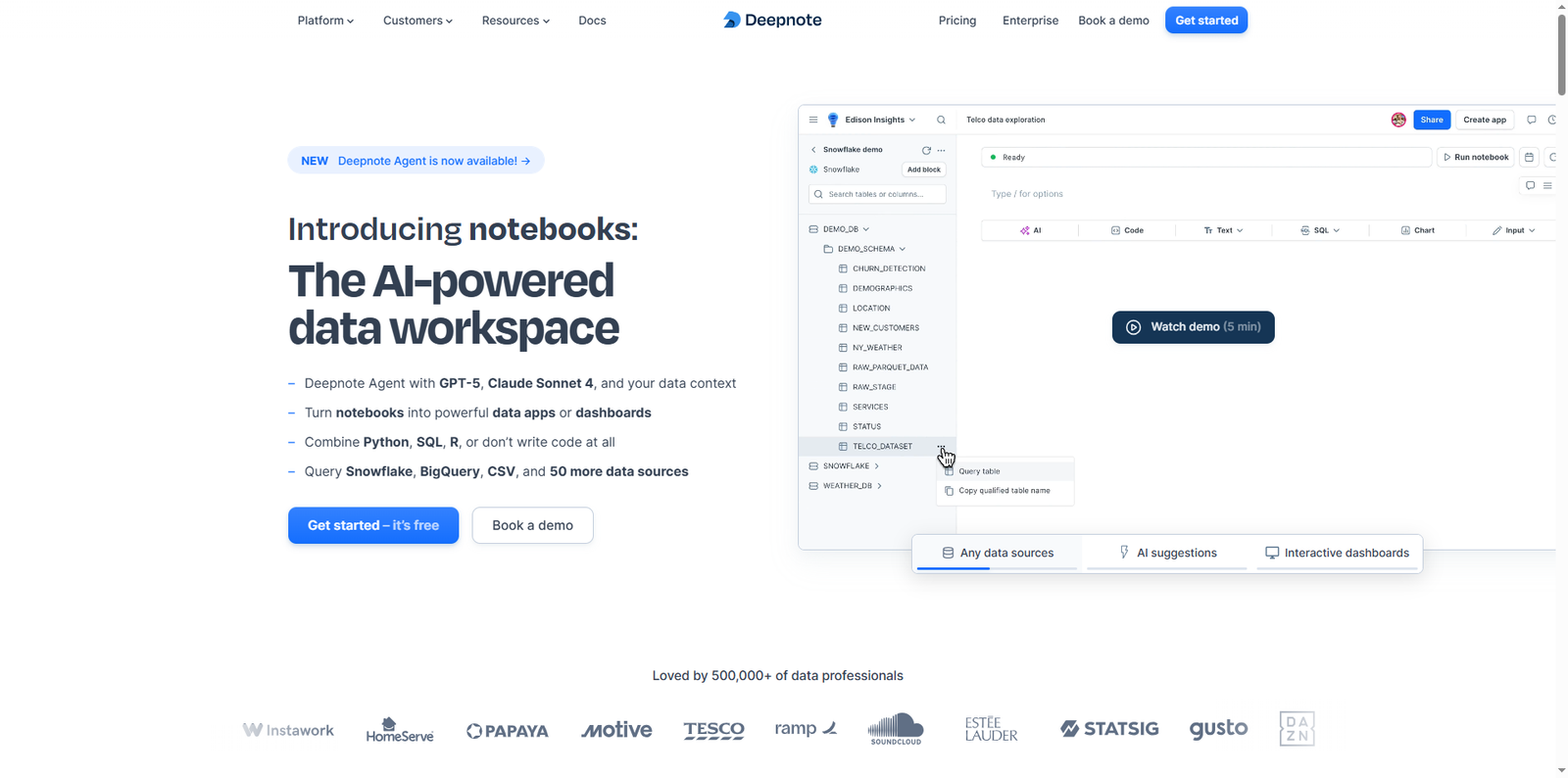
Deepnote is an AI-powered collaborative notebook platform that allows users to combine Python, SQL, and R in a single environment. Unlike traditional Jupyter notebooks, Deepnote runs entirely in the cloud, eliminating the need for local setup or environment management. It integrates seamlessly with major data sources such as Snowflake, BigQuery, and CSV files, allowing users to explore data directly within the browser.
Deepnote’s intelligent environment adapts to user context, offering real-time code suggestions, debugging support, and automated documentation. It’s not just a coding tool—it’s a full-fledged data workspace that supports both technical and non-technical users.
How Deepnote Transforms Data Collaboration
One of Deepnote’s strongest advantages lies in its collaborative capabilities. Traditional notebooks are often static and difficult to share, but Deepnote redefines this experience by offering real-time collaboration similar to Google Docs. Multiple users can edit, comment, and review notebooks simultaneously, making teamwork seamless and efficient.
Deepnote also includes version control and commenting features, ensuring that teams can track changes and provide feedback directly within the workspace. This eliminates the need for endless email threads or Slack messages about code updates.
Benefits of Collaborative Notebooks
- Real-time editing: Work together with teammates on the same notebook simultaneously.
- Commenting and feedback: Add comments to specific code blocks for discussions.
- Version history: Track changes and revert to previous versions easily.
- Cloud-based sharing: Share notebooks via links or email invites without worrying about dependencies.
AI-Powered Capabilities
Deepnote’s integration of AI agents such as GPT-5 and Claude Sonnet 4 brings a new dimension to data analysis. The platform can automatically generate, refactor, and explain code, making it accessible even for users with limited programming experience. Deepnote understands your business context and data stack, allowing it to deliver tailored insights quickly.
For example, users can describe their analytical goals in natural language—such as “analyze customer churn by region”—and Deepnote will generate the appropriate queries and visualizations. This AI-driven approach accelerates workflows and reduces the time spent on repetitive coding tasks.
AI Features at a Glance
- Automated code generation and completion.
- Context-aware debugging and refactoring.
- Natural language querying for non-technical users.
- Instant visualization of dataframes as configurable charts.
Integration with Popular Data Tools
Deepnote supports over 50 data sources, making it a versatile hub for data professionals. Whether you’re connecting to cloud warehouses or local files, Deepnote simplifies integration and ensures smooth data flow. It supports direct connections to platforms like Snowflake, BigQuery, PostgreSQL, and Google Sheets, among others.
Users can also deploy notebooks as APIs, schedule them to run automatically, and even transform them into interactive dashboards. This flexibility allows teams to move from exploration to production without switching tools.
Supported Integrations
- Snowflake
- BigQuery
- PostgreSQL
- Google Sheets
- CSV and Excel files
Collaboration and Cloud-Based Workflow
Deepnote’s cloud-native architecture eliminates the challenges of dependency management and local configuration. Every project runs in a consistent environment, ensuring reproducibility and reliability. Teams can organize projects into folders, create shared libraries, and manage permissions easily.
Moreover, Deepnote offers scheduling capabilities that allow notebooks to run hourly, daily, or weekly. This is particularly useful for automated reporting, data pipeline monitoring, or recurring analyses. The ability to deploy notebooks as APIs further enhances its utility for production workflows.
Advantages of Cloud Collaboration
- No setup required—everything runs in the browser.
- Automatic environment management and dependency handling.
- Seamless sharing and version control.
- Scalable performance with GPU and CPU options.
Alternatives to Deepnote
While Deepnote stands out for its AI integration and collaborative design, several other platforms offer similar capabilities for data analysis and notebook management. Below is a comparison of some popular alternatives.
| Tool | Description |
|---|---|
| Google Colab | A free, cloud-based notebook environment by Google that supports Python and integrates with Google Drive. |
| Jupyter Notebook | An open-source web application that allows users to create and share documents containing live code, equations, and visualizations. |
| Databricks | A unified analytics platform built on Apache Spark, designed for big data processing and machine learning workflows. |
| Hex | A collaborative data workspace that combines SQL, Python, and no-code tools for data analysis and reporting. |
| Mode | A collaborative analytics platform that integrates SQL, Python, and R for data exploration and visualization. |
Use Cases and Real-World Applications
Deepnote’s versatility makes it suitable for a wide range of use cases across industries. From quick data explorations to production-grade dashboards, it supports every stage of the data lifecycle. Below are some practical applications where Deepnote excels:
1. Business Intelligence and Reporting
Teams can create interactive dashboards for sales performance, customer segmentation, or marketing analytics. With scheduling features, reports can be automatically updated and shared with stakeholders.
2. Machine Learning and Predictive Analytics
Data scientists can prototype models using Python or R, visualize results, and deploy them directly as APIs. Deepnote’s GPU support enables efficient model training and experimentation.
3. Data Engineering and ETL Pipelines
Deepnote can serve as a lightweight ETL platform, connecting to multiple data sources, transforming data, and loading it into target systems. Its scheduling and automation features make it ideal for recurring data workflows.
4. Education and Research
Because Deepnote runs in the browser, educators and students can collaborate on assignments without worrying about setup. It’s widely used in universities for teaching data science and analytics.
5. Cross-Functional Collaboration
Deepnote bridges the gap between technical and non-technical teams. Product managers, analysts, and engineers can all work within the same environment, ensuring transparency and faster decision-making.
Conclusion
Deepnote represents a significant evolution in how teams approach data analysis and collaboration. By combining the flexibility of traditional notebooks with the power of AI and cloud computing, it empowers users to move from raw data to actionable insights faster than ever before. Its intuitive interface, real-time collaboration, and intelligent automation make it a valuable asset for organizations seeking to modernize their data workflows.
Whether you’re a data scientist building predictive models, a business analyst generating reports, or a student learning data analysis, Deepnote provides a unified, intelligent workspace that adapts to your needs. As the data landscape continues to evolve, platforms like Deepnote are setting the standard for the future of collaborative, AI-driven analytics.