


Outline
- Introduction to DataRobot and its mission
- Understanding Agentic AI and its enterprise significance
- Core components of the DataRobot Agent Workforce Platform
- Integration with enterprise ecosystems
- How DataRobot enhances AI lifecycle management
- Benefits of adopting DataRobot in enterprise environments
- Comparison with alternative AI platforms
- Real-world applications and industry adoption
- Challenges and future outlook
- Conclusion
Introduction
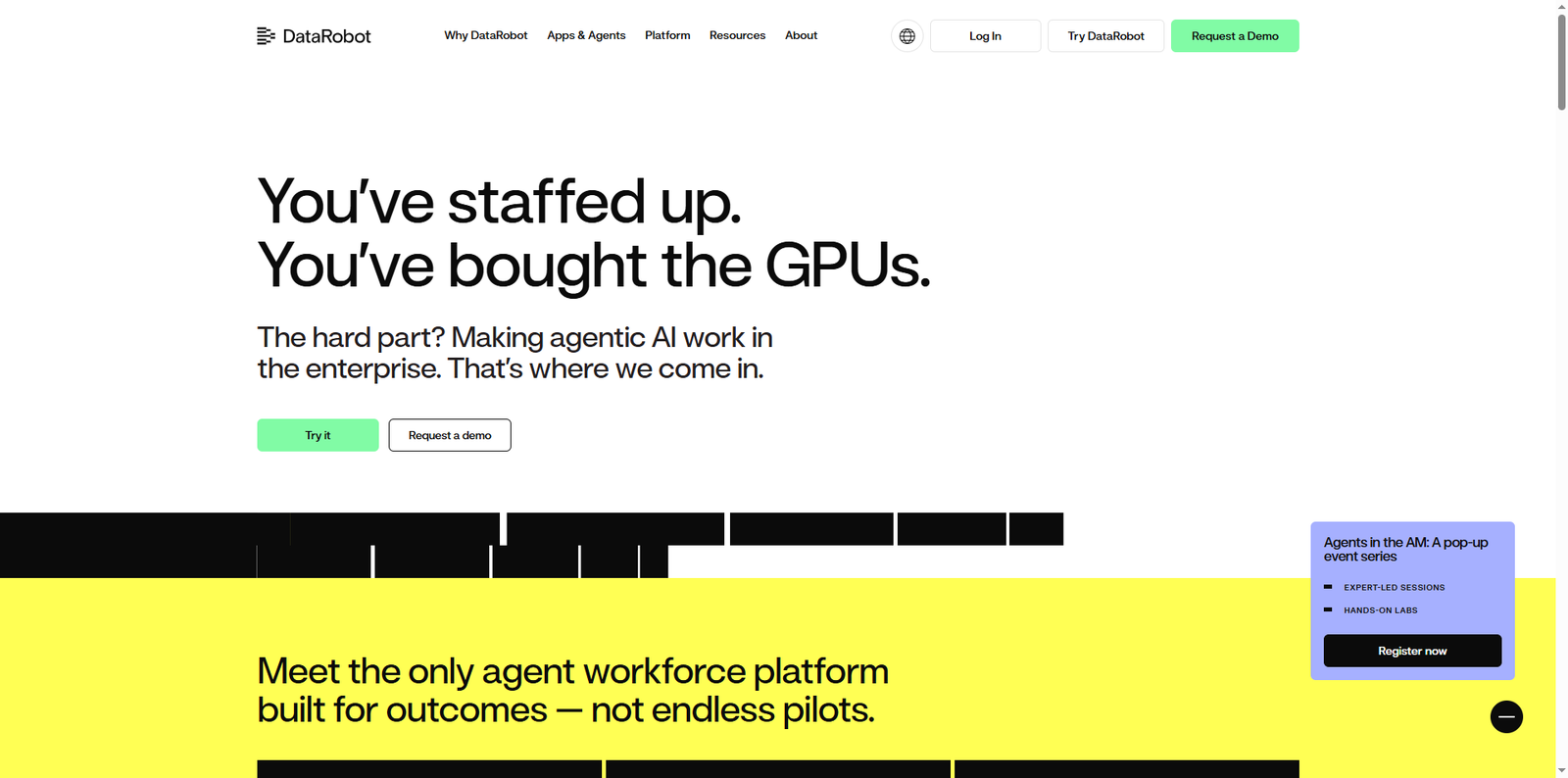
In the rapidly evolving world of artificial intelligence, enterprises face a growing challenge: how to operationalize AI at scale while maintaining security, compliance, and performance. DataRobot has emerged as a leader in solving this problem by introducing an Agentic AI approach—an innovative framework that allows organizations to build, deploy, and manage intelligent agents across diverse environments. Founded in 2012, DataRobot has evolved from an automated machine learning (AutoML) pioneer into a comprehensive AI lifecycle platform trusted by global enterprises such as Lenovo, United Airlines, and Deloitte.
Understanding Agentic AI and Its Enterprise Significance
Agentic AI refers to autonomous, goal-driven AI systems—called agents—that can perform complex tasks, make decisions, and adapt to dynamic business conditions. Unlike traditional AI models that require manual oversight, agentic AI systems are designed to act independently within defined parameters, improving efficiency and scalability. According to Gartner’s 2024 AI report, over 60% of enterprises plan to adopt agent-based AI systems by 2026, highlighting the growing importance of this paradigm.
Why Agentic AI Matters
- Autonomy: Agents can perform tasks without constant human intervention.
- Scalability: Enterprises can deploy multiple agents across departments and workflows.
- Adaptability: Agents continuously learn from data and adjust their behavior accordingly.
- Integration: They can connect with existing enterprise systems, such as ERP and CRM platforms.
Core Components of the DataRobot Agent Workforce Platform
DataRobot’s Agent Workforce Platform is designed to unify complex enterprise environments by enabling the creation, deployment, and management of AI agents. The platform supports on-premises, hybrid, and cross-cloud deployments, ensuring flexibility and compliance with enterprise IT policies.
Foundational Agents
These are pre-built, customizable agents that can be quickly integrated into existing business processes. They serve as the foundation for building specialized AI solutions tailored to organizational needs.
Business Agents
Business agents are designed to integrate seamlessly with enterprise systems like SAP, Salesforce, and ServiceNow. DataRobot’s collaboration with SAP allows these agents to operate natively within the SAP ecosystem, enhancing automation and decision-making capabilities.
Purpose-Built Agents
For organizations seeking end-to-end solutions, DataRobot offers service-led delivery of purpose-built agents. These agents are co-developed with clients to address specific use cases, such as predictive maintenance, fraud detection, or customer service automation.
Integration with Enterprise Ecosystems
One of DataRobot’s key differentiators is its ability to integrate across multiple enterprise ecosystems. The platform is co-engineered with NVIDIA, ensuring compatibility with NVIDIA Enterprise AI infrastructure for high-performance computing. This integration enables enterprises to leverage GPU acceleration for faster model training and inference.
Additionally, DataRobot’s certification within the SAP ecosystem allows organizations to embed AI agents directly into SAP workflows. This co-development ensures that AI-driven insights are accessible within familiar business applications, minimizing disruption and maximizing adoption.
How DataRobot Enhances AI Lifecycle Management
DataRobot’s platform supports every phase of the AI lifecycle—from data preparation to model deployment and monitoring. Its modular architecture allows teams to build agents using large language models (LLMs), embeddings, and other AI components tailored to specific use cases.
Building Agents
Developers can use customizable blueprints and built-in integrations to accelerate agent creation. The platform supports both low-code and pro-code environments, enabling collaboration between data scientists and business analysts.
Operating Agents
Once deployed, agents can be monitored in real time to ensure reliability and compliance. The platform includes tools for dynamic compute orchestration, allowing agents to run on the edge, in the cloud, or on-premises. Authentication and access controls ensure data security and governance.
Benefits of Adopting DataRobot in Enterprise Environments
Enterprises adopting DataRobot gain several strategic advantages:
- Unified AI Infrastructure: Consolidates disparate AI tools into a single, cohesive platform.
- Faster Time-to-Value: Enables rapid deployment of agents—often within days instead of months.
- Operational Efficiency: Reduces manual workload through intelligent automation.
- Cross-Cloud Flexibility: Supports hybrid and multi-cloud environments for maximum scalability.
- Security and Compliance: Built-in governance ensures adherence to enterprise data standards.
Comparison with Alternative AI Platforms
While DataRobot leads in agentic AI, several other platforms provide complementary capabilities. The table below compares DataRobot with a few notable alternatives.
| Platform | Primary Focus | Key Strength |
|---|---|---|
| Vertex AI | End-to-end ML development | Deep integration with Google Cloud ecosystem |
| Azure Machine Learning | Model training and deployment | Enterprise-grade security and compliance |
| Amazon SageMaker | ML model management | Comprehensive suite for data preparation and deployment |
| IBM watsonx | AI and data platform | Advanced governance and transparency features |
Real-World Applications and Industry Adoption
DataRobot’s agentic AI platform is transforming industries by enabling intelligent automation and predictive insights. In the financial sector, institutions use DataRobot agents to detect fraudulent transactions in real time. Healthcare organizations leverage predictive models to optimize patient outcomes and resource allocation. Manufacturing companies employ AI agents for predictive maintenance, reducing downtime and operational costs.
According to a 2023 Forrester study, enterprises using DataRobot reported a 40% reduction in model deployment time and a 25% improvement in operational efficiency. These metrics underscore the platform’s ability to deliver measurable business outcomes.
Challenges and Future Outlook
Despite its advantages, implementing agentic AI at scale presents challenges. Organizations must address issues related to data quality, model interpretability, and ethical AI governance. DataRobot continues to invest in research and partnerships to enhance transparency and trust in AI systems. The company’s collaboration with NVIDIA and SAP positions it at the forefront of enterprise AI innovation.
Looking ahead, DataRobot aims to expand its agentic AI capabilities by integrating generative AI models and reinforcement learning frameworks. These advancements will enable agents to handle increasingly complex tasks, from dynamic decision-making to autonomous process optimization.
Conclusion
DataRobot stands as a transformative force in the enterprise AI landscape. By pioneering the concept of an Agent Workforce Platform, it empowers organizations to move beyond isolated AI experiments toward scalable, outcome-driven automation. Its seamless integration with enterprise systems, robust lifecycle management, and cross-cloud flexibility make it a cornerstone for businesses seeking to harness the full potential of artificial intelligence. As enterprises continue to embrace agentic AI, DataRobot’s vision of a unified, intelligent workforce is poised to redefine how organizations operate in the digital era.