



Outline
- Introduction
- What is Dataiku?
- Why Enterprises Choose Dataiku
- Core Capabilities of Dataiku
- How Dataiku Supports the AI Lifecycle
- Real-World Applications and Case Studies
- Comparison with Alternative AI Platforms
- Future of Enterprise AI with Dataiku
- Conclusion
Introduction
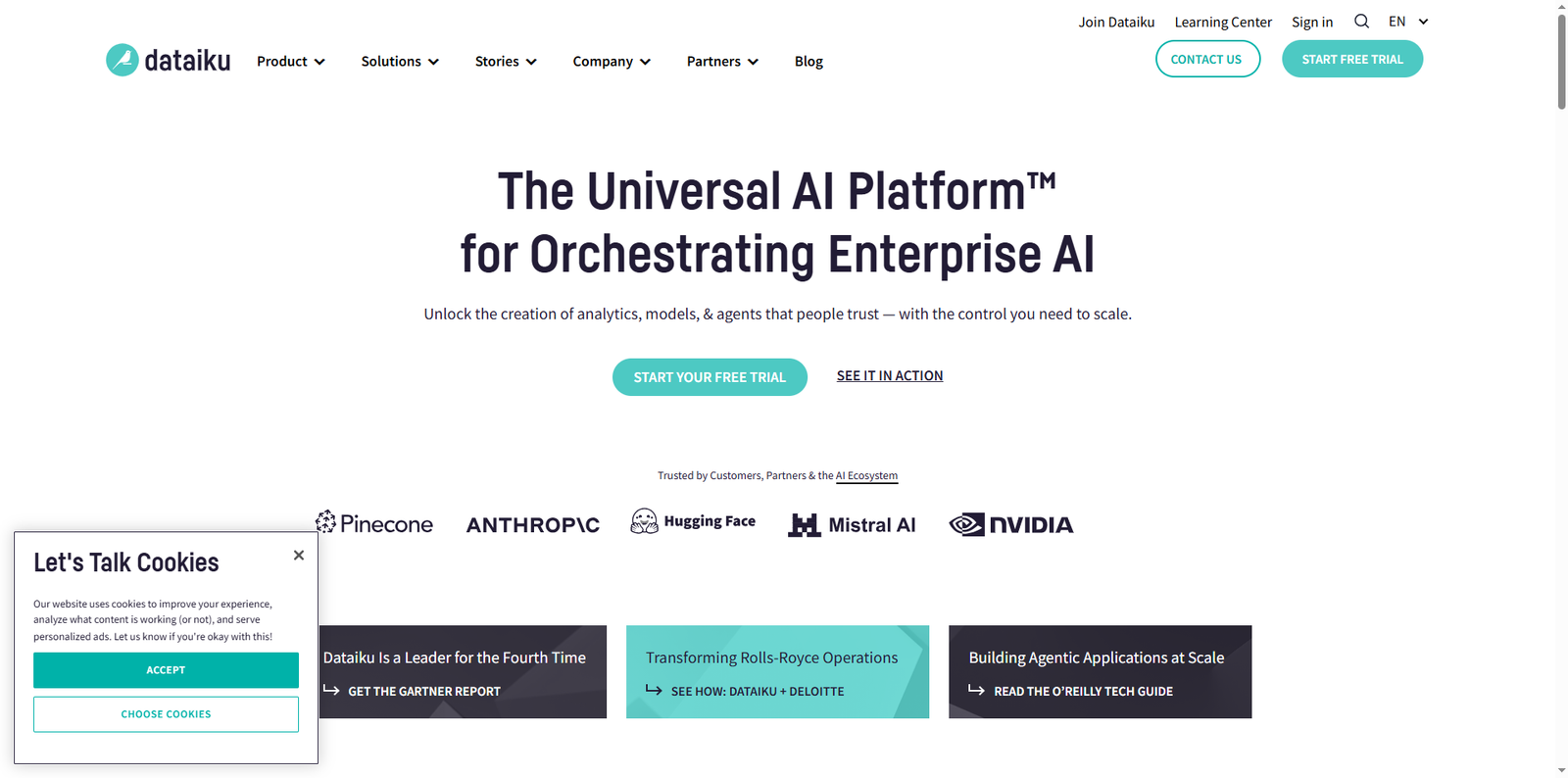
In today’s data-driven world, organizations are racing to harness artificial intelligence (AI) for competitive advantage. However, scaling AI initiatives across departments often proves challenging due to fragmented data systems, lack of collaboration, and governance issues. This is where Dataiku steps in — a platform designed to unify data science, machine learning, and analytics under one collaborative environment. Recognized by Gartner as a leader in AI and machine learning platforms for four consecutive years, Dataiku empowers enterprises to transform raw data into actionable insights efficiently and responsibly.
What is Dataiku?
Dataiku is an end-to-end AI and machine learning platform that enables organizations to design, deploy, and manage AI applications at scale. Founded in 2013, the company has grown rapidly, serving over 500 global enterprises, including industry leaders like Rolls-Royce, Unilever, and GE Aviation. The platform’s mission is to democratize data science by allowing both technical and non-technical users to collaborate seamlessly on data projects.
According to Dataiku’s official resources, the platform integrates data preparation, machine learning, analytics, and governance into a single environment. This unified approach helps teams move from experimentation to production faster while maintaining transparency and compliance.
Why Enterprises Choose Dataiku
Enterprises adopt Dataiku for its ability to orchestrate complex AI workflows while maintaining control and compliance. The platform supports a wide range of use cases, from predictive maintenance and customer segmentation to generative AI and intelligent automation. Some of the key reasons organizations choose Dataiku include:
- Collaboration: Dataiku bridges the gap between data scientists, analysts, and business users.
- Scalability: It supports enterprise-grade deployments across cloud and on-premise environments.
- Governance: Built-in governance ensures AI models are explainable, auditable, and compliant with regulations.
- Integration: Dataiku connects with popular data storage, visualization, and machine learning tools.
Core Capabilities of Dataiku
1. Data Preparation and Integration
Dataiku simplifies data preparation by allowing users to connect to multiple data sources, clean, and transform datasets visually or through code. The platform supports SQL, Python, R, and Spark, making it versatile for different technical backgrounds. Its data wrangling capabilities enable faster transitions from raw data to ready-to-use datasets for modeling or analytics.
2. Machine Learning and AutoML
Dataiku’s machine learning environment offers both guided and advanced modeling options. Users can leverage AutoML for quick model creation or dive deep into custom algorithms. The platform supports model explainability and performance tracking, ensuring transparency throughout the AI lifecycle.
3. Generative AI and Agents
With the rise of generative AI, Dataiku has expanded its capabilities to include large language model (LLM) integration. It provides a secure LLM gateway that allows enterprises to build, evaluate, and govern generative AI applications responsibly. This includes developing AI agents that automate workflows and enhance decision-making processes.
4. Analytics and Insights
Dataiku enhances business intelligence (BI) by enabling self-service analytics. Users can create dashboards, visualizations, and data stories powered by AI. This empowers decision-makers to act on real-time insights without relying solely on data teams.
5. Governance and Compliance
AI governance is a critical component of Dataiku’s platform. It ensures that all models and data pipelines adhere to ethical and regulatory standards. Features like model versioning, audit trails, and explainability reports help organizations maintain accountability and trust in their AI systems.
How Dataiku Supports the AI Lifecycle
Dataiku covers the entire AI lifecycle — from data ingestion to deployment and monitoring. Here’s how it aligns with each stage:
- Data Collection: Connects to diverse data sources, including cloud storage, databases, and APIs.
- Preparation: Cleanses and transforms data for analysis using visual recipes or code-based workflows.
- Modeling: Builds predictive models using AutoML or custom algorithms.
- Deployment: Deploys models into production environments with monitoring and retraining capabilities.
- Monitoring: Tracks performance metrics and ensures models remain accurate and unbiased over time.
Real-World Applications and Case Studies
Dataiku’s versatility is evident in its real-world applications across industries. For instance, Rolls-Royce uses Dataiku to optimize operations by analyzing engine performance data, leading to improved maintenance scheduling and reduced downtime. Similarly, Unilever leverages the platform to enhance demand forecasting and supply chain efficiency.
In the financial sector, Dataiku assists banks in detecting fraudulent transactions and assessing credit risk through predictive analytics. Healthcare organizations use it to analyze patient data for better diagnosis and treatment planning. These examples highlight how Dataiku enables data-driven transformation across diverse sectors.
Comparison with Alternative AI Platforms
While Dataiku stands out for its collaborative and governance-focused approach, several other platforms also offer robust AI capabilities. The table below compares Dataiku with some notable alternatives:
| Tool Name | Primary Focus | Best For |
|---|---|---|
| Databricks | Unified analytics and data engineering | Organizations needing large-scale data processing and ML integration |
| Vertex AI | Cloud-based AI model management | Enterprises leveraging Google Cloud infrastructure |
| Azure Machine Learning | End-to-end ML lifecycle management | Businesses using Microsoft Azure ecosystem |
| Snowflake AI | Data cloud with AI and ML capabilities | Companies focusing on data warehousing and real-time analytics |
Each of these platforms offers unique strengths, but Dataiku’s emphasis on collaboration, governance, and hybrid deployment options makes it particularly appealing for enterprises seeking a unified AI environment.
Future of Enterprise AI with Dataiku
The future of enterprise AI lies in democratization, automation, and trust. Dataiku is actively shaping this future by integrating generative AI capabilities and expanding its ecosystem partnerships. As organizations increasingly adopt AI-driven decision-making, platforms like Dataiku will play a pivotal role in ensuring responsible and scalable implementation.
Moreover, the platform’s continuous innovation in areas such as explainable AI (XAI) and MLOps positions it as a long-term partner for enterprises navigating digital transformation. With the rise of AI agents and automation, Dataiku’s approach to governance ensures that innovation does not come at the expense of accountability.
Conclusion
Dataiku has emerged as a cornerstone in the enterprise AI landscape, offering a comprehensive platform that unites data science, machine learning, and analytics. Its collaborative environment empowers teams to build, deploy, and manage AI solutions efficiently while maintaining transparency and compliance. From predictive modeling to generative AI, Dataiku enables organizations to harness the full potential of their data assets.
As businesses continue to embrace AI-driven transformation, platforms like Dataiku will remain essential for orchestrating scalable, trustworthy, and impactful AI initiatives. Whether you’re a data scientist, analyst, or business leader, adopting a unified platform like Dataiku can accelerate your journey toward becoming a truly data-powered enterprise.