



Outline
- Introduction
- What is Databricks?
- The Evolution of Data Intelligence
- Core Components of the Databricks Platform
- How Databricks Unifies Data, AI, and Governance
- Key Use Cases and Industry Applications
- Alternatives to Databricks
- Conclusion
Introduction
In today’s data-driven world, organizations are constantly seeking ways to unify data, analytics, and artificial intelligence (AI) to drive innovation and efficiency. Databricks has emerged as a leading platform that bridges the gap between data engineering, data science, and business intelligence. Founded in 2013 by the creators of Apache Spark, Databricks has evolved into a comprehensive Data Intelligence Platform that helps enterprises build and deploy AI applications securely and efficiently.
What is Databricks?
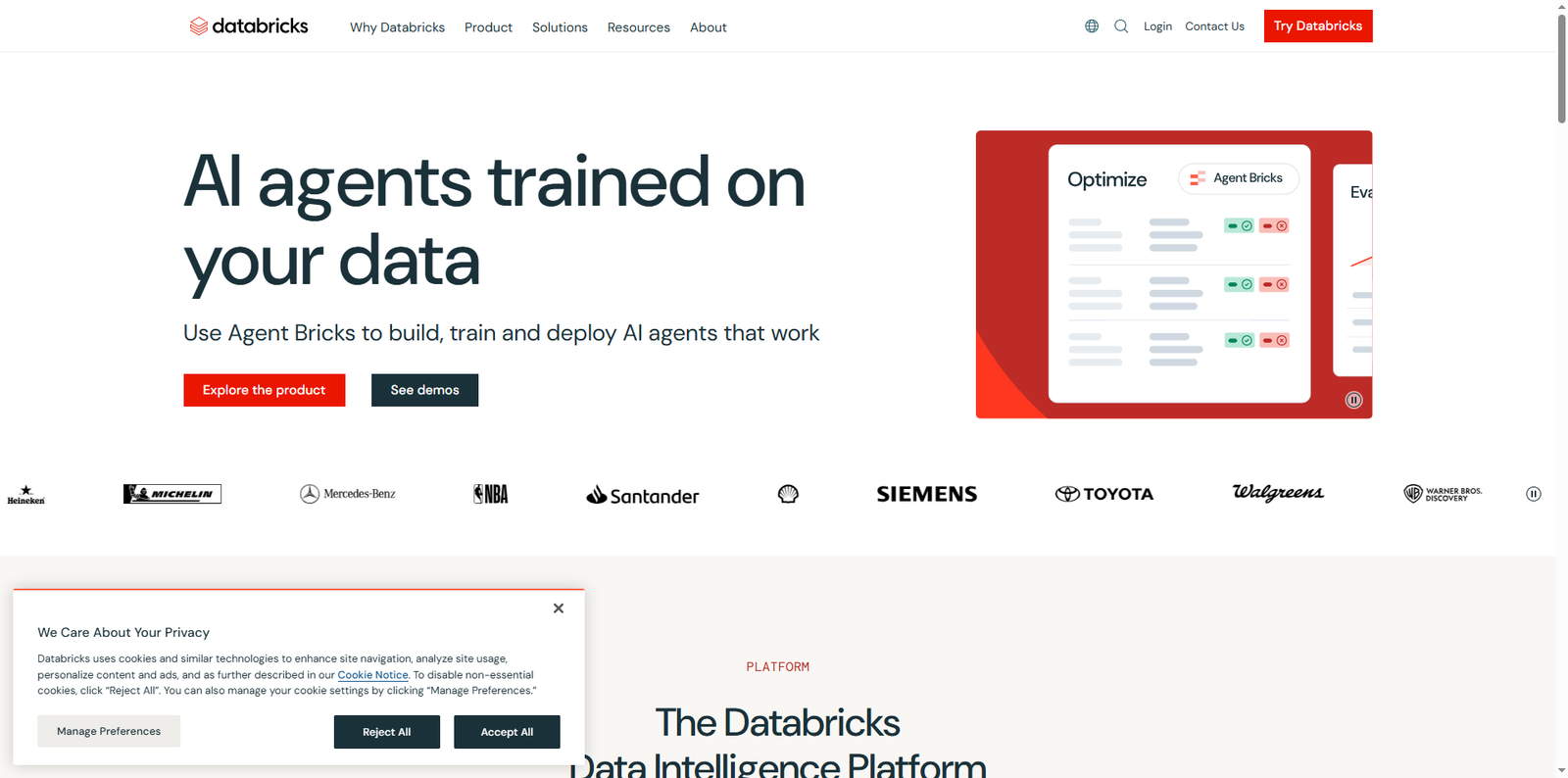
Databricks is a cloud-based platform designed to simplify data management and accelerate AI innovation. It integrates data engineering, machine learning, and analytics into a single collaborative environment. The platform enables teams to process massive datasets, train machine learning models, and deploy AI solutions without compromising data governance or privacy.
According to Databricks, its Data Intelligence Platform allows organizations to “bring AI to their data to help bring AI to the world.” This philosophy emphasizes the importance of having a unified data foundation to develop scalable and reliable AI systems.
The Evolution of Data Intelligence
Traditional data systems often operate in silos, making it difficult for organizations to extract meaningful insights. Databricks addresses this challenge by introducing the concept of a lakehouse architecture, which combines the best features of data lakes and data warehouses. This approach allows for real-time analytics, improved data governance, and seamless integration with AI workflows.
As of 2024, Databricks serves over 10,000 organizations globally, including major enterprises such as Shell, Comcast, and HSBC. The company’s focus on open-source technologies and interoperability has made it a preferred choice for enterprises transitioning to modern data architectures.
Core Components of the Databricks Platform
The Databricks platform consists of several interconnected layers that work together to deliver a unified data and AI experience:
1. Data Engineering
Databricks simplifies data ingestion, transformation, and orchestration. With built-in support for Apache Spark, it enables large-scale ETL (Extract, Transform, Load) operations and real-time data processing. Data engineers can automate workflows and ensure data quality across pipelines.
2. Machine Learning and AI
Data scientists can use Databricks to build, train, and deploy machine learning models efficiently. The platform supports popular frameworks such as TensorFlow, PyTorch, and scikit-learn. It also provides experiment tracking, model versioning, and automated governance to ensure compliance and reproducibility.
3. Data Governance
Governance is a critical aspect of any enterprise data strategy. Databricks offers a unified governance model that spans structured and unstructured data. This includes lineage tracking, access control, and compliance monitoring to maintain transparency and trust across the data lifecycle.
4. Collaboration and Productivity
Databricks fosters collaboration between data engineers, analysts, and business users through shared workspaces and notebooks. Teams can write code, visualize data, and document insights in real time, promoting a culture of data-driven decision-making.
How Databricks Unifies Data, AI, and Governance
One of the defining features of Databricks is its ability to unify data, AI, and governance within a single platform. This integration eliminates the need for multiple disconnected tools and ensures consistency across workflows.
Unified Data Management
Databricks integrates with major cloud providers such as AWS, Microsoft Azure, and Google Cloud, allowing organizations to centralize their data assets. The platform supports multiple data formats and sources, enabling seamless data sharing and collaboration across departments.
AI-Powered Insights
Through its Agent Bricks framework, Databricks empowers organizations to build intelligent AI agents that can interact with data using natural language. This democratizes access to insights, allowing non-technical users to query data and generate reports effortlessly.
End-to-End Governance
Databricks ensures that data privacy and compliance are maintained throughout the AI lifecycle. Features such as context-aware search, observability, and a single permission model simplify governance and reduce operational overhead.
Key Use Cases and Industry Applications
Databricks is used across a wide range of industries to solve complex data and AI challenges. Below are some of the most common applications:
1. Financial Services
Financial institutions use Databricks to detect fraud, assess risk, and optimize trading strategies. By integrating real-time analytics with machine learning, banks can make faster and more accurate decisions.
2. Healthcare and Life Sciences
In healthcare, Databricks supports genomic analysis, patient data management, and predictive modeling. Hospitals and research institutions leverage the platform to accelerate drug discovery and improve patient outcomes.
3. Retail and E-commerce
Retailers use Databricks to analyze customer behavior, personalize recommendations, and optimize supply chains. The platform’s ability to process large volumes of transactional data enables real-time decision-making and improved customer experiences.
4. Manufacturing
Manufacturers rely on Databricks for predictive maintenance, quality control, and supply chain optimization. By analyzing sensor and IoT data, they can identify potential issues before they impact production.
5. Public Sector
Government agencies use Databricks to enhance transparency, improve citizen services, and manage large-scale data initiatives. The platform’s scalability and security make it ideal for handling sensitive public data.
Alternatives to Databricks
While Databricks offers a robust and unified platform, several alternatives provide similar capabilities for data engineering and AI development. Below is a comparison of some popular alternatives:
| Alternative Tool | Description |
|---|---|
| BigQuery | Google’s serverless data warehouse that supports large-scale analytics and integrates with AI and ML tools in the Google Cloud ecosystem. |
| Amazon Redshift | A fully managed cloud data warehouse that enables fast query performance on large datasets and integrates with AWS analytics services. |
| Azure Synapse Analytics | Microsoft’s analytics service that combines big data and data warehousing for unified data integration and analysis. |
| Snowflake | A cloud-native data platform that supports multi-cloud environments and offers scalable data sharing and analytics capabilities. |
| Cloudera | An enterprise data platform that provides hybrid cloud data management and advanced analytics for large organizations. |
Conclusion
Databricks stands at the forefront of the data and AI revolution, offering a unified platform that simplifies complex workflows and accelerates innovation. By combining data engineering, machine learning, and governance into a single ecosystem, it empowers organizations to harness the full potential of their data. Whether it’s building generative AI models, ensuring compliance, or democratizing insights, Databricks provides the foundation for intelligent, data-driven enterprises.
As businesses continue to embrace AI and automation, platforms like Databricks will play a crucial role in shaping the future of digital transformation. For organizations seeking to unify their data strategy and drive measurable outcomes, Databricks represents not just a tool, but a strategic enabler of innovation and growth.