



Outline
- Introduction
- What is data.world?
- The Importance of Data Catalogs in Modern Enterprises
- How data.world Enhances Data Discovery and Governance
- Key Integrations and Ecosystem
- Real-World Applications and Case Studies
- Alternatives to data.world
- Conclusion
Introduction
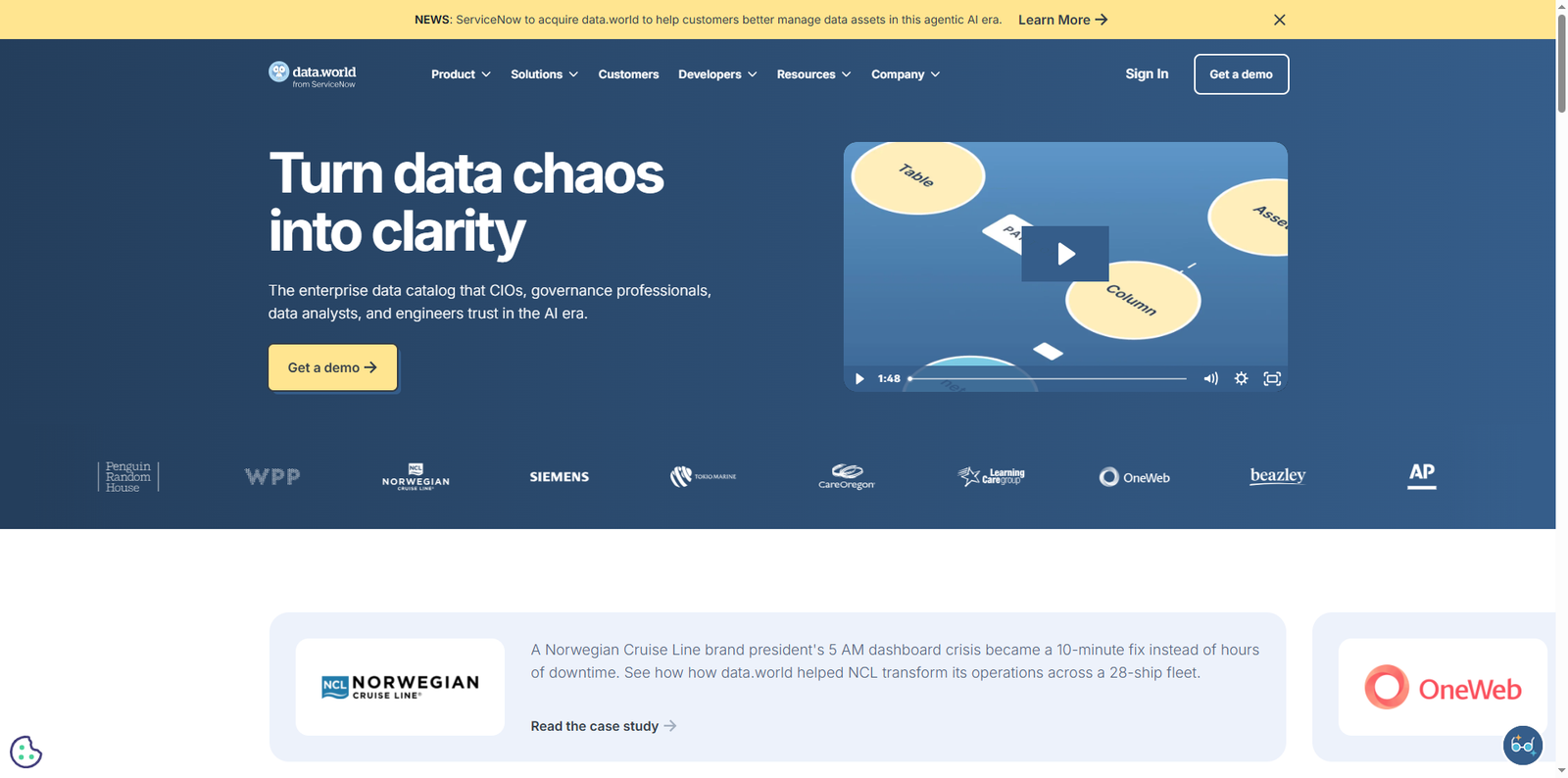
In today’s data-driven economy, organizations are generating more information than ever before. Managing, discovering, and governing this data efficiently is critical to achieving business agility and innovation. data.world has emerged as a leading data catalog platform that helps enterprises organize and operationalize their data assets. Recently, the platform gained even more attention when ServiceNow announced its acquisition of data.world to strengthen AI-driven data management capabilities. This move underscores the growing importance of intelligent data catalogs in the modern enterprise landscape.
What is data.world?
data.world is a cloud-native data catalog platform designed to help organizations discover, understand, and trust their data. Founded in 2015, the company has built a collaborative environment where data professionals can connect datasets, metadata, and insights across teams. The platform supports a semantic knowledge graph architecture, enabling users to link data assets contextually and derive meaningful relationships between them.
According to the company, data.world’s mission is to make data discovery as intuitive as possible, allowing users to find and use data quickly without technical barriers. The platform is widely used across industries such as financial services, healthcare, higher education, and government sectors.
The Importance of Data Catalogs in Modern Enterprises
As organizations scale their data operations, they often face challenges related to data silos, inconsistent governance, and lack of visibility. A data catalog acts as a centralized repository that indexes all data assets, making them searchable and easier to manage. This is especially crucial in the era of AI and machine learning, where data quality and accessibility directly impact model performance and business outcomes.
According to Gartner, by 2025, 80% of organizations seeking to scale digital business will fail because they do not take a modern approach to data governance. This statistic highlights the need for platforms like data.world that combine governance, discovery, and collaboration in one ecosystem.
How data.world Enhances Data Discovery and Governance
1. Collaborative Data Environment
data.world promotes collaboration by allowing teams to share datasets, queries, and insights in real time. This fosters a culture of transparency and shared understanding across departments. Users can annotate datasets, document lineage, and add business context, ensuring that everyone interprets data consistently.
2. Knowledge Graph Architecture
At the core of data.world lies its knowledge graph technology, which connects data assets through semantic relationships. This approach helps users discover related datasets and understand how data flows through the organization. It also supports automated metadata enrichment, improving both accuracy and efficiency in data management.
3. Governance and Compliance
With increasing regulatory requirements such as GDPR and CCPA, maintaining proper data governance is essential. data.world provides tools for tracking data lineage, managing access permissions, and ensuring compliance. Its governance framework allows organizations to define policies and monitor adherence across the data lifecycle.
4. Integration with Modern Data Stack
data.world integrates seamlessly with popular data platforms, enabling users to connect their existing tools without disrupting workflows. This interoperability is a key differentiator, as it allows enterprises to unify their data ecosystem under a single catalog interface.
Key Integrations and Ecosystem
data.world supports a wide range of integrations with leading data management and analytics platforms. These integrations enable users to connect, query, and visualize data from multiple sources efficiently. Some of the most common integrations include:
- Snowflake
- Oracle Database
- PostgreSQL
- Databricks
- Dremio
These integrations make it easier for data engineers and analysts to access governed data directly within their preferred tools, streamlining workflows and improving productivity.
Real-World Applications and Case Studies
1. Financial Services
In the financial sector, data.world helps institutions manage complex datasets related to transactions, risk assessments, and compliance. By cataloging and linking data assets, financial analysts can quickly identify trends and anomalies, improving decision-making and regulatory reporting.
2. Healthcare
Healthcare organizations use data.world to unify patient data, research findings, and clinical trial information. This unified view enhances collaboration between researchers and clinicians, leading to faster insights and improved patient outcomes. The platform’s governance capabilities also ensure compliance with healthcare data privacy regulations.
3. Higher Education
Universities and research institutions leverage data.world to manage academic datasets, research outputs, and institutional metrics. By enabling open data sharing, the platform fosters collaboration among researchers and supports reproducible science initiatives.
4. Government and Public Sector
Government agencies use data.world to promote transparency and data-driven policymaking. By cataloging public datasets, agencies can make information more accessible to citizens, researchers, and policymakers. This approach supports evidence-based governance and enhances public trust.
Alternatives to data.world
While data.world is a powerful platform, several other tools also offer robust data catalog and governance capabilities. Below is a comparison table of popular alternatives that organizations may consider:
| Tool Name | Description |
|---|---|
| Alation | A widely adopted data catalog platform that focuses on data governance, stewardship, and collaboration across enterprise environments. |
| Collibra | Provides a comprehensive data intelligence platform that helps organizations manage data governance, privacy, and quality at scale. |
| Atlan | Known for its modern user experience and collaborative data workspace, Atlan integrates seamlessly with cloud data warehouses and BI tools. |
| Informatica | Offers enterprise-grade data management solutions, including metadata management and governance capabilities for large organizations. |
| Talend | Combines data integration and governance features, enabling organizations to ensure data reliability and accessibility across systems. |
Conclusion
As enterprises continue to embrace digital transformation and AI-driven decision-making, the need for a unified, intelligent data catalog becomes increasingly vital. data.world stands out as a platform that not only organizes and governs data but also fosters collaboration and knowledge sharing across teams. Its semantic knowledge graph, integration capabilities, and governance framework make it a valuable asset for organizations seeking to maximize the value of their data.
The recent acquisition by ServiceNow signals a new chapter for data.world, potentially expanding its capabilities within enterprise ecosystems. Whether you are a data engineer, analyst, or governance professional, adopting a modern data catalog like data.world can significantly enhance your organization’s ability to manage and leverage data effectively. For those exploring alternatives, platforms such as Alation and Collibra also offer strong solutions tailored to diverse business needs.
In conclusion, data.world exemplifies the future of data management—intelligent, collaborative, and built for the AI era. Organizations that invest in such platforms are better positioned to unlock insights, ensure compliance, and drive innovation through data.