




Outline
- Introduction
- What Is ClickHouse?
- How ClickHouse Works
- Why ClickHouse Is So Fast
- Key Use Cases Across Industries
- Integration and Ecosystem
- Alternatives to ClickHouse
- Conclusion
Introduction
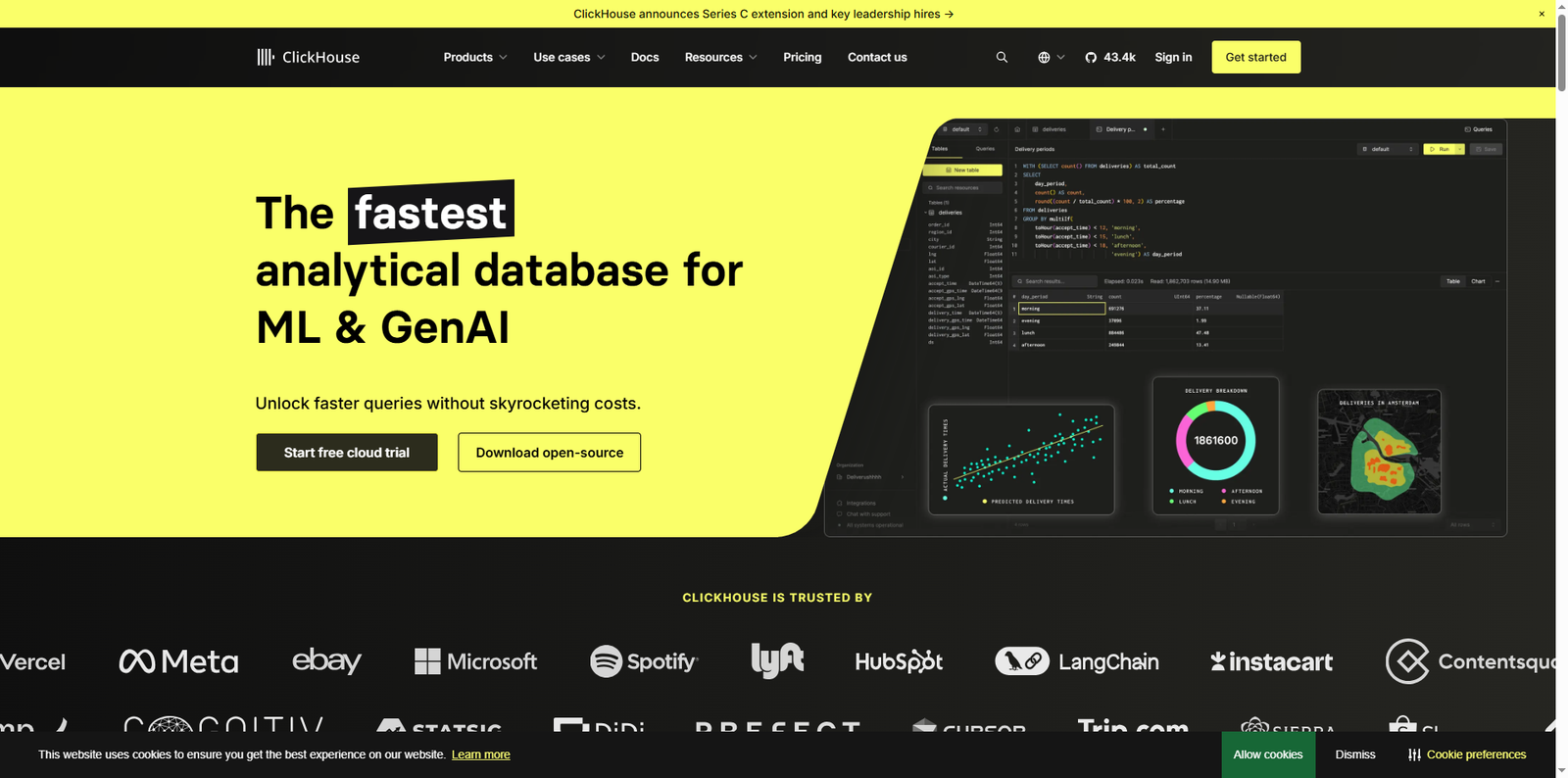
In today’s data-driven world, organizations need to process and analyze massive volumes of information in real time. Traditional databases often struggle to keep up with the demands of modern analytics, especially when dealing with large-scale datasets. ClickHouse has emerged as a leading open-source analytical database designed to handle these challenges efficiently. Trusted by global enterprises like Sony, Lyft, Tesla, Cisco, and GitLab, ClickHouse enables businesses to unlock faster queries, reduce costs, and build scalable real-time data products.
What Is ClickHouse?
ClickHouse is an open-source, column-oriented database management system (DBMS) optimized for online analytical processing (OLAP). Originally developed by Yandex, it is now maintained by an active community and the ClickHouse Inc. team. The platform is designed to deliver high-performance analytics on large datasets while maintaining cost efficiency and simplicity.
Unlike traditional row-based databases, ClickHouse stores data by columns, making it ideal for analytical queries that aggregate large amounts of data. This architecture allows it to process billions of rows per second, providing near-instant query responses even on petabyte-scale datasets.
How ClickHouse Works
ClickHouse’s architecture is built around the principle of maximizing hardware utilization. It leverages all available CPU cores, memory, and disk I/O to execute queries in parallel. The system uses vectorized query execution, advanced compression algorithms, and data skipping indexes to minimize the amount of data read from disk.
Columnar Storage
In a column-oriented database like ClickHouse, data is stored in columns rather than rows. This structure allows for efficient compression and faster aggregation since only the relevant columns are read during query execution.
Compression and Encoding
ClickHouse employs sophisticated compression codecs that significantly reduce storage requirements. This not only saves disk space but also accelerates data retrieval by minimizing I/O operations.
Parallel Processing
ClickHouse executes queries in parallel across multiple CPU cores and nodes, ensuring optimal performance even under heavy workloads. This distributed processing capability makes it suitable for large-scale analytics and real-time dashboards.
Why ClickHouse Is So Fast
The exceptional speed of ClickHouse stems from its columnar architecture and efficient use of system resources. In traditional row-oriented databases, data from multiple columns must be read together, even if only one column is needed. ClickHouse avoids this inefficiency by reading only the necessary columns, drastically reducing I/O overhead.
Additionally, ClickHouse supports vectorized execution, where operations are performed on batches of data rather than individual rows. This approach enhances CPU efficiency and reduces latency. Benchmarks have shown that ClickHouse can outperform other analytical databases by up to 100 times in certain workloads, making it one of the fastest OLAP systems available.
Key Use Cases Across Industries
ClickHouse’s versatility and performance make it suitable for a wide range of applications. Below are some of the most common use cases:
- Real-Time Analytics: Companies use ClickHouse to power interactive dashboards and monitoring systems that require instant insights from streaming data.
- Business Intelligence (BI): Organizations integrate ClickHouse with BI tools to analyze historical and real-time data for strategic decision-making.
- Observability and Monitoring: ClickHouse is widely adopted for observability platforms, enabling engineers to analyze logs, metrics, and traces at scale.
- Machine Learning and AI: Data scientists leverage ClickHouse to preprocess large datasets for machine learning pipelines and model training.
- Financial Services: Banks and fintech companies use ClickHouse for fraud detection, risk analysis, and transaction monitoring.
- Gaming and E-Commerce: ClickHouse supports analytics for user engagement, in-game metrics, and personalized recommendations.
Integration and Ecosystem
ClickHouse offers a rich ecosystem of integrations that make it easy to connect with various data ingestion, visualization, and orchestration tools. It supports standard SQL queries, making it accessible to developers and analysts familiar with relational databases. The platform integrates seamlessly with data visualization tools like Grafana and Tableau, as well as data ingestion frameworks such as Apache Kafka and Airbyte.
ClickHouse also provides native connectors for programming languages including Python, Go, and Java, enabling developers to build custom applications and analytics pipelines. Its open-source nature encourages community contributions and continuous innovation, ensuring that the platform evolves alongside modern data infrastructure needs.
Integration Highlights
- Data Ingestion: Connects with Kafka, Airbyte, and Debezium for real-time data streaming.
- Visualization: Works with Grafana, Tableau, and Superset for interactive dashboards.
- ETL and Orchestration: Compatible with Apache Airflow and dbt for data transformation and workflow automation.
- Machine Learning: Integrates with frameworks like TensorFlow and PyTorch for data preprocessing and model serving.
Alternatives to ClickHouse
While ClickHouse is a powerful solution for analytical workloads, several other tools offer similar capabilities. The choice often depends on specific use cases, infrastructure preferences, and scalability requirements. Below is a comparison of popular alternatives:
| Tool Name | Description |
|---|---|
| Apache Druid | A high-performance, column-oriented, distributed data store designed for real-time analytics on large datasets. |
| Snowflake | A cloud-based data warehouse that offers elastic scaling and seamless integration with major cloud providers. |
| Google BigQuery | A fully managed, serverless data warehouse that enables super-fast SQL queries using Google’s infrastructure. |
| Amazon Redshift | A scalable cloud data warehouse service optimized for complex analytical queries and large-scale data processing. |
| Databricks | A unified analytics platform that combines data engineering, machine learning, and collaborative analytics in one environment. |
Conclusion
ClickHouse stands out as a groundbreaking solution for organizations seeking real-time, high-performance analytics. Its columnar architecture, efficient compression, and parallel processing capabilities make it one of the fastest analytical databases available today. From powering observability platforms to enabling advanced machine learning pipelines, ClickHouse provides the scalability and flexibility modern data teams require.
As data continues to grow exponentially, the need for efficient, cost-effective analytical systems becomes even more critical. ClickHouse not only meets these demands but also fosters innovation through its open-source community and extensive integration ecosystem. Whether you are building a real-time analytics dashboard, optimizing business intelligence workflows, or developing AI-driven applications, ClickHouse offers the performance foundation to turn data into actionable insights.