




Outline
- Introduction
- What Was Chartio?
- Why Chartio Stood Out in the BI Landscape
- Chartio’s Role in Democratizing Data
- Transition After Chartio’s Acquisition
- Top Alternatives to Chartio
- How to Choose the Right BI Tool
- Conclusion
Introduction
Data visualization has become a cornerstone of modern business intelligence (BI). Among the platforms that shaped this evolution, Chartio stood out as a pioneer in simplifying complex data analysis. Although Chartio was officially acquired by Atlassian in 2021 and later sunset, its influence continues to inspire new generations of BI tools. This article explores Chartio’s legacy, its contribution to data democratization, and the best alternatives available today for businesses seeking powerful, user-friendly analytics solutions.
What Was Chartio?
Chartio was a cloud-based business intelligence platform designed to make data exploration accessible to everyone, regardless of technical expertise. Founded in 2010 by Dave Fowler, Chartio aimed to bridge the gap between data analysts and business users by offering an intuitive drag-and-drop interface for building dashboards and reports. The platform connected seamlessly with a wide range of databases and cloud services, enabling users to visualize data from multiple sources in real time.
By 2020, Chartio had established itself as a trusted BI solution for companies like Shazam, Squarespace, and Udemy. Its mission was clear: to empower teams to make data-driven decisions without relying heavily on engineering resources. This vision resonated strongly with startups and mid-sized companies looking for agility in their analytics workflows.
Why Chartio Stood Out in the BI Landscape
Chartio’s success stemmed from its focus on usability and flexibility. Unlike traditional BI tools that required extensive setup and SQL expertise, Chartio offered a visual query builder that allowed users to create complex queries through an intuitive interface. This approach democratized data analysis, enabling marketers, product managers, and executives to explore insights independently.
Key Advantages of Chartio’s Approach
- Ease of Use: The drag-and-drop interface minimized the learning curve, making it accessible to non-technical users.
- Real-Time Data Connectivity: Chartio connected directly to live databases, ensuring that dashboards always reflected the latest information.
- Collaboration: Teams could share dashboards and insights effortlessly, promoting transparency and data-driven culture.
- Customization: Users could tailor visualizations to match their unique reporting needs, from simple bar charts to complex multi-source dashboards.
These features positioned Chartio as a flexible and scalable BI solution that could adapt to diverse business environments.
Chartio’s Role in Democratizing Data
Before platforms like Chartio, data analysis was often confined to specialized teams with technical expertise. Chartio disrupted this model by making data accessible across departments. Its visual query builder allowed users to interact with data without writing SQL, while still offering advanced users the option to dive deeper with custom queries. This dual approach empowered organizations to foster a culture where decisions were guided by data rather than intuition.
According to Atlassian’s announcement following the acquisition, Chartio’s technology and philosophy were integrated into Atlassian’s ecosystem to enhance data visualization capabilities across tools like Jira and Confluence. This integration underscored the growing importance of embedded analytics in collaborative software environments.
Transition After Chartio’s Acquisition
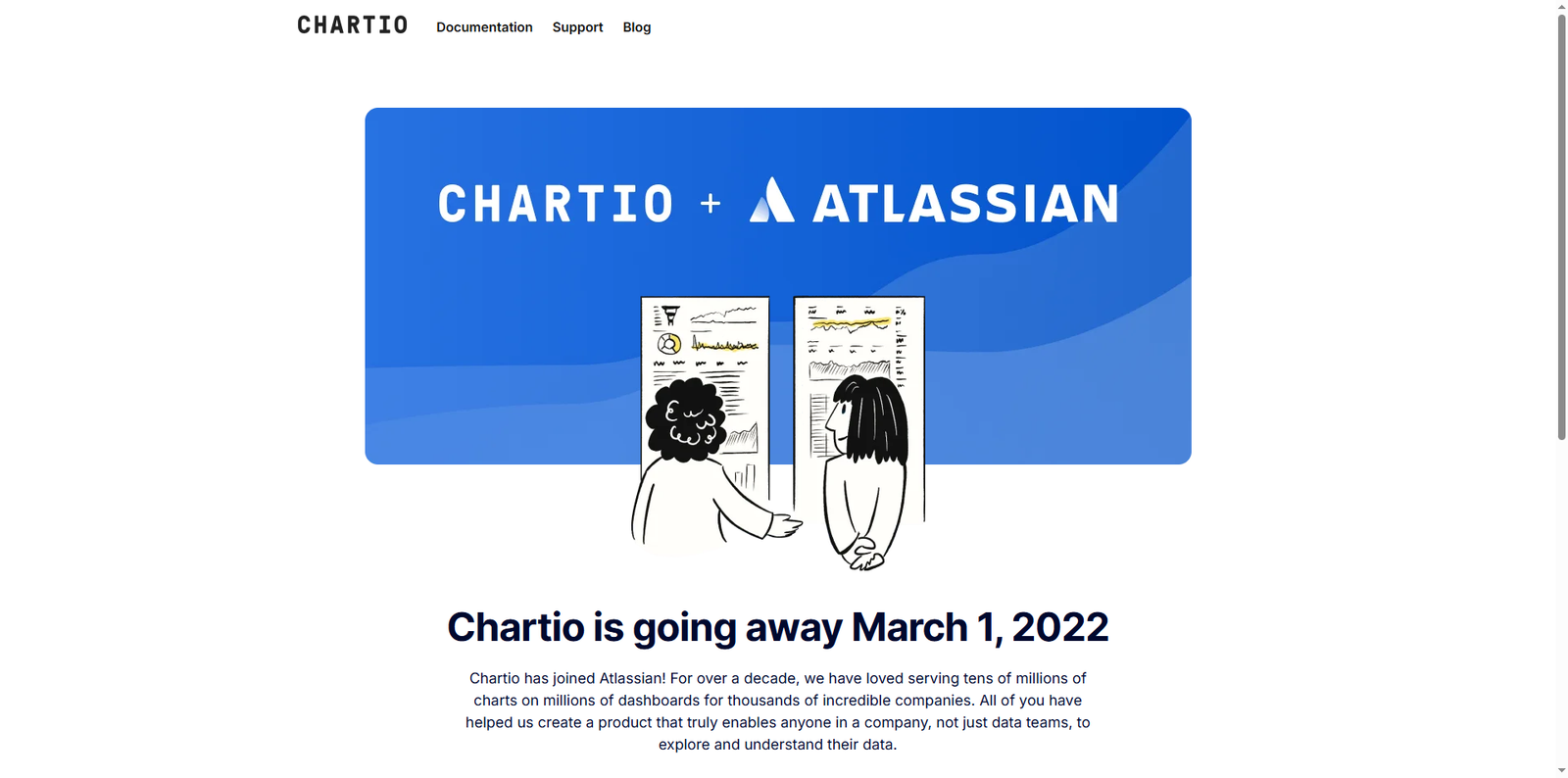
In February 2021, Atlassian announced its acquisition of Chartio, marking a significant milestone in the BI industry. The goal was to integrate Chartio’s visualization technology into Atlassian’s suite of products, enhancing data accessibility for teams worldwide. However, by March 2022, Chartio was officially discontinued as a standalone product. While this marked the end of an era, it also opened opportunities for users to explore new BI tools that continued Chartio’s mission of simplifying data analytics.
Many former Chartio users transitioned to other platforms that offered similar capabilities, focusing on ease of use, scalability, and integration with modern data stacks. The BI landscape has since evolved rapidly, with numerous tools emerging to fill the gap left by Chartio’s departure.
Top Alternatives to Chartio
For businesses seeking to replace Chartio or explore modern BI solutions, several alternatives provide comparable or enhanced functionality. Below is a table highlighting some of the most popular options available today.
| Tool Name | Description |
|---|---|
| Looker | A Google Cloud-based BI platform that offers powerful data modeling and embedded analytics capabilities, ideal for enterprises seeking deep integration with cloud ecosystems. |
| Tableau | Known for its advanced visualization capabilities, Tableau enables users to create interactive dashboards and share insights across teams effortlessly. |
| Power BI | Microsoft’s BI solution integrates seamlessly with Office 365 and Azure, providing robust analytics and visualization tools for organizations of all sizes. |
| Metabase | An open-source BI tool that allows teams to query data easily and build dashboards without coding, making it a great choice for startups and small businesses. |
| Mode | Combines SQL, Python, and R in a collaborative environment, enabling data teams to perform advanced analytics and share insights efficiently. |
How to Choose the Right BI Tool
Selecting the right BI platform depends on several factors, including organizational goals, data infrastructure, and user expertise. Below are key considerations to guide the decision-making process:
- Ease of Use: Choose a platform that matches your team’s technical proficiency. Tools like Metabase or Power BI are ideal for non-technical users, while Mode or Looker cater to more advanced analysts.
- Integration Capabilities: Ensure the BI tool integrates smoothly with your existing databases, cloud services, and data warehouses.
- Scalability: As your organization grows, the BI platform should handle increasing data volumes and user demands without performance issues.
- Collaboration Features: Look for tools that promote teamwork through shared dashboards, version control, and embedded analytics.
- Security and Compliance: Data governance is critical. Verify that the platform adheres to industry standards for data protection and privacy.
By evaluating these factors, businesses can identify a BI solution that aligns with their strategic objectives and technical environment.
Emerging Trends in Business Intelligence
The BI landscape continues to evolve, driven by advancements in artificial intelligence and machine learning. Modern tools are increasingly incorporating predictive analytics, natural language queries, and automated insights. These innovations reduce the barrier to entry for non-technical users and enhance the speed of decision-making. Additionally, the rise of cloud-native BI platforms has made data analytics more accessible, scalable, and cost-efficient.
Organizations are also prioritizing self-service analytics, enabling employees at all levels to explore data independently. This shift reflects Chartio’s original vision—empowering everyone to make data-driven decisions without relying solely on data teams.
Conclusion
Chartio’s legacy in the world of business intelligence remains significant. By simplifying data visualization and empowering non-technical users, it set a new standard for accessibility and collaboration in analytics. Although Chartio is no longer available as a standalone product, its influence persists through modern BI tools that continue to build upon its foundational principles. Whether you choose Looker, Tableau, Power BI, Metabase, or Mode, the goal remains the same: to transform raw data into actionable insights that drive smarter business decisions.
As the BI industry continues to evolve, the spirit of Chartio lives on in every platform that strives to make data exploration intuitive, collaborative, and impactful. Businesses that embrace these modern tools can carry forward Chartio’s mission—turning data into a strategic advantage for growth and innovation.