


Outline
- Introduction
- What is C3.ai?
- How C3.ai Works
- Key Industry Applications
- Benefits of Using C3.ai
- Alternatives to C3.ai
- Real-World Case Studies
- Challenges and Considerations
- Future of Enterprise AI with C3.ai
- Conclusion
Introduction
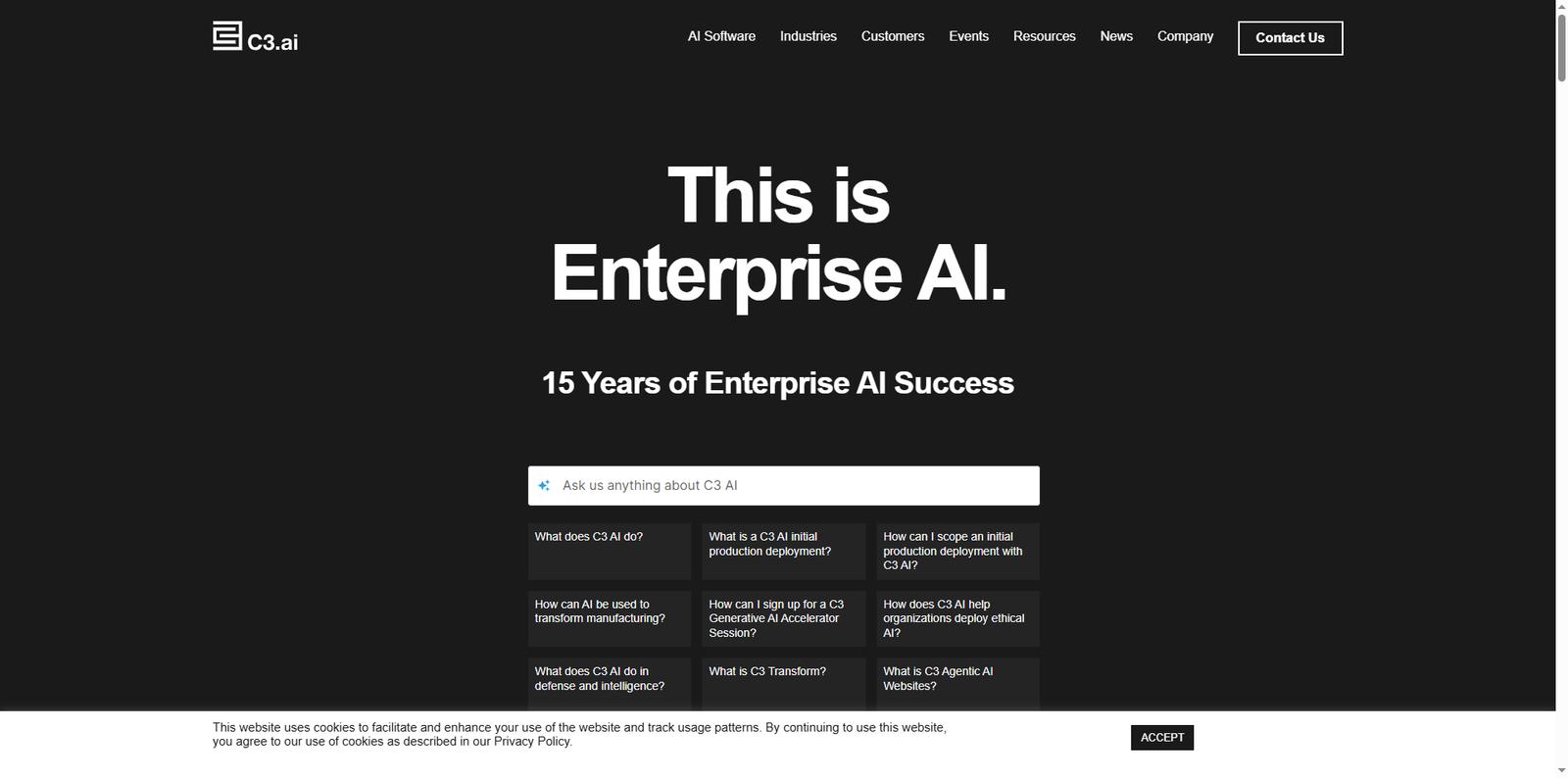
Artificial intelligence (AI) has become a transformative force across industries, and C3.ai stands at the forefront of this revolution. Founded in 2009 by Thomas Siebel, C3.ai has evolved into one of the leading enterprise AI software providers, enabling organizations to harness the power of predictive analytics, machine learning, and IoT data integration. As of 2024, C3.ai continues to expand its footprint across sectors such as energy, manufacturing, defense, and healthcare, driving digital transformation at scale.
What is C3.ai?
C3.ai is an enterprise AI software platform that provides tools and applications for developing, deploying, and operating large-scale AI, predictive analytics, and IoT solutions. The company’s mission is to accelerate digital transformation by simplifying the process of building AI-driven applications. C3.ai’s platform integrates data from disparate sources, applies advanced analytics, and delivers actionable insights that help organizations optimize operations and improve decision-making.
Company Overview
Headquartered in Redwood City, California, C3.ai has established partnerships with major technology players such as Microsoft, Google Cloud, and Amazon Web Services. The company’s AI Suite is designed to support a wide range of use cases, from predictive maintenance to fraud detection and supply chain optimization. According to company reports, C3.ai’s technology can reduce AI application development time by up to 90%, making it one of the most efficient enterprise AI platforms available today.
How C3.ai Works
The C3.ai platform operates as a model-driven architecture that allows developers and data scientists to build AI applications rapidly. It integrates data from multiple sources—structured and unstructured—and provides a unified data image that supports machine learning model development and deployment.
Core Components
- Data Integration: C3.ai connects to enterprise systems, IoT devices, and cloud databases to aggregate data in real time.
- AI and Machine Learning: The platform supports supervised and unsupervised learning models, enabling predictive analytics and anomaly detection.
- Application Development: Developers can use pre-built modules and templates to accelerate the creation of AI applications.
- Scalability: C3.ai’s cloud-native architecture ensures scalability across large enterprise environments.
Key Industry Applications
C3.ai’s versatility allows it to be applied across multiple industries. Below are some of the most prominent sectors leveraging its technology:
Energy and Utilities
In the energy sector, C3.ai helps companies optimize production, reduce equipment downtime, and improve sustainability. For example, oil and gas companies use C3.ai’s predictive maintenance models to anticipate equipment failures, saving millions in operational costs.
Manufacturing
Manufacturers use C3.ai to enhance supply chain visibility, predict equipment failures, and improve product quality. By analyzing sensor data, the platform enables predictive maintenance and process optimization.
Financial Services
Financial institutions leverage C3.ai for fraud detection, risk management, and customer analytics. The platform’s AI-driven insights help banks identify suspicious activity and improve compliance.
Healthcare
In healthcare, C3.ai supports predictive diagnostics, patient outcome forecasting, and operational efficiency. Hospitals and research institutions use it to analyze large datasets, improving patient care and reducing costs.
Benefits of Using C3.ai
Organizations adopting C3.ai gain several advantages that enhance their digital transformation journey:
- Accelerated AI Deployment: Pre-built models and templates reduce development time.
- Data Unification: Seamless integration of multiple data sources into a single, coherent dataset.
- Operational Efficiency: Predictive analytics help identify inefficiencies and optimize performance.
- Scalability and Flexibility: Cloud-based architecture supports enterprise-scale operations.
- Enhanced Decision-Making: Real-time insights empower leaders to make data-driven decisions.
Alternatives to C3.ai
While C3.ai is a leading player in the enterprise AI market, several other platforms offer similar capabilities. Below is a comparison table of notable alternatives:
| Alternative Tool | Description |
|---|---|
| Vertex AI | Google Cloud’s managed machine learning platform that enables developers to build, deploy, and scale AI models efficiently. |
| Azure Machine Learning | Microsoft’s cloud-based environment for training, deploying, and managing AI models with integrated MLOps capabilities. |
| Amazon SageMaker | A comprehensive service from AWS that provides tools for building, training, and deploying machine learning models at scale. |
| IBM Watson Studio | IBM’s AI and data science platform that supports collaborative model development and deployment. |
Real-World Case Studies
C3.ai’s technology has been adopted by several global enterprises to address complex challenges. Below are a few examples:
Shell
Shell uses C3.ai to enhance predictive maintenance across its global operations. By analyzing sensor data from equipment, Shell can predict potential failures and schedule maintenance proactively, reducing downtime and operational costs.
U.S. Air Force
The U.S. Air Force partnered with C3.ai to improve aircraft readiness through predictive analytics. The AI models developed on the platform analyze maintenance data to forecast component failures, improving mission readiness and safety.
ENGIE
ENGIE, a global energy company, leverages C3.ai to optimize energy consumption and reduce carbon emissions. The platform’s analytics help identify inefficiencies and support the company’s sustainability goals.
Challenges and Considerations
Despite its advantages, implementing C3.ai comes with certain challenges that organizations should consider:
- Complex Integration: Integrating legacy systems and diverse data sources can require significant effort.
- Skill Requirements: Effective use of the platform demands expertise in data science and machine learning.
- Change Management: Adopting AI-driven workflows may require organizational restructuring and training.
- Data Governance: Ensuring data quality and compliance with regulations such as GDPR is critical.
Future of Enterprise AI with C3.ai
As AI adoption accelerates, C3.ai is poised to play a pivotal role in shaping the next generation of intelligent enterprises. The company continues to invest in research and development, focusing on enhancing automation, improving model accuracy, and expanding industry-specific applications. With the rise of generative AI and edge computing, C3.ai’s platform is expected to evolve further, offering even more powerful tools for real-time analytics and decision-making.
Moreover, C3.ai’s collaboration with major cloud providers ensures that its solutions remain accessible and scalable. As organizations increasingly prioritize sustainability and efficiency, AI-driven insights from platforms like C3.ai will become indispensable for achieving operational excellence.
Conclusion
C3.ai represents a significant leap forward in enterprise AI, offering a robust and scalable platform that empowers organizations to harness the full potential of artificial intelligence. Its ability to unify data, streamline AI development, and deliver actionable insights makes it a cornerstone of digital transformation strategies across industries. While challenges such as integration complexity and skill requirements exist, the long-term benefits far outweigh the initial hurdles. As businesses continue to embrace AI-driven innovation, C3.ai stands as a trusted partner in building a smarter, more efficient, and sustainable future.