



Outline
- Introduction
- Understanding BigML and Its Purpose
- How BigML Works
- Core Functionalities and Capabilities
- Applications of BigML Across Industries
- Advantages of Using BigML
- Alternatives to BigML
- Getting Started with BigML
- Conclusion
Introduction
In the modern era of data-driven decision-making, machine learning (ML) has become a cornerstone for innovation and efficiency. However, implementing ML solutions often requires significant technical expertise and resources. BigML bridges this gap by offering a user-friendly platform that simplifies the entire machine learning process—from data preparation to model deployment. Founded in 2011, BigML has grown into one of the most accessible ML platforms, empowering organizations of all sizes to harness the power of predictive analytics without the need for deep programming knowledge.
Understanding BigML and Its Purpose
BigML is a cloud-based machine learning platform designed to make ML accessible to everyone. It provides a comprehensive suite of tools for data analysis, model training, and deployment through an intuitive web interface and API. The platform supports various machine learning tasks such as classification, regression, clustering, anomaly detection, and time-series forecasting. Its mission is to democratize machine learning by removing the technical barriers that often prevent businesses from leveraging data effectively.
How BigML Works
BigML operates on a straightforward workflow that guides users through each stage of the machine learning pipeline. The process typically involves:
- Data Upload: Users can import datasets from local files, cloud storage, or external databases.
- Data Preparation: The platform offers tools for cleaning, transforming, and enriching data to ensure quality inputs for modeling.
- Model Creation: Users can build models using algorithms such as decision trees, ensembles, logistic regression, and deepnets.
- Evaluation: BigML provides detailed performance metrics and visualizations to assess model accuracy and reliability.
- Deployment: Models can be deployed via REST APIs or integrated directly into applications for real-time predictions.
Core Functionalities and Capabilities
BigML’s strength lies in its comprehensive yet easy-to-use interface that supports multiple machine learning techniques. The platform’s capabilities include supervised and unsupervised learning, feature engineering, and model automation. It also supports workflows for anomaly detection and time-series forecasting, which are essential for detecting irregular patterns and predicting future trends.
One of BigML’s standout features is its WhizzML scripting language, which allows users to automate repetitive tasks and create custom workflows. This makes it ideal for organizations that need to scale their machine learning operations efficiently. Additionally, BigML integrates seamlessly with popular data visualization and business intelligence tools, enabling users to derive actionable insights from their models.
Applications of BigML Across Industries
BigML’s versatility makes it suitable for a wide range of industries. Below are some common use cases:
- Finance: Predicting credit risk, detecting fraudulent transactions, and optimizing investment strategies.
- Healthcare: Forecasting patient outcomes, identifying disease patterns, and improving diagnostic accuracy.
- Retail: Enhancing customer segmentation, predicting sales trends, and optimizing inventory management.
- Manufacturing: Predictive maintenance, quality control, and supply chain optimization.
- Education: Student performance prediction and personalized learning recommendations.
For example, a retail company can use BigML to analyze historical sales data and predict future demand, helping them reduce overstocking and understocking issues. Similarly, healthcare organizations can leverage BigML’s predictive models to identify high-risk patients and allocate resources more effectively.
Advantages of Using BigML
BigML offers several advantages that make it a preferred choice for businesses seeking to implement machine learning solutions without extensive technical expertise:
- Ease of Use: The platform’s intuitive interface allows users to build and deploy models quickly.
- Scalability: BigML can handle datasets of varying sizes, making it suitable for both small businesses and large enterprises.
- Automation: With WhizzML, users can automate complex workflows, saving time and reducing human error.
- Integration: BigML’s API enables seamless integration with existing systems and applications.
- Transparency: The platform provides detailed visualizations that help users understand how models make predictions.
Alternatives to BigML
While BigML is a powerful and accessible platform, several other tools also offer robust machine learning capabilities. Below is a comparison table highlighting some popular alternatives:
| Tool Name | Description |
|---|---|
| Vertex AI | A unified machine learning platform by Google Cloud that enables users to build, deploy, and scale ML models efficiently. |
| Azure Machine Learning | Microsoft’s cloud-based ML service that provides tools for building, training, and deploying predictive models. |
| Amazon SageMaker | A fully managed service by AWS that helps developers and data scientists build, train, and deploy machine learning models at scale. |
| IBM Watson Machine Learning | An enterprise-grade platform that offers AI and ML tools for model creation, deployment, and lifecycle management. |
| RapidMiner | A data science platform that simplifies predictive analytics with a visual workflow designer and automated modeling features. |
Getting Started with BigML
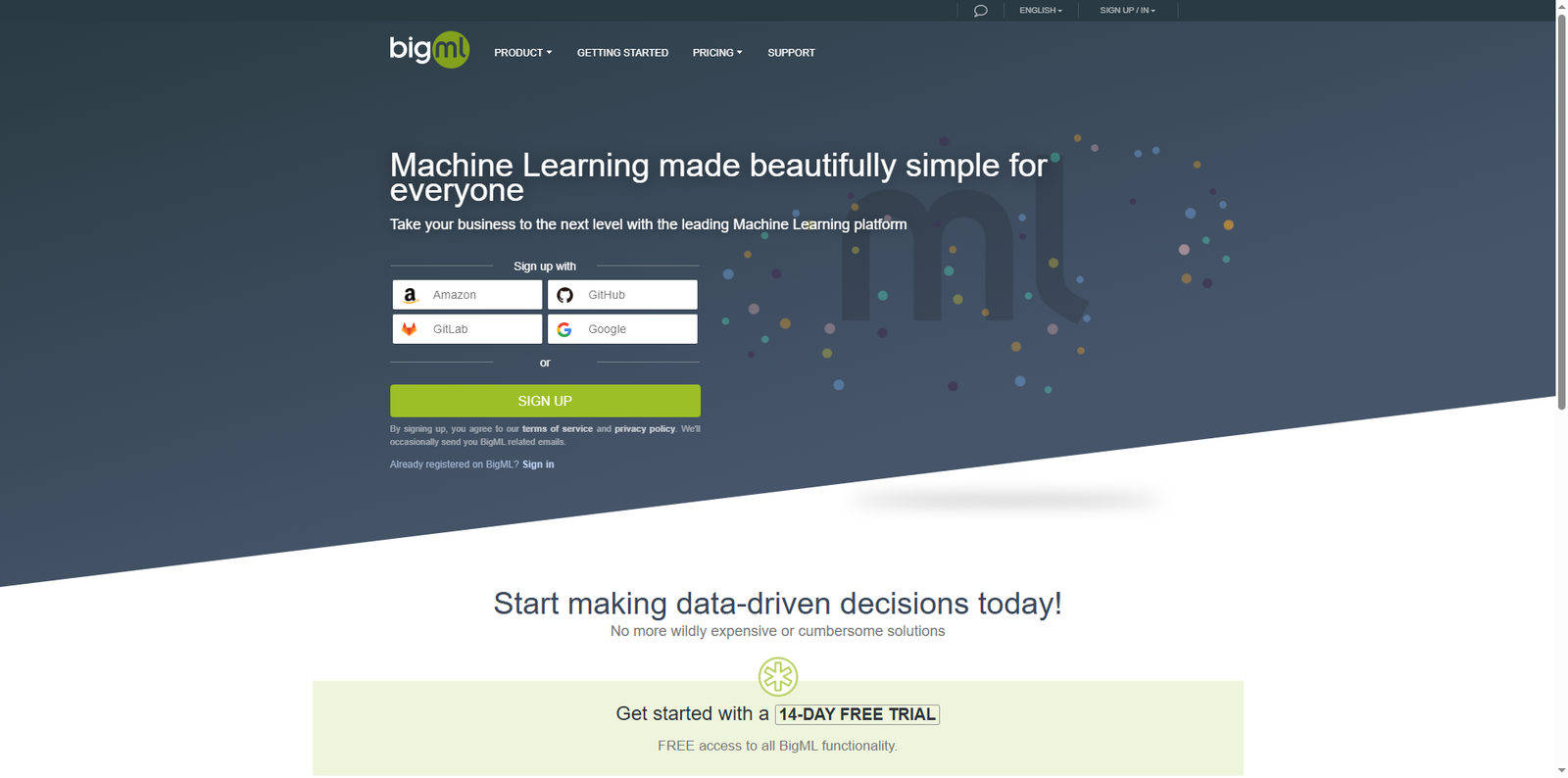
Starting with BigML is straightforward. Users can sign up for a free account and explore the platform’s full functionality through its trial offering. Once registered, users can upload datasets, experiment with different algorithms, and visualize results in real time. BigML also provides extensive documentation, tutorials, and community resources to help new users get up to speed quickly.
For developers, BigML’s REST API allows integration with external applications, enabling automated workflows and real-time predictions. The platform supports multiple programming languages, including Python, Java, and Node.js, making it flexible for various development environments.
Educational institutions and research organizations also benefit from BigML’s accessibility. The platform is widely used in academic settings to teach machine learning concepts through hands-on experimentation. This practical approach helps students and professionals alike gain a deeper understanding of data science methodologies.
Conclusion
BigML stands out as a pioneering platform that democratizes access to machine learning. By offering an intuitive interface, powerful automation tools, and seamless integration capabilities, it enables businesses and individuals to make data-driven decisions with confidence. Whether you are a data scientist seeking to streamline model deployment or a business leader aiming to leverage predictive analytics, BigML provides the tools and flexibility needed to succeed in an increasingly data-centric world. As machine learning continues to shape industries, platforms like BigML will play a crucial role in ensuring that innovation remains accessible to all.