


Outline
- Introduction
- What is DagsHub?
- Why DagsHub Matters in the AI Ecosystem
- Core Capabilities of DagsHub
- How DagsHub Supports Data and Model Versioning
- Experiment Tracking and Collaboration
- Integrations and Workflow Automation
- Alternatives to DagsHub
- Use Cases and Real-World Applications
- Conclusion
Introduction
In the rapidly evolving world of artificial intelligence (AI) and machine learning (ML), managing data, experiments, and models efficiently is crucial. DagsHub has emerged as a collaborative platform that simplifies these processes, enabling data scientists and ML engineers to work together seamlessly. By combining version control, experiment tracking, and dataset management, DagsHub helps teams build reproducible and scalable AI pipelines.
What is DagsHub?
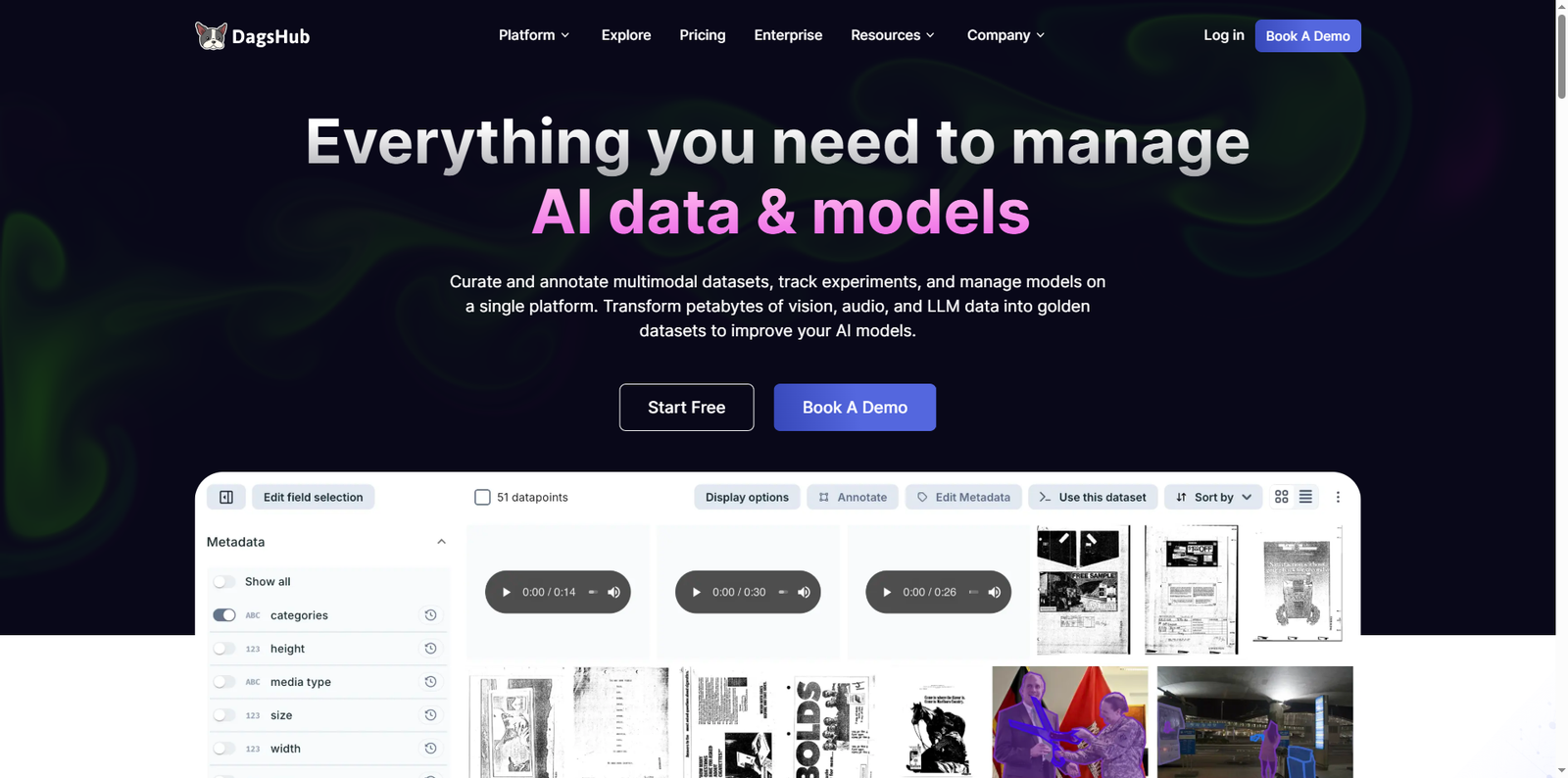
DagsHub is an open-source-based platform designed for data science collaboration. It provides a unified environment where teams can store, version, and manage datasets, models, and experiments. Built on top of Git and DVC (Data Version Control), DagsHub brings the principles of software engineering—such as versioning, transparency, and collaboration—into the world of machine learning.
Founded in 2019, DagsHub has grown into a trusted platform for thousands of AI practitioners worldwide. It supports multimodal datasets, including text, images, audio, and large language model (LLM) data, making it a versatile solution for modern AI workflows.
Why DagsHub Matters in the AI Ecosystem
AI development involves multiple moving parts—data collection, preprocessing, model training, evaluation, and deployment. Without proper management, these processes can become chaotic. DagsHub addresses this challenge by offering:
- Transparency: Every change in data or model is tracked, ensuring full reproducibility.
- Collaboration: Teams can work together on shared repositories, similar to how developers collaborate on GitHub.
- Scalability: DagsHub supports petabyte-scale data management, making it suitable for enterprise-level AI projects.
- Integration: It connects seamlessly with popular ML tools and frameworks, streamlining the workflow.
Core Capabilities of DagsHub
At its core, DagsHub combines three essential components of the ML lifecycle:
- Data Versioning: Track and manage datasets with lineage and reproducibility.
- Experiment Tracking: Record hyperparameters, metrics, and results for every experiment.
- Model Management: Store and version models alongside code and data for complete traceability.
These capabilities make DagsHub a one-stop solution for managing the entire AI workflow, from data ingestion to model deployment.
How DagsHub Supports Data and Model Versioning
Data versioning is one of the most challenging aspects of machine learning. DagsHub leverages DVC to version datasets efficiently without duplicating large files. Instead of storing entire datasets in Git, DagsHub tracks metadata and pointers, allowing users to retrieve specific versions when needed.
For model management, DagsHub allows users to store trained models in the same repository as their code and data. This ensures that every model version can be traced back to the exact dataset and experiment configuration used to produce it. Such traceability is vital for compliance, reproducibility, and debugging.
Experiment Tracking and Collaboration
DagsHub provides an integrated experiment tracking system that records metrics, parameters, and results automatically. This helps teams compare different runs, identify the best-performing models, and maintain a history of their experiments. The platform’s interface allows users to visualize experiment outcomes, making it easier to analyze performance trends.
Collaboration is at the heart of DagsHub’s design. Multiple team members can contribute to the same repository, review changes, and discuss results in real time. This Git-like workflow enhances transparency and ensures that everyone stays aligned throughout the project lifecycle.
Integrations and Workflow Automation
DagsHub integrates with a wide range of tools commonly used in the ML ecosystem. Some of the notable integrations include:
- MLflow: For advanced experiment tracking and model registry.
- Label Studio: For data annotation and labeling workflows.
- GitHub Actions: For continuous integration and deployment (CI/CD) pipelines.
- Weights & Biases: For experiment visualization and performance tracking.
These integrations allow teams to automate repetitive tasks, such as model retraining or dataset updates, ensuring a smoother and more efficient workflow.
Alternatives to DagsHub
While DagsHub offers a comprehensive solution, several other platforms provide similar functionalities for managing AI projects. The table below lists some popular alternatives:
| Tool Name | Description |
|---|---|
| MLflow | An open-source platform for managing the ML lifecycle, including experiment tracking and model deployment. |
| Comet | A platform for tracking experiments, visualizing metrics, and collaborating on ML projects. |
| Neptune.ai | Experiment tracking and model registry tool designed for research and production teams. |
| Kubeflow | An open-source ML toolkit for Kubernetes, enabling scalable model training and deployment. |
| Pachyderm | A data versioning and pipeline automation tool for reproducible data science workflows. |
Use Cases and Real-World Applications
DagsHub is used by organizations and researchers across various industries to streamline their AI development processes. Some common use cases include:
- Computer Vision: Managing large image datasets and tracking model performance across experiments.
- Natural Language Processing (NLP): Versioning text corpora and fine-tuning language models with reproducible workflows.
- Audio Processing: Annotating and managing multimodal datasets for speech recognition and sound classification.
- Research Collaboration: Enabling academic teams to share datasets, code, and results transparently.
- Enterprise AI: Supporting large-scale data management and compliance for production-grade AI systems.
For example, research teams working on LLM fine-tuning can use DagsHub to track dataset changes and model iterations, ensuring that every experiment is fully documented. Similarly, startups developing computer vision applications can leverage DagsHub’s annotation workspace to label and manage datasets collaboratively.
Conclusion
DagsHub stands out as a powerful platform that bridges the gap between data science and software engineering. By integrating data versioning, experiment tracking, and model management into a single collaborative environment, it empowers AI teams to build reproducible, transparent, and scalable workflows. Whether you are a researcher, data scientist, or enterprise AI engineer, DagsHub provides the tools needed to manage complex ML projects efficiently.
As the demand for reliable and transparent AI systems continues to grow, platforms like DagsHub will play an increasingly vital role in shaping the future of machine learning development. For teams seeking a unified solution to manage their AI lifecycle, DagsHub offers a compelling, open, and collaborative approach to building better models and datasets together.