




Outline
- Introduction
- What is Replicate.com?
- How Replicate Works
- Key Benefits of Using Replicate
- Popular Models Hosted on Replicate
- Integration and Developer Experience
- Alternatives to Replicate
- Real-World Use Cases
- Community and Ecosystem
- Conclusion
Introduction
Artificial Intelligence (AI) and machine learning (ML) have become integral to modern software development, yet deploying models often remains complex. Replicate.com bridges this gap by providing a platform where developers can run and share machine learning models through simple APIs. Whether you are a data scientist, developer, or creative professional, Replicate makes it possible to integrate advanced AI capabilities into applications without managing infrastructure or dependencies.
What is Replicate.com?
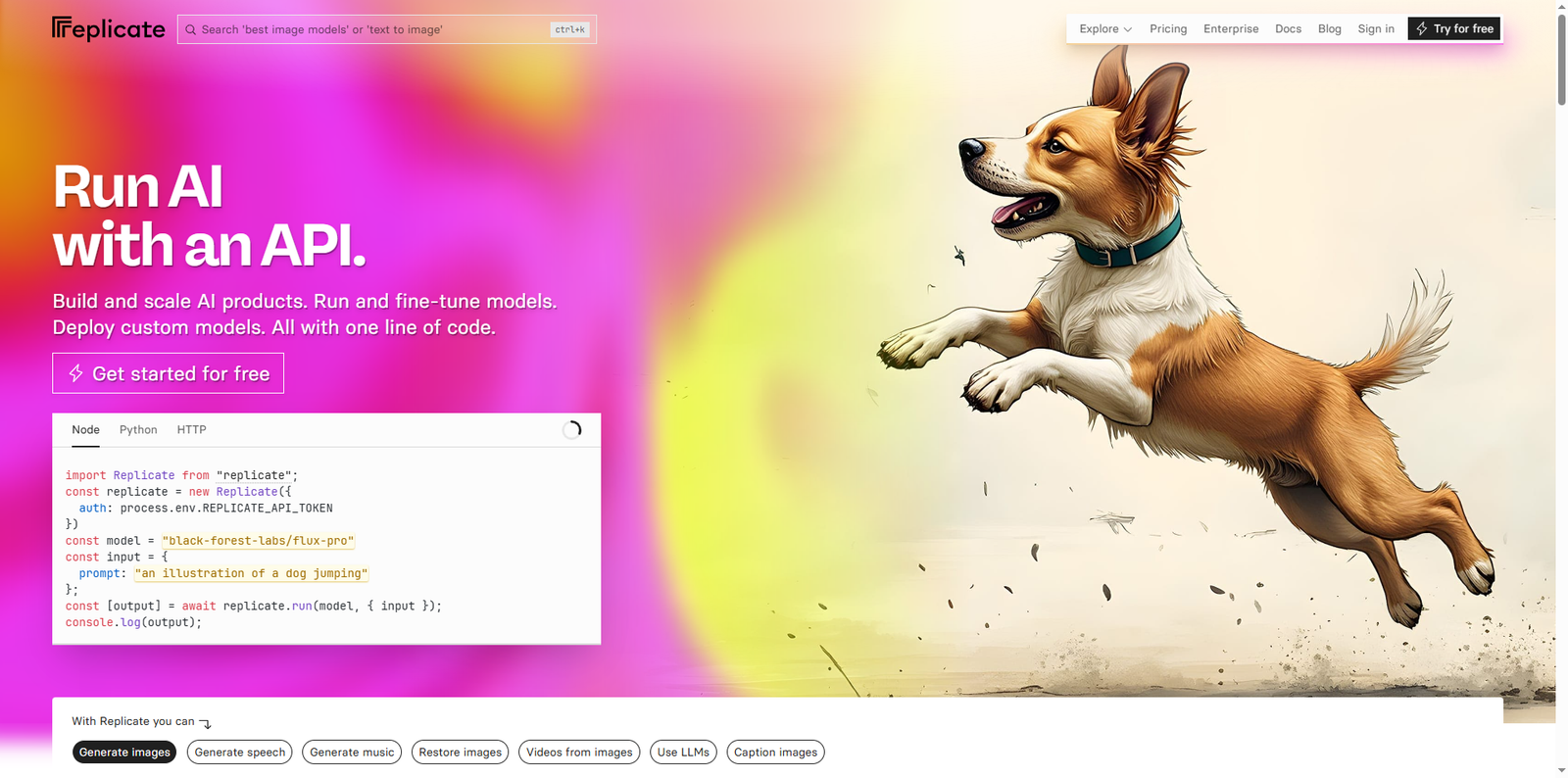
Replicate.com is a cloud-based platform that allows users to run open-source machine learning models in the cloud via API calls. Founded in 2021, Replicate aims to democratize access to machine learning by making it as easy to use as any other web service. The platform hosts thousands of publicly available models covering areas such as image generation, text processing, and audio synthesis.
Unlike traditional ML deployment methods that require extensive setup, Replicate handles the containerization, scaling, and execution of models automatically. Users can simply call the model through an API endpoint and receive results in seconds. This approach eliminates the need for GPU management or environment configuration, making it ideal for rapid prototyping and production use.
How Replicate Works
Replicate operates on a simple yet powerful concept: every model runs inside a containerized environment. Developers can publish models using the replicate Python client or the command-line interface. Once uploaded, the model becomes accessible through a REST API, allowing anyone to run it with minimal code.
For example, developers can use the following workflow:
- Train or obtain a model locally.
- Package the model with a
replicate.yamlconfiguration file. - Push it to Replicate using the CLI or SDK.
- Access it through an API endpoint for inference.
This streamlined process enables reproducibility and scalability. The infrastructure automatically provisions GPUs and manages runtime environments, ensuring consistent performance across different users and projects.
Key Benefits of Using Replicate
Replicate offers several advantages that make it stand out in the AI deployment ecosystem:
- Ease of Use: Developers can integrate models into applications using simple API calls without worrying about setup or dependencies.
- Scalability: The platform automatically scales workloads based on demand, ensuring reliable performance for both small and large-scale applications.
- Reproducibility: Each model version is immutable, guaranteeing consistent results across different runs.
- Community-Driven: Replicate hosts a growing library of open-source models contributed by researchers and developers worldwide.
Popular Models Hosted on Replicate
Replicate has become a hub for some of the most popular AI models available today. These include models for text-to-image generation, natural language processing, and audio synthesis. Some well-known examples include:
- Stable Diffusion: A powerful text-to-image model that generates high-quality visuals from textual prompts.
- LLaMA and GPT-based models: Advanced language models capable of generating human-like text for chatbots and content creation.
- Whisper: An automatic speech recognition model developed by OpenAI for transcribing audio with high accuracy.
- Segment Anything: A computer vision model from Meta AI that performs object segmentation in images.
Each of these models can be accessed through Replicate’s API, allowing developers to integrate them into web applications, mobile apps, or backend systems.
Integration and Developer Experience
Replicate provides a developer-friendly experience through its SDKs and REST APIs. The platform supports multiple programming languages, including Python, JavaScript, and Go. Developers can authenticate using API tokens and run models with just a few lines of code.
For instance, using the JavaScript SDK, one can import and run a model as follows:
import Replicate from "replicate";
This simplicity allows developers to focus on building features rather than managing infrastructure. Additionally, Replicate integrates seamlessly with cloud services such as Vercel and AWS, enabling automated workflows and continuous deployment pipelines.
Alternatives to Replicate
While Replicate provides a unique approach to model deployment, several alternative platforms offer similar capabilities. Developers may explore these options depending on their specific requirements:
| Platform | Website | Description |
|---|---|---|
| Hugging Face | huggingface.co | Hosts a large repository of models and datasets with tools for inference and fine-tuning. |
| Google Vertex AI | cloud.google.com/vertex-ai | Provides managed ML services for training, deploying, and scaling models on Google Cloud. |
| RunPod | runpod.io | Offers GPU-based cloud computing for running and hosting AI workloads efficiently. |
| Banana.dev | banana.dev | Focuses on serverless GPU inference for deploying machine learning models at scale. |
Real-World Use Cases
Replicate’s flexibility has made it a preferred choice for developers and organizations across various industries. Some notable use cases include:
- Creative Applications: Artists and designers use text-to-image models to generate concept art, illustrations, and visual effects.
- Content Automation: Businesses leverage language models for automated copywriting, summarization, and translation tasks.
- Data Analysis: Researchers utilize Replicate to run machine learning experiments without setting up local environments.
- Voice and Audio Processing: Developers integrate speech recognition and synthesis models into applications for accessibility and entertainment.
For example, a startup developing a social media app could integrate Replicate’s image generation API to allow users to create personalized avatars or backgrounds dynamically. Similarly, educators can use NLP models to build AI-powered tutoring systems that adapt to student needs.
Community and Ecosystem
Replicate’s success is largely driven by its open and collaborative community. The platform encourages developers to share models publicly, fostering innovation and accessibility. Each model page includes documentation, example code, and version history, making it easy for others to reproduce results.
Moreover, Replicate integrates with GitHub, allowing developers to link repositories directly to their models. This transparency supports reproducible research and encourages best practices in AI development. The community also contributes to discussions, tutorials, and open-source projects that expand the platform’s capabilities.
Conclusion
Replicate.com has emerged as a transformative platform in the AI ecosystem, simplifying how developers and researchers deploy and share machine learning models. By abstracting away the complexities of infrastructure management, it enables anyone to harness the power of AI through simple API calls. With its growing library of open-source models, active community, and seamless integration options, Replicate continues to push the boundaries of accessible machine learning.
As AI adoption accelerates across industries, platforms like Replicate will play a crucial role in bridging the gap between research and real-world applications. Whether you are building creative tools, automating workflows, or exploring new AI-driven ideas, Replicate provides the foundation to bring those innovations to life with ease and reliability.