









Outline
- Introduction
- Understanding Galileo AI
- How Galileo AI Enhances AI Observability
- Automated Evaluation and Testing
- Real-Time Protection and Safety Metrics
- Integration and Developer Experience
- Alternative Tools to Galileo AI
- Conclusion
Introduction
Artificial Intelligence (AI) is transforming industries across the globe, but ensuring that AI systems perform reliably and safely remains a major challenge. As organizations deploy increasingly complex large language models (LLMs) and generative AI tools, the need for robust observability and evaluation platforms has become critical. Galileo AI emerges as a leading solution in this space, offering developers and enterprises a comprehensive platform to monitor, test, and improve AI systems efficiently.
Founded by experienced AI engineers, Galileo AI focuses on making AI development more transparent and measurable. The platform enables teams to identify weaknesses, prevent hallucinations, and ensure compliance with safety standards—all while accelerating the iteration cycle of AI models.
Understanding Galileo AI
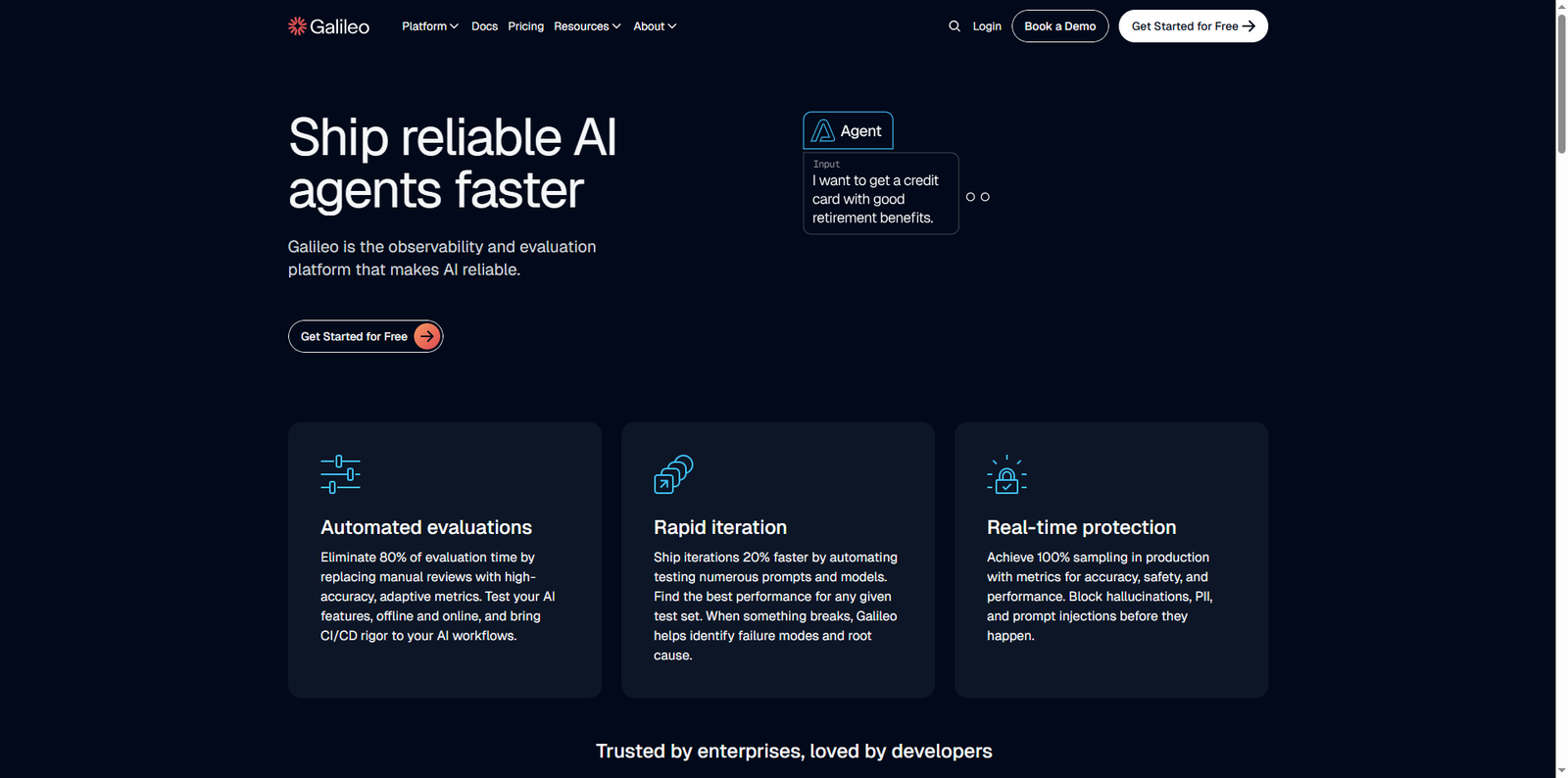
Galileo AI is an observability and evaluation platform designed to make AI systems more reliable. It allows developers to measure and monitor AI performance across various metrics such as accuracy, safety, and latency. The platform integrates seamlessly into existing workflows, supporting both offline and online evaluations.
According to the official website, Galileo AI helps teams eliminate up to 80% of manual evaluation time by automating the testing process. It provides adaptive metrics that evolve with model updates, ensuring that evaluations remain relevant even as AI systems change. This approach brings the rigor of Continuous Integration and Continuous Deployment (CI/CD) to AI development, a practice that has long been standard in software engineering but is still emerging in AI workflows.
How Galileo AI Enhances AI Observability
Observability in AI refers to the ability to understand and interpret how an AI model behaves under different conditions. Galileo AI provides detailed insights into model performance, helping developers pinpoint where and why a model might fail. The platform’s observability features include:
- Comprehensive Metrics: Galileo tracks multiple dimensions of AI performance, including accuracy, safety, and security.
- Custom Evaluators: Users can create their own evaluators to measure domain-specific performance.
- Low-Latency Monitoring: Evaluations run efficiently, even in large-scale production environments.
These capabilities empower teams to detect anomalies early, reducing the risk of deploying unreliable AI models. By integrating observability directly into the AI lifecycle, Galileo ensures that developers can continuously monitor and improve their systems.
Automated Evaluation and Testing
One of Galileo AI’s strongest features is its automated evaluation engine. Traditional AI evaluation often involves manual reviews, which are time-consuming and prone to human bias. Galileo automates this process using adaptive metrics that can test thousands of prompts and models simultaneously.
The platform supports both offline and online testing, allowing developers to validate models before deployment and monitor them in real time once live. This dual approach ensures that AI systems remain consistent and reliable throughout their lifecycle.
Galileo’s evaluation engine also supports specialized metrics such as:
- RAG Metrics: For retrieval-augmented generation models, ensuring that responses are grounded in factual data.
- Agent Metrics: To measure the performance of autonomous AI agents across tasks.
- Safety and Security Metrics: To detect and block harmful or biased outputs.
By automating these evaluations, Galileo enables teams to ship AI iterations up to 20% faster, according to the company’s data. This speed advantage is crucial in a competitive landscape where AI innovation moves rapidly.
Real-Time Protection and Safety Metrics
As AI systems become more integrated into critical workflows, ensuring their safety and compliance is paramount. Galileo AI provides real-time protection by monitoring 100% of production traffic and applying guardrail policies that prevent unsafe or non-compliant outputs.
These guardrails can block hallucinations, personally identifiable information (PII) leaks, and prompt injections before they reach users. This proactive approach not only protects end-users but also safeguards organizations from reputational and regulatory risks.
In addition to safety, Galileo’s real-time protection extends to performance monitoring. Developers can track latency, throughput, and accuracy metrics continuously, ensuring that their AI systems maintain optimal performance under varying loads.
Integration and Developer Experience
Galileo AI is designed with developers in mind. Its intuitive interface and flexible APIs make it easy to integrate into existing machine learning pipelines. Whether teams are using cloud-based AI services or on-premise infrastructure, Galileo adapts seamlessly.
The platform supports integration with popular AI frameworks and tools, enabling developers to incorporate observability and evaluation without disrupting their workflows. Moreover, Galileo’s low-latency architecture ensures that evaluations run efficiently, even on large datasets or complex models.
To enhance collaboration, Galileo provides detailed dashboards and visualizations that help teams understand model behavior at a glance. These insights facilitate data-driven decision-making and foster a culture of continuous improvement within AI development teams.
Example of Integration Workflow
| Stage | Action | Galileo AI Role |
|---|---|---|
| Model Training | Developers train LLMs using internal or external datasets. | Captures baseline metrics and identifies potential weaknesses. |
| Evaluation | Models are tested using adaptive metrics. | Automates evaluation and generates performance reports. |
| Deployment | Models are deployed to production. | Monitors real-time performance and applies safety guardrails. |
| Iteration | Developers refine models based on insights. | Provides feedback loops for continuous improvement. |
Alternative Tools to Galileo AI
While Galileo AI offers a comprehensive solution for AI observability and evaluation, several other tools provide complementary or alternative capabilities. Some notable options include:
- Weights & Biases – A platform for experiment tracking, model management, and data visualization.
- Arize AI – Focused on ML observability, helping teams monitor model drift and data quality.
- Truera – Provides model intelligence and explainability tools for AI governance.
- MLflow – An open-source platform for managing the ML lifecycle, including experimentation and deployment.
Each of these tools brings unique strengths to the AI development ecosystem, and many organizations use them in combination with Galileo AI to achieve a holistic observability strategy.
Conclusion
Galileo AI represents a significant advancement in the field of AI observability and evaluation. By automating testing, providing real-time protection, and integrating seamlessly into existing workflows, it empowers developers to build more reliable and trustworthy AI systems. The platform’s focus on adaptive metrics, safety, and low-latency performance makes it a valuable asset for any organization working with large language models or generative AI applications.
As AI continues to evolve, the importance of observability and evaluation will only grow. Tools like Galileo AI are paving the way for a future where AI systems are not only powerful but also transparent, accountable, and safe. For developers and enterprises seeking to enhance their AI reliability, Galileo AI stands out as a robust and forward-thinking solution.