










Outline
- Introduction
- What Is Boosted.ai?
- How Boosted.ai Works
- Applications in Financial Research and Portfolio Management
- Benefits of Using AI in Finance
- Real-World Impact and Case Studies
- Alternatives to Boosted.ai
- Challenges and Considerations
- Future of AI in Financial Services
- Conclusion
Introduction
In recent years, artificial intelligence (AI) has become a transformative force across industries, and finance is no exception. Among the companies leading this transformation is Boosted.ai, a Toronto and New York-based fintech firm that leverages AI to empower investment professionals. Founded in 2017, Boosted.ai has developed advanced machine learning tools that help portfolio managers, analysts, and asset managers make data-driven decisions with greater accuracy and efficiency. This article explores how Boosted.ai is reshaping financial research, its core applications, and the broader implications of AI in the financial sector.
What Is Boosted.ai?
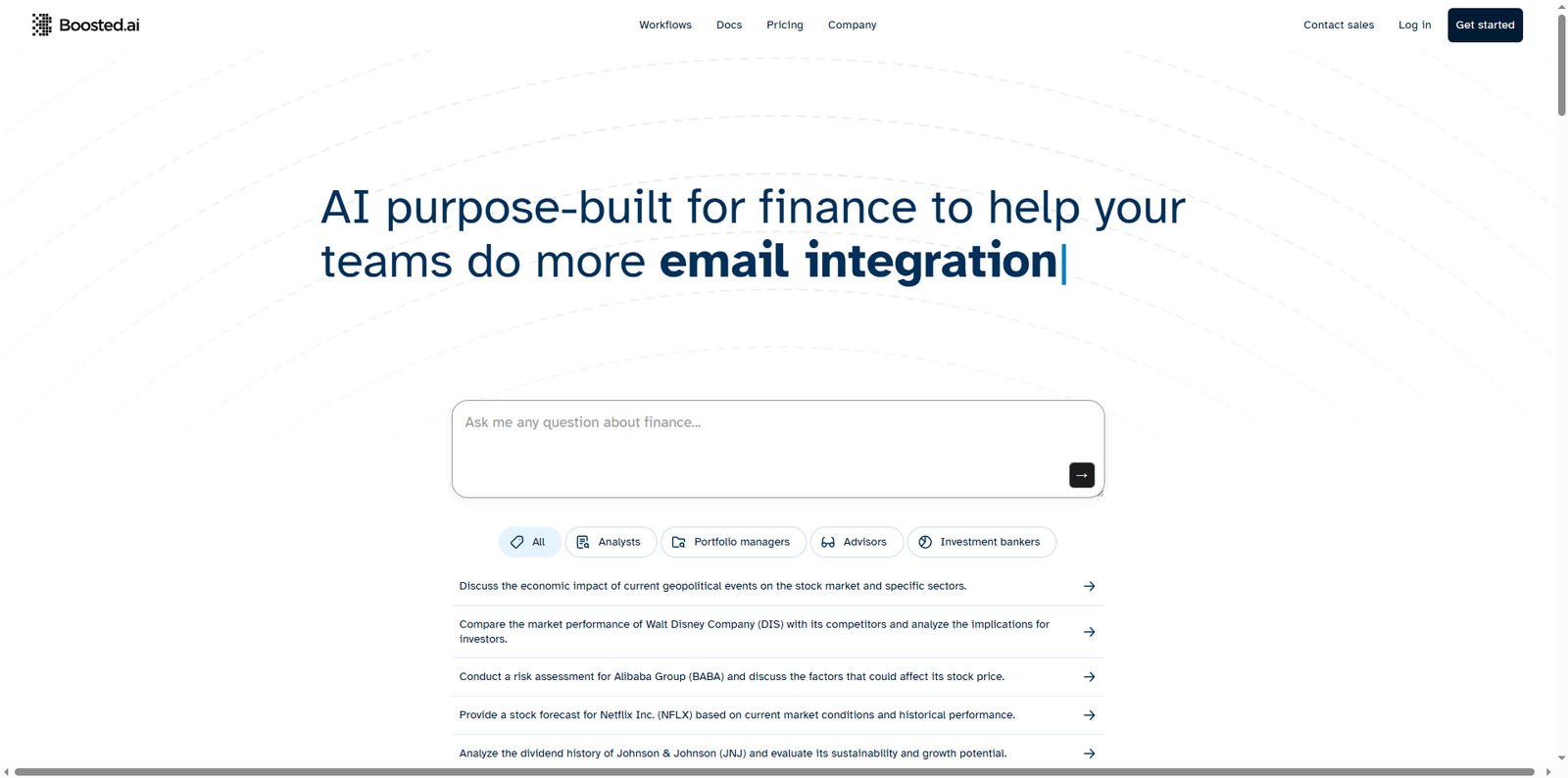
Boosted.ai is an artificial intelligence platform designed specifically for the financial industry. Its primary goal is to enhance human decision-making rather than replace it. The platform enables investment professionals to integrate AI-driven insights into their workflows, improving portfolio construction, risk management, and alpha generation. According to the company’s official website, Boosted.ai’s mission is to “help your teams do more research” by providing tools that identify hidden patterns and opportunities in financial data.
Company Background
Boosted.ai was founded by Joshua Pantony, Nick Abe, and Henry Shi, who combined their expertise in finance and technology to create a platform that bridges the gap between data science and investment management. The company has raised funding from investors such as Portag3 Ventures and Spark Capital, reflecting growing confidence in AI’s role in asset management.
How Boosted.ai Works
Boosted.ai operates by integrating machine learning models into the investment process. The platform uses structured and unstructured data to generate predictive insights. These models can analyze thousands of variables simultaneously, uncovering relationships that might be invisible to traditional analysis.
Core Mechanisms
- Data Ingestion: The system aggregates data from multiple sources, including financial statements, market data, and alternative datasets.
- Model Training: Machine learning algorithms are trained to recognize patterns that correlate with asset performance.
- Portfolio Optimization: The platform provides recommendations for asset allocation and risk management based on predictive analytics.
- Continuous Learning: Models are updated regularly to adapt to changing market conditions.
Integration with Existing Systems
Boosted.ai is designed to integrate seamlessly with existing investment workflows. It can be used alongside traditional research tools and data providers, allowing analysts to validate or challenge their hypotheses using AI-generated insights.
Applications in Financial Research and Portfolio Management
Boosted.ai’s technology is used across various aspects of financial research and portfolio management. Its applications span from idea generation to risk assessment, enabling professionals to make more informed decisions.
1. Equity Research
Analysts can use Boosted.ai to identify undervalued stocks or sectors by analyzing large datasets that include price movements, earnings reports, and sentiment indicators. The platform’s models can detect subtle correlations that might indicate future performance trends.
2. Portfolio Construction
Portfolio managers can leverage AI-driven insights to optimize asset allocation. By simulating different scenarios, Boosted.ai helps managers balance risk and return more effectively, ensuring portfolios are resilient under various market conditions.
3. Risk Management
Boosted.ai’s predictive analytics can flag potential risks before they materialize. For example, it can identify stocks with increasing volatility or sectors that may be exposed to macroeconomic shocks, allowing managers to adjust their strategies proactively.
4. ESG and Alternative Data Analysis
As environmental, social, and governance (ESG) investing gains traction, Boosted.ai enables firms to analyze ESG-related data efficiently. It can process textual data from reports and news sources to assess a company’s ESG performance, helping investors align their portfolios with sustainability goals.
Benefits of Using AI in Finance
The integration of AI tools like Boosted.ai offers several advantages to financial institutions and professionals.
- Enhanced Efficiency: AI automates repetitive tasks, freeing analysts to focus on strategic decision-making.
- Improved Accuracy: Machine learning models can analyze vast datasets with fewer errors than manual methods.
- Faster Insights: Real-time analytics enable quicker responses to market changes.
- Data-Driven Decisions: AI provides empirical evidence to support investment strategies.
- Scalability: AI systems can handle increasing data volumes without proportional increases in cost or time.
Real-World Impact and Case Studies
Boosted.ai has been adopted by numerous asset management firms globally. According to company reports, clients have used its platform to enhance their research capabilities and improve portfolio performance. For instance, one mid-sized asset manager reportedly increased research coverage by over 30% after integrating Boosted.ai into its workflow. Another firm used the platform to identify hidden correlations in small-cap equities, leading to improved alpha generation.
Industry Recognition
Boosted.ai has received recognition from industry publications such as Forbes and Institutional Investor for its innovative approach to AI in finance. The company’s success demonstrates the growing acceptance of machine learning as a valuable tool in investment management.
Alternatives to Boosted.ai
While Boosted.ai is a leading solution in AI-driven finance, several other platforms offer similar capabilities. Professionals seeking alternatives can explore the following:
- Kensho – A data analytics and AI platform used by S&P Global for financial intelligence.
- AlphaSense – A market intelligence platform that uses AI to analyze financial documents and earnings calls.
- DataRobot – A machine learning platform that supports predictive modeling across industries, including finance.
- QuantConnect – An open-source algorithmic trading platform for quantitative researchers.
Challenges and Considerations
Despite its advantages, implementing AI in finance comes with challenges. Data quality remains a critical issue—models are only as good as the data they are trained on. Additionally, regulatory compliance and model transparency are essential, as financial institutions must ensure that AI-driven decisions are explainable and auditable.
Ethical and Operational Concerns
- Bias in Data: AI models can inadvertently learn biases present in historical data.
- Interpretability: Complex models may produce results that are difficult to explain to stakeholders.
- Security: Protecting sensitive financial data from breaches is paramount.
- Talent Gap: Integrating AI effectively requires skilled professionals who understand both finance and data science.
Future of AI in Financial Services
The future of AI in finance looks promising. As technology evolves, AI tools will become more sophisticated, offering deeper insights and greater automation. According to a 2023 report by Deloitte, over 70% of financial institutions plan to increase their AI investments within the next three years. This trend indicates that AI will continue to play a central role in shaping the future of investment research and management.
Emerging Trends
- Explainable AI (XAI): Efforts to make AI models more transparent and interpretable.
- Integration with Blockchain: Combining AI with blockchain for enhanced data security and traceability.
- AI-Driven ESG Analytics: Expanding the use of AI to assess sustainability metrics.
- Personalized Investment Strategies: Using AI to tailor portfolios to individual investor preferences and risk profiles.
Conclusion
Boosted.ai represents a significant advancement in the application of artificial intelligence to finance. By empowering investment professionals with data-driven insights, it bridges the gap between human expertise and machine intelligence. The platform’s ability to enhance research, optimize portfolios, and manage risk demonstrates the transformative potential of AI in the financial sector. As the industry continues to evolve, tools like Boosted.ai will play an increasingly vital role in helping firms stay competitive, agile, and informed. Whether used alongside traditional methods or as part of a broader digital transformation strategy, AI-driven platforms are set to define the future of financial research and portfolio management.