
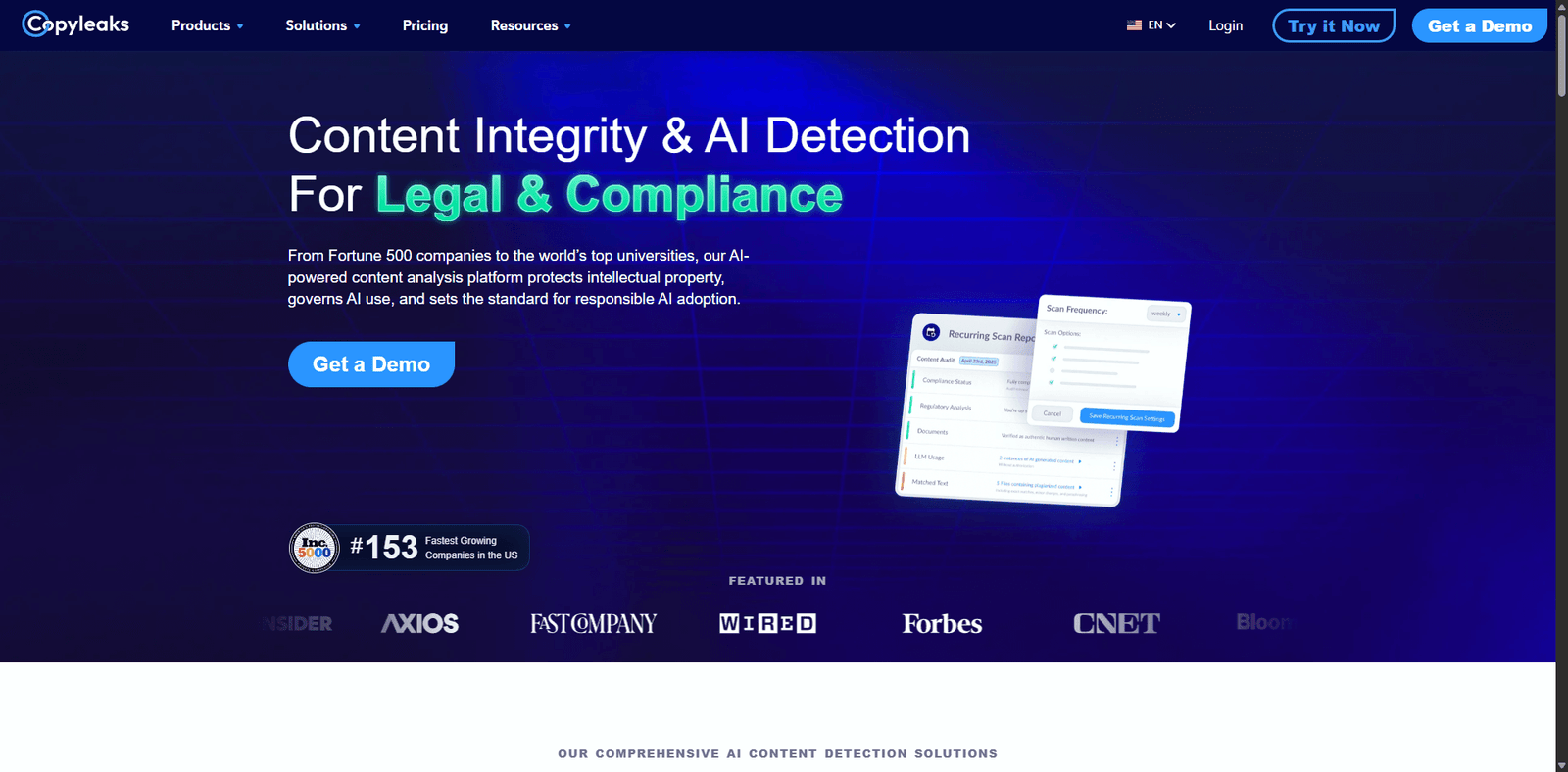




Copyleaks is a comprehensive content integrity platform designed to help individuals, educational institutions, businesses, and publishers maintain originality, detect plagiarism, and guard against unauthorized or AI-generated content. Over time it has evolved to not only identify duplicated content but also to detect whether text was produced by generative AI tools. Its mission is rooted in ensuring authenticity, compliance, and intellectual property protection in a world where AI-assisted content generation is increasingly common.
Main Features & How They Work
- AI Detector & Model Support
Copyleaks’ AI detector is meant to identify content written by AI tools such as ChatGPT, Claude, Gemini, and others. It claims a high accuracy rate (~99%) and a low false positive rate (~0.2%). This includes detection even when content is edited or paraphrased—though some users report that heavily edited AI content can evade detection. - Plagiarism Checker
Their plagiarism tool scans content for direct copying, paraphrases, and similarity to existing published sources. It supports multiple languages and document formats. The checker not only flags duplicate material but also provides source citations so users can see where matches have been found. - Writing Assistant & Error Correction
To complement detection, Copyleaks provides tools to help polish writing—improving grammar, structure, choice of words, readability, and adjusting for tone. This helps users fix flagged sections or ambiguous passages that may trigger AI detection or plagiarism alerts.
Integrations & Ecosystem
Copyleaks supports a wide variety of integrations: LMS (Learning Management Systems), Google Docs, browser extensions, API access, etc. This integration capability means it’s usable in education settings (for academic integrity), SEO/publishing workflows, intellectual property protection, and compliance settings.
Recent Updates & Reputation
- They publish independent third-party studies and testing methodologies to back their accuracy claims.
- Copyleaks recently introduced “AI Logic for LMS” for more transparent AI detection in educational systems.
- There has been feedback from users questioning inconsistent detection, especially false positives (human written content flagged as AI) and variability over repeated scans.
Pros & Cons
Pros:
- Very high claimed detection accuracy and low false positive rate.
- Support for many languages and file/document/code formats.
- Strong integrations (API, LMS, Google Docs, browser extension).
Cons:
- Premium features relatively expensive for casual users.
- Some complaints about false positives or inconsistent detection.
- Processing speed and response time can sometimes lag for large documents or intensive scans.